

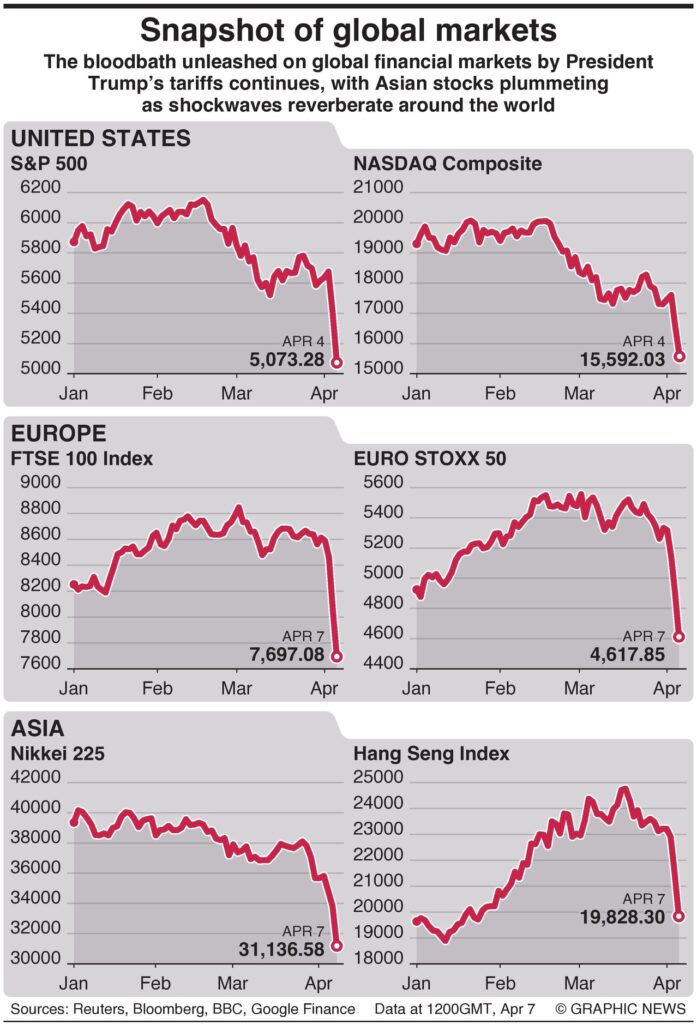
But they may be the shock the world’s nations needed to play fair with the United States. President Trump’s “trade war” pushing for “fair trade” has caused investors to panic, with financial markets across the world losing trillions of dollars or euros in value.
European stocks suffered their biggest one-day falls since the start of the COVID pandemic on Monday. The financial bloodbath unleashed on global markets by Trump’s tariffs continues, with Asian stocks plummeting as shockwaves reverberate around the world.
Suffering the biggest losses are most of the world’s billionaires.
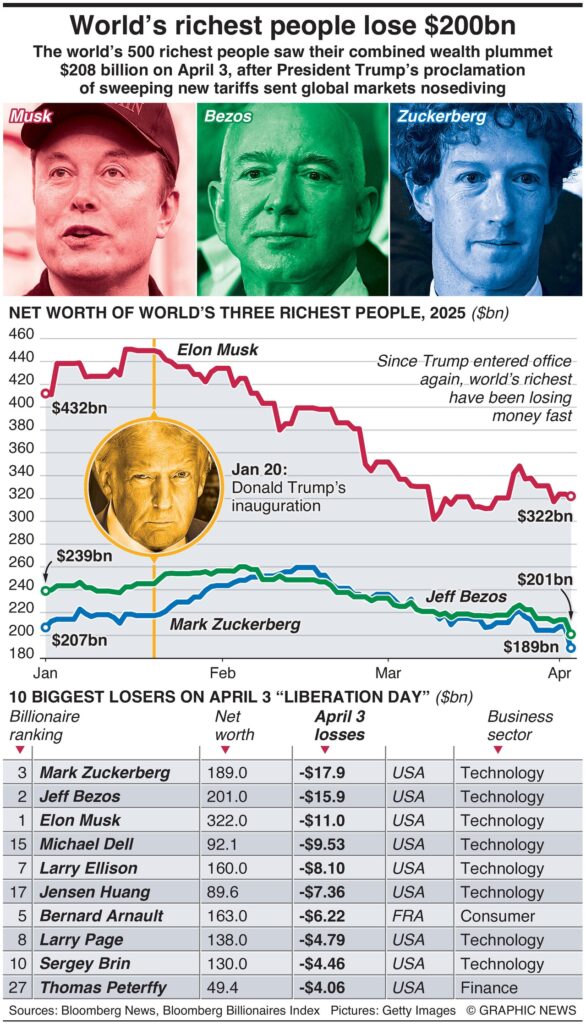
The world’s 500 richest people saw their combined wealth plummet $208 billion on April 3, after Trump’s sweeping new tariffs sent global markets nosediving.
The drop was the fourth-largest single-day decline in the history of Bloomberg’s billionaire index, and the largest collapse since the COVID-19 pandemic.
Meanwhile, as a region that manufactures many of the goods sold to the rest of the world, Asia is being targeted directly by the tariffs, sending markets from Shanghai to Sydney plunging, and creating fears that they could spark a recession.
However, those fears should only come true if the global community refuses to negotiate fair trade deals with the U.S., or worse retaliate with even more unfair tariffs. Many are using panic and fear of that very prospect in the hopes they will pressure Trump to back down without making any concessions.
But, as he tends to do, Trump is playing chicken with the rest of the world, expecting that most countries will blink.; especially since he isn’t bluffing, and everyone stands to lose. (RELATED: Solving Bidenomics: Trump’s Threefold Solution Through Genius Fiscal Maneuvering)
The European Union (EU) may be the best indicator of which approach many will take.
Bilateral trade between the EU and U.S. amounted to some $1.75 trillion in 2023, with goods accounting for $930 billion—while services made up $815 billion of that total. Europe ran a goods trade surplus of around $171.5 billion but a services deficit of $119 billion.
If it chooses to retaliate, the EU has a range of options already in place for enacting tough countermeasures.
Given the value of U.S. service exports to Europe, rather than using tariffs on a range of goods as Trump has done, some EU politicians have been calling for a greater focus on trade, investment or funding instruments already in place to bring the U.S. to the negotiating table. (RELATED: Top US Ally To Issue Surprising Response To Trump’s Warnings: A New Era Begins?)
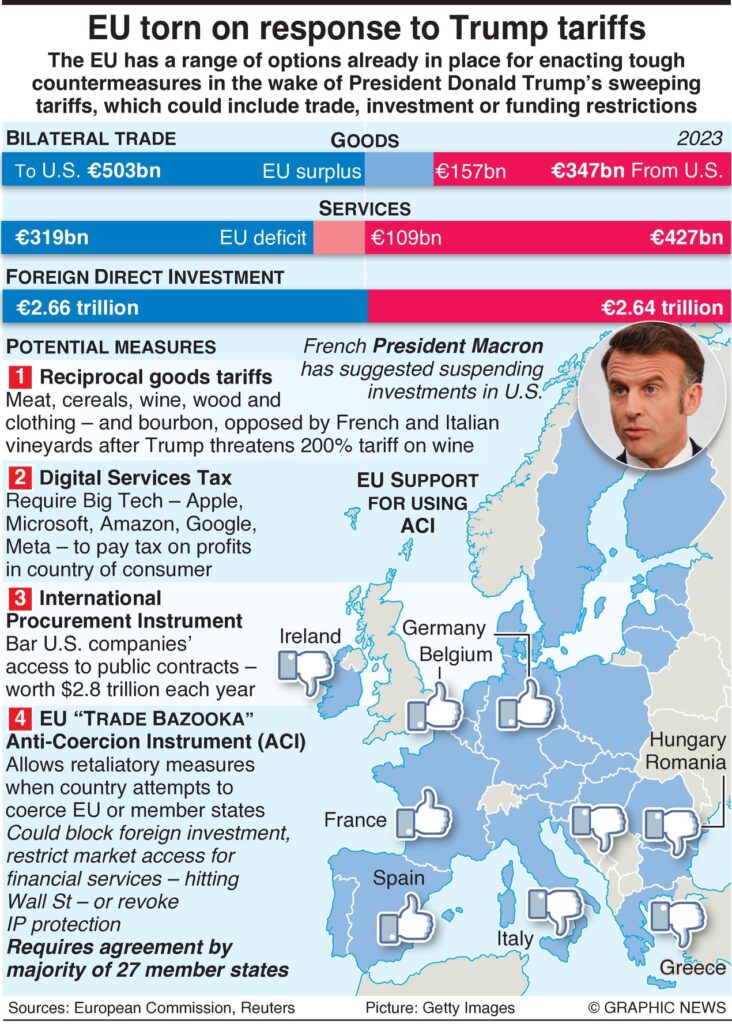
These instruments include the Digital Services Act, which is designed to tax Big Tech on profits made in the location of the consumer, and the International Procurement Instrument which could be used to bar U.S. companies’ access to EU public contracts, worth up to $2.8 trillion each year.
French President Macron has suggested suspending EU investment into the U.S. until the situation is “clarified.”
As a last resort, the EU’s “nuclear option”, the Anti-Coercion Instrument could be brought into play, which would allow retaliatory measures if a third country attempts to coerce the EU or member states.
This could be used to block foreign investment, restrict market access for financial services—hitting Wall Street harder—or revoke Intellectual Property protection, but is opposed by some key EU members who fear it would trigger a full trade war, with damaging consequences for both economies.
This is why, despite all the bluster about retaliating, the EU appears ready to make a deal. Specifically, EU Commission President Ursula von der Leyen just said: “We stand ready to negotiate with the U.S.”
As Politico reported, the EU has now offered the U.S. a “zero-for-zero” tariff scheme to avoid a tit-for-tat trade war. “We have offered zero-for-zero tariffs for industrial goods as we have successfully done with many other trading partners,” von der Leyden added. “Europe is always ready for a good deal.”
The EU Trade Commissioner said separately that the zero-for-zero deal could cover automobiles, and all other industrial goods, such as chemicals, pharmaceuticals, rubber and plastic machinery.
But it’s not just the EU that may make a deal with the U.S., Team Trump says more than 50 countries have reached out for economic negotiations in the wake of his “Liberation Day” tariffs.
That big list of countries includes Israel, Japan, the U.K., Vietnam (which offered to cut their tariffs down to ZERO if they are able to make an agreement with the U.S.), Cambodia, Thailand and India (which has informed the U.S. that it is willing to cut tariffs on more than half of U.S. imports, totaling some $23 billion, as part of an initial deal. (RELATED: High Stakes Diplomacy: Foreign Leader’s Strategic Visit To Washington Shakes Things Up)
Others looking to cut a deal with Trump on tariffs and trade are Australia, South Korea, Argentina, Canada, Mexico, Switzerland and Malaysia.
Expect more countries to come to the table in the next few weeks.
The opinions expressed in this article are those of the author and do not necessarily reflect the positions of American Liberty News.
READ NEXT: Democrat Congressman Suffers ‘Emergency Medical Event’
















The Stock Market is the ORIGINAL * DUNCAN YoYo!! *. UP, – Down, UP,- Down, UP, – Down, UP,- Down, —- Suprised some of these idiots aren’t jumping out of Windows like in 1929!!
Watch TRUMP do his work and the “attack Dogs” in a some weeks will go slinking and whimpering away and look for something else to DEMAGOGUE!!