

In the American imagination, members of Congress are the architects of legislation, the fierce debaters of national policy, and the guardians of our republic. Yet in the actual mechanics of governance, the reality is rather different. It is not the lawmakers, but their staffers, unelected, unaccountable, and often ideologically misaligned with the American electorate, who carry out the substantive work of governing. They write the bills. They negotiate the language. They shepherd policy through committee. And they do all of this in the shadows, often for decades.
This is precisely why reformers like Elon Musk, brought in to streamline and modernize government operations, so often express frustration. It is not always the elected members themselves who resist change, it is their staff. These entrenched operatives are the true enforcers of the status quo. They are the uniparty’s muscle, shielding legacy systems from disruption and neutralizing elected outsiders with bureaucratic inertia. When Musk speaks of the swamp, he is not lamenting a few corrupt politicians. He is describing a vast, unelected ecosystem of aides and advisers who quietly nullify bold policy before it can reach the floor.
If we are serious about restoring accountability in government, if we truly want to drain the swamp, then it is not term limits for members of Congress we need. It is term limits for congressional staff.
Roughly 18,300 staffers work on Capitol Hill. Among senior congressional staff, chiefs of staff, legislative directors, communications directors, tenure is deeply entrenched. A 2024 survey showed that only 3% had worked less than two years in Congress. Thirteen percent had worked between two and five years, 30% between six and ten years, 33% between eleven and twenty years, and 22% had worked more than twenty years. That means the average senior staffer today has spent roughly 12 to 15 years embedded in Congress, with two-thirds having worked in at least three different offices or committees. These are not apprentices to power. They are power.
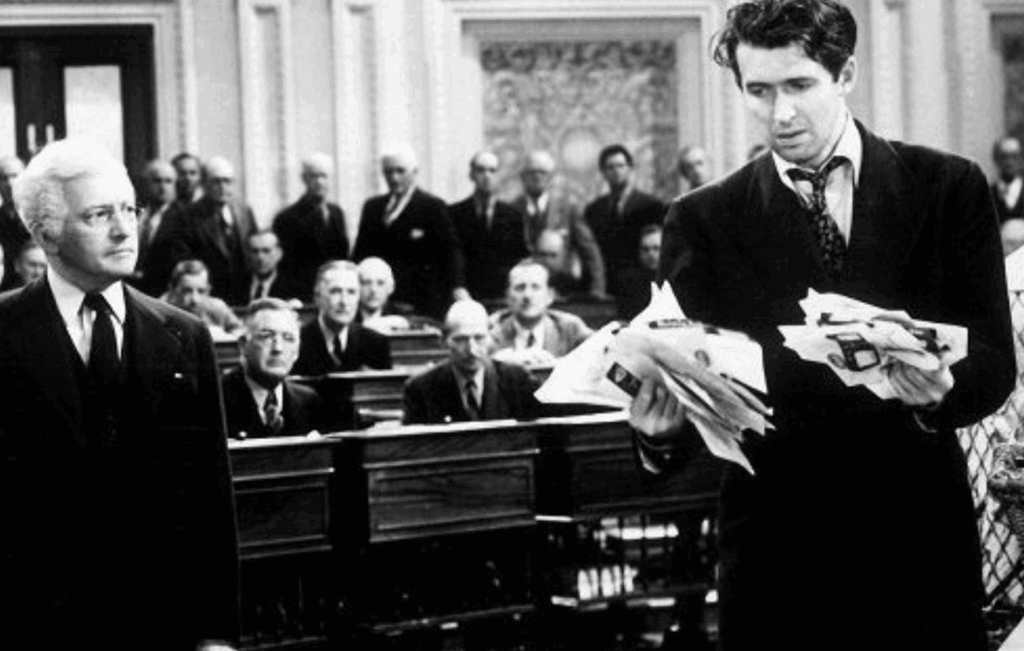
On this day, 85 years ago, Frank Capra's "Mr. Smith Goes to Washington" (1939) premiered in Washington, USA. pic.twitter.com/hYzAvi9aaO
— DepressedBergman (@DannyDrinksWine) October 17, 2024
The image of a fresh-faced Congressman arriving in Washington with a reform agenda, only to be gently but firmly redirected by his seasoned staff, is not fiction. It is routine. New members, often overwhelmed by the Byzantine procedural web of Congress, are told to trust the judgment of their aides. These aides, many of whom have served multiple prior bosses, are described as the office’s “institutional memory.” They know the players. They know the rules. They know which lobbyists to call and which amendments to ignore. And more often than not, they are more loyal to the permanent Washington apparatus than to the voters who elected their current employer.
This arrangement is not only undemocratic, it is corrosive. Members are beholden to staff not merely for information, but for direction. Legislative text, riddled with cross-references and obscure revisions to past statutes, is often intelligible only to those steeped in Hill procedure. Change line 26 of Section 103 in Public Law 1200 from “may” to “shall” and you may have altered national environmental policy. Lawmakers do not have the time, the resources, or often the ability to decipher this. They rely instead on staffer memos and summaries. The elected representative casts the vote, but the unelected aide decides what that vote means.
One might think, then, that we should term-limit the members themselves to break this cycle. But evidence from term-limited legislatures, like California’s, suggests otherwise. There, strict limits imposed in 1990 led to what political scientists dubbed a “brain drain” from the legislature to the lobbying sector. Institutional memory was not eliminated, it was privatized. Experienced lawmakers exited, leaving inexperienced replacements who turned, predictably, to lobbyists and staffers for guidance. The result was a weakening of legislative independence and a strengthening of outside unelected influence. One California Senate leader confessed that she often had to consult former staffers, now lobbyists, for the historical context she once gleaned from her own team.
The same danger exists in Washington. Term-limiting members while leaving their staff intact only increases the power of these aides. And here lies the key: the real entrenchment in Washington is not among the politicians, who come and go with elections. It is among the staffers, who often spend twenty or thirty years on Capitol Hill, outlasting wave after wave of partisan turnover. They are the permanent class. They are the swamp.
Moreover, these staffers are not merely passive experts. They are active gatekeepers of ideology. In fact, they are the institutional manifestation of the uniparty itself, the seamless consensus between legacy Democrats and establishment Republicans who resist disruption to the status quo. Ask any member of the House Freedom Caucus how many of their aides truly share their views on trade, immigration, or executive overreach. The answer is usually: very few. Most congressional staffers are products of elite universities, Washington think tanks, and the legacy media ecosystem. Their instincts are procedural, technocratic, and often progressive. Even well-meaning Republican members find themselves surrounded by staffers who speak in the hushed tones of compromise, not conviction. “This is how it’s done,” they are told. “We can’t do that here.”
Consider President Trump’s so-called Big Beautiful Bill, legislation he championed and voters supported, expecting bold reform. What ultimately emerged, however, was not the president’s vision, but a neutered artifact of staffer interference. The final text, stripped of sweeping changes and bold provisions, contained only the bare minimum the president personally demanded. It was the staffers, not the voters, who prevailed. Their quiet red pens, wielded behind closed doors, did what no televised opposition could: they diluted Trump’s legislative agenda until it conformed to the tastes of the permanent political class. The public got the label, not the substance. This is the quiet, methodical sabotage that happens when unelected staff wield unchecked influence.
The result is a slow but relentless drift toward consensus policies that please donors, lobbyists, and the media, not voters. And when these staffers leave Congress, they do not go home. They cash in. As of 2024, 67 current members of Congress had thirty or more former aides working as lobbyists. Senator Chuck Schumer alone boasted 102 such alumni. This revolving door is not incidental. It is the business model. The longer a staffer stays, the more valuable he becomes to K Street. One study found that just a single standard deviation increase in Hill connections yields an 18% jump in a lobbyist’s revenue in the first year. A former aide, Joe Cirincione, put it plainly: “You take that knowledge and sell it.”
James Stewart delivers one of his most unforgettable performances in MR. SMITH GOES TO WASHINGTON ('39), which solidified one of his key character archetypes as "the everyman with integrity."
— TCM (@tcm) September 24, 2023
See it tonight with Guest Programmer Richard Dreyfuss at 8pm ET. pic.twitter.com/Seo5bqa0hq
Critics worry that limiting staff terms would only worsen the problem, that inexperienced aides would make Congress more reliant on lobbyists. This concern misreads the source of lobbyist power. Lobbyists do not gain leverage from staff ignorance. They gain it from staff familiarity. From decades of dinners, favors, and whispered deals. It is the tenure, not the turnover, that empowers them. Break that tenure, and you disrupt the relationships they exploit.
A six- or eight-year term limit for senior staff, coupled with a 10-year ban on lobbying one’s former office or committee, would end the cartel. Lobbyists cannot leverage a network if the network resets every few years. It is the long-serving committee director who quietly shapes the tax code with the same K Street consultant he’s known since 1999. If you want to stop that behavior, you do not extend his contract. You end it.
This reform is not without precedent. In 2018, a group of freshman lawmakers discussed staffer term limits with President Trump. Outside groups like Convention of States have since floated the idea as a means to check unelected power. Mark Meckler, its co-founder, dubbed it the “Fauci amendment,” arguing that no one should spend four decades in government wielding unreviewable authority.
Opponents may object that high turnover would cripple congressional function. But there are ways to mitigate this. A Congressional Staff Academy, offering nonpartisan training and comprehensive onboarding, could preserve institutional competence while refreshing personnel. Public disclosures of post-Congress employment would deter revolving-door abuse. And, crucially, injecting uncertainty into the lobbyist-staffer relationship would hinder the “soft landing” culture that now distorts policymaking.
Moreover, Congress should harness technology that already exists to make legislation readable, transparent, and accessible. Artificial intelligence can now be used to translate the opaque language of legislative markup into plain English, cross-referencing all citations and amendments to reveal precisely what each bill does. Instead of trusting staff to summarize legislation, members should use AI-driven tools to analyze the full legal impact of proposed laws. AI systems can consume the entirety of the US Code and relevant case law, and present members with a coherent picture of a bill’s effects. Equip members with these tools, train them to use them, and require their deployment before any vote is cast. We don’t need to blindly trust staffers to explain what a bill says. We now have the tools to find out for ourselves.
There is a historical parallel here. George Washington, in rejecting a third term, warned against the concentration of power in any one man. He understood, as Jefferson did, that liberty depends not just on who governs, but how long they govern. The spirit of the Republic demands rotation. That demand ought to apply equally to those who write the laws, not just those who vote on them.
Congressional aides are indispensable. But indispensability must not be mistaken for irreplaceability. No one is entitled to a permanent seat in the cockpit of the American legislative machine. Staffers should serve, contribute, and then step aside. Only by forcing turnover can we ensure that the legislative branch reflects the will of the people rather than the will of the permanent class.
Power without accountability is the definition of tyranny. Today, too much power resides with individuals whom voters cannot name and cannot remove. That must change. Term limits for congressional staffers would not weaken democracy. They would restore it.
If you enjoy my work, please consider subscribing: https://x.com/amuse.
READ NEXT: Epstein Jail Video Under Fire Again After New Discovery
Sponsored



















Anyone that has spent any time in the district of corruption knows that the biggest problem with all of the unelected bureaucrats is that it is virtually impossible to take any punitive actions against them no matter how incompetent they are or even worse when they intentionally go against the best interests of We the People. With their unions ‘protecting’ them they know that they will likely never be held accountable for their actions. Even FDR realized that unions were NOT viable with federal government yet here we are.
Your article on the swampy nature of staffers and lobbyists makes a lot of sense, and I does seem that term limits should be focused on them. However, your suggestion at the end of the article to let AI sort out the implications of language in newly proposed bills is I think equally problematic. AI has it’s place, e.g. in medical procedures and other forms of pattern recognition. But consider this. AI combs large databases for patterns and draws summarizing conclusions. These conclusions will eventually end up as part of the database. This is apt to produce “circular” reasoning going forward. That reasoning will begin to reflect inevitable biases that are part and parcel of the creation of AI programming. This should give real pause of thought!
Take out the garbage. We didn’t vote for them and they are a waste of money and the reason we have so many rinos.
For as long as I can remember, Congress has been the most dysfunctional body in our government. It’s actually appalling that all the millions and millions of dollars these buffoons spend to be elected so they can get their sponsors money and special considerations. They are a joke and have been a joke for decades. They are supposed to be the legislative body. They are worthless to the American people for the most part. There are a handful that seem to be pretty good, but the rest are in it for themselves. It is so very obvious. It’s sickening. There is no telling what most of them would do to stay in power and continue to become richer at the tax payers expense. THEY DO NOT CARE AND ARE CORRUPT TO THE CORE.
Furthermore, they not only need term limits. They need the bureaucracy that supports their bs to be reduced to minimal. They should be paid less and not have the right to increase their own salaries. They need the same healthcare, retirement available to them as us Americans. They serve us, we do not serve them. They are not elitist, but currently they think they are. They serve tlhemselves.
& to add
all staffers in WH
DoD CIA NSA CDC NIH HHS HUD Dept Interior,
FT staffers
The desired effect might be better achieved through writing less law but better laws where congressmen themselves write and produce the laws. This whole staffer stuff is too much stuff too many attempts to influence. Californias attempts to influence the process should be taken more time to understand. However California is influenced heavily by immigration and that should be considered and evaluaged. It would seem a more concentrated power on less repsrentatives and less aids and those without experience may be the answer. Keeping things simpler and simply less. Less addressed and less done but done better and more considered by fewer.