
The Supreme Court’s decision in Trump v. Illinois is not merely mistaken. It is conceptually confused, historically inverted, and institutionally reckless. The Court issued its ruling per curiam, without a named author, in a case that reshapes the relationship between the presidency, the National Guard, and the active-duty military. That choice alone should give pause. When the Court alters the structure of presidential authority in matters of domestic security, it should be willing to attach responsibility to reasoning. Justices Alito and Gorsuch did exactly that. They signed dissents that are clear, direct, and sober about consequences. The unsigned majority opinion does the opposite. It announces a sweeping reinterpretation of federal law while insulating its authors from accountability.
At the center of the dispute is a simple statutory provision, 10 USC §12406, which authorizes the president to federalize the National Guard when he is unable, with the regular forces, to execute the laws of the United States. For decades, this language was understood in light of a basic escalation framework embedded in American constitutional practice. Domestic order proceeds from civilian law enforcement to the National Guard and only then, in extreme cases, to active-duty military forces. The Guard exists precisely to avoid the routine domestic use of the standing army. It is the constitutional buffer between policing and war-fighting.
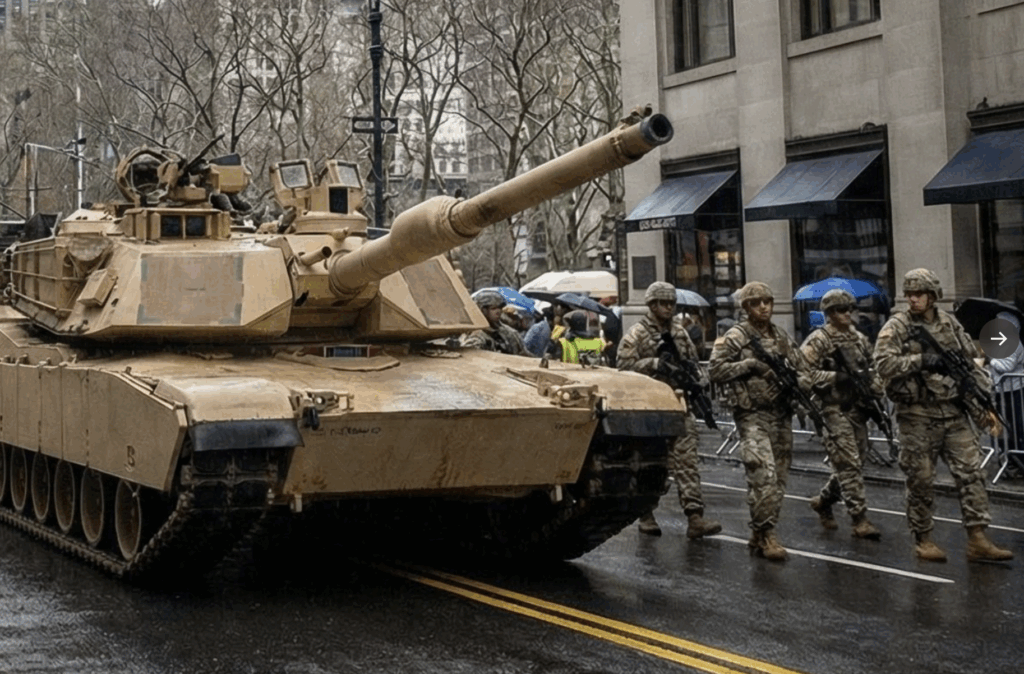
The Court’s decision turns this structure upside down. Under the majority’s interpretation, the president may not deploy the National Guard unless he first determines that he is unable to execute the laws using active-duty military forces. In other words, the president must treat the Army, Marines, or airborne units as the first line of response before turning to the Guard. That is not restraint. It is inversion. It is a reading that makes the Guard superfluous and encourages precisely the kind of militarization that American law has long sought to prevent.
Justice Alito’s dissent exposes this inversion with characteristic clarity. The Guard is not a substitute for the military. It is an intermediate institution designed to prevent escalation. To require the president to exhaust military options before using the Guard is like requiring a surgeon to perform an amputation before prescribing antibiotics. The existence of the intermediate tool is explained by the desire to avoid the extreme one. The Court’s logic denies that basic fact.
The majority attempts to defend its conclusion by rewriting the statutory text. The statute says nothing about exhausting lawful military options. It does not say the president must attempt to deploy active-duty troops. It does not say he must invoke the Insurrection Act. It does not say that inability means physical impossibility. The Court nonetheless reads all of these requirements into the statute. This is not an interpretation. It is an amendment.
Justice Alito is right to emphasize that Congress knows how to impose conditions when it wishes to do so. The Insurrection Act is explicit. The Posse Comitatus Act is explicit. Section 12406 is not. It grants discretion to the president to determine when execution of the laws has become untenable with existing forces. Courts are not licensed to supply missing words simply because they prefer a narrower grant of authority.
The majority’s treatment of the word unable illustrates the problem. Unable does not mean physically impossible. In law and in ordinary language, inability encompasses judgment, proportionality, and prudence. A president may be fully capable of ordering active duty troops into a city and still be unable to do so in any responsible sense. The costs may be unacceptable. The risks may be disproportionate. The action may violate long-standing norms that separate civilian life from military occupation. That is precisely why the Guard exists.
Under the Court’s reading, however, the president must say something like this: I could deploy the military domestically, but because I choose not to, I am therefore not unable. This renders the statute inert. It transforms a grant of discretion into a logical trap. The president is never unable unless he is willing to do the very thing the statute was designed to avoid.
The decision’s practical consequences are even more troubling. By making Guard deployment contingent on military incapacity, the Court incentivizes presidents to escalate sooner and more aggressively. If a future president faces organized violence targeting federal officers or property, he will know that the Guard is legally unavailable unless he first clears the hurdles associated with military deployment. The rational response will be to invoke the Insurrection Act earlier, normalize active-duty presence, and treat domestic unrest as a military problem. This is not speculation. It is the predictable effect of the Court’s rule.
The Court’s suggestion that protecting federal officers and property may not constitute executing the laws compounds the error. Federal law cannot be executed if federal agents are under siege. Protecting courthouses, immigration facilities, and officers performing their duties is not ancillary to law enforcement. It is a precondition of it. The Guard standing watch outside a federal building is not conducting general policing. It is enabling lawful authority to function. Courts have long recognized this distinction. The majority’s semantic narrowing ignores reality.
Justice Alito also identifies a profound procedural defect. The Court decided an issue that no party pressed. The meaning of regular forces, on which the entire decision turns, was waived below. It was not relied upon by the Seventh Circuit. It was not defended by respondents. The Supreme Court raised it on its own and then ruled on it. That is an extraordinary move in any case. It is indefensible in a case that constrains Article II authority nationwide.
Appellate courts exist to resolve disputes presented to them, not to manufacture theories that reshape the separation of powers. The Court’s willingness to do so here suggests a deeper problem. The majority was less interested in interpreting the statute as written than in reaching a particular outcome. The per curiam format allowed it to do so without individual responsibility.
Finally, the decision reflects a failure to respect the institutional competence of the presidency. Congress vested the determination of inability in the president because real-time security judgments cannot be made by courts. Judges do not receive intelligence briefings. They do not coordinate across agencies. They do not bear responsibility for the safety of federal personnel. Deference in this context is not abdication. It is recognition of the constitutional role.
The district court afforded the president no deference. The Supreme Court compounded that error by imposing novel constraints at the stay stage. That combination is not caution. It is judicial overreach masquerading as textual fidelity.
Justice Alito is right. The Court inverted the escalation ladder. It added words Congress never enacted. It drained of its ordinary meaning. It encouraged militarization rather than restraint. It decided an issue the parties did not present. And it undermined the president’s core duty to protect federal officers and property.
Whatever one thinks of President Trump, the Constitution does not require presidents to deploy Marines into American cities before calling up the National Guard. The Court’s decision is not merely wrong. It is structurally incoherent. Future presidents of both parties will inherit its consequences.
If you enjoy my work, please subscribe: https://x.com/amuse.
Sponsored by the John Milton Freedom Foundation, a nonprofit dedicated to helping independent journalists overcome formidable challenges in today’s media landscape and bring crucial stories to you.
READ NEXT: Trump Approves New Phase Of US Military Operations







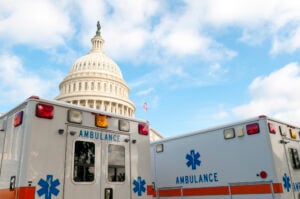





I know we call the highest court in the US the SUPREME Court or SCOTUS. But does even SCOTUS have the wisdom or foresight for all unintended consequences?
That’s why I am SO GLAD we have a three branch government and balance of powers. As with Roe v. Wade, even the SC (and most lower courts) can get things wrong sometimes.
I made the following comment on the NY Post yesterday (or the day before) under the name “Miker” prior to reading this article today.
It just fits within the NY Post word limit.
So far I have not seen any response, which makes me wonder if it really posted.
—
The Supreme Court decided that he couldn’t use the National Guard because he had not exhausted the use of “regular forces” in Chicago, Illinois.
The only “regular force” he had not already put to use was the active duty military.
The National Guard has personnel trained to prevent legal protests from devolving into illegal assemblies and riots.
Active duty military doesn’t train for that.
The Supreme Court is undermining the concept of a unitary executive under a President who is Commander in Chief of the military.
As a practical matter they are empowering state governors to veto the President’s use of the most appropriately trained and equipped part of the military to deal with rioters and protect Federal agents and property.
The National Guard would not have been called out if the state and local governments used their police powers appropriately to take timely action against illegal assemblies.
Those failures to act are a passive aggressive tactic to nullify Federal Law.
Some local governments have gone so far as to pass ordinances to declare some areas “off limits” to Federal Law enforcement.
That crosses the line into insurrection.
Ironic that the left is so focused on keeping the military out of supporting law enforcement.
Statutes to limit the military were enacted by Congress after the Civil War, under the political pressure of southern states, to keep Federal troops from protecting the rights of former slaves in the South.
Nullification of Federal Law rears its head again.
—