











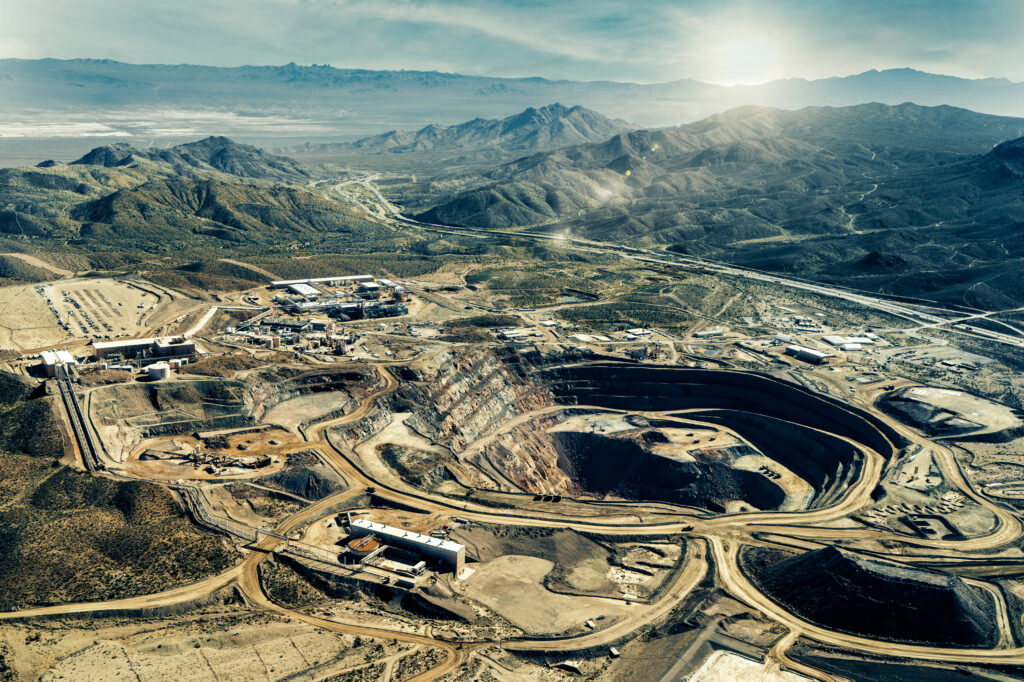
As the U.S. signs a rare earth minerals agreement with Ukraine, and President Donald Trump pushes his interest in gaining control over Greenland’s natural resources, it is important to understand why. The primary reason is national security and economic necessity, especially cutting-edge high-tech development.
The other reason is China, which controls 75% of rare earth deposits in the world, and is scrambling to gain more worldwide. China has banned the export of some rare earth minerals to the U.S. and Trump wants to break that U.S. reliance on China.
Of the two Trump targets, Ukraine holds the most valuable and largest store of resources. Greenland’s resources, while significant, are more limited in amounts.
Ukraine is home to significantly high concentrations of mineral resources (around 5% of the world’s critical raw materials) such as coal, iron ore, natural gas, manganese, salt, oil, graphite, Sulphur, kaolin, titanium, nickel, magnesium, timber and mercury.
Trump wants the U.S. to receive a proportion of Ukraine’s vast mineral deposits as compensation for its support of Ukraine over the last three years.
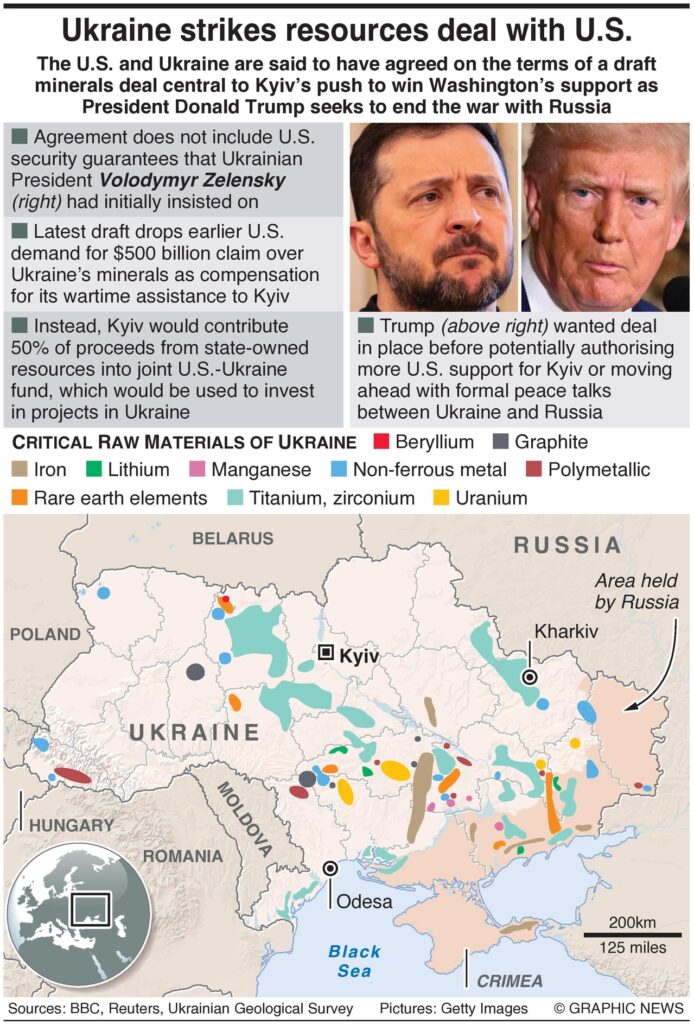
Ukraine has agreed to a deal to jointly establish a Reconstruction Investment Fund to collect and reinvest revenues from Ukrainian sources including minerals, hydrocarbons and other extractable materials. This after Ukraine rejected Trump’s demand to have Washington gain rights to $500 billion in Ukraine’s natural wealth.
Instead, Ukraine would contribute to the fund 50% of the revenue minus operating expenses and continue until the contributions reach the sum of $500 billion. The U.S. meanwhile would provide a long-term financial commitment to the development of a “stable and economically prosperous Ukraine.”
Asked what Ukraine would get in return for the minerals deal, Trump cited what he said was $350 billion already provided by the U.S. “and lots of … military equipment and the right to fight on.”
The $350 billion dollar figure has been challenged by many as much higher than the $180 billion estimated by the Pentagon.
Still, Scott Anderson, a fellow at the Brookings Institution, said that while the minerals deal looks like “a kind of piracy” to many, it “gives him (Trump) real skin in the game. I think there is real logic to that.”
A report from the Ukrainian Geological Survey (UGS) notes that the country has deposits of 25 of the 34 minerals identified by the European Union (EU) as critical. And 22 of the 50 that are identified that way by the U.S. They include industrial and construction materials, ferroalloy, precious and non-ferrous metals and some rare earth elements.
Particularly, Ukraine holds very competitive positions in five key ones: graphite, lithium, titanium, beryllium and uranium.
Ukraine’s reserves of graphite, a key component in electric vehicle batteries and nuclear reactors, represent 20% of global resources.
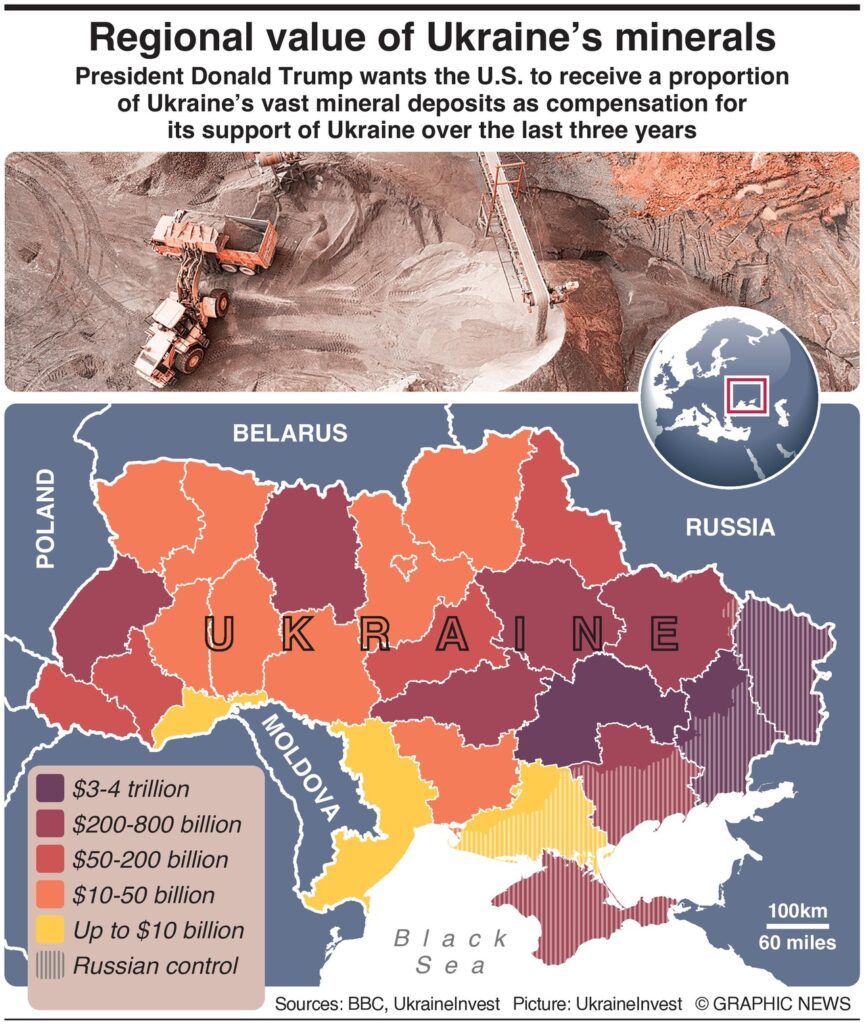
Kyiv’s proven reserves of graphite makes the nation “one of the top five leading countries” for the supply of the mineral. Graphite is used to make batteries for electric vehicles.
Ukraine also has 7% of Europe’s supplies of titanium, a lightweight metal used in the construction of everything from airplanes to power stations and is home to a third of all European lithium deposits, the key component in current batteries.
Other elements found in Ukraine include beryllium and uranium, which are both crucial for nuclear weapons and reactors.
Ukraine also has significant deposits of rare earth metals. These are a group of 17 elements required to produce weapons, wind turbines, electronics and other key modern products.
Meanwhile, Greenland is believed to hold significant untapped mineral and oil reserves, but on a global scale these amounts are modest. Still, when added to those of Ukraine, they make a difference.
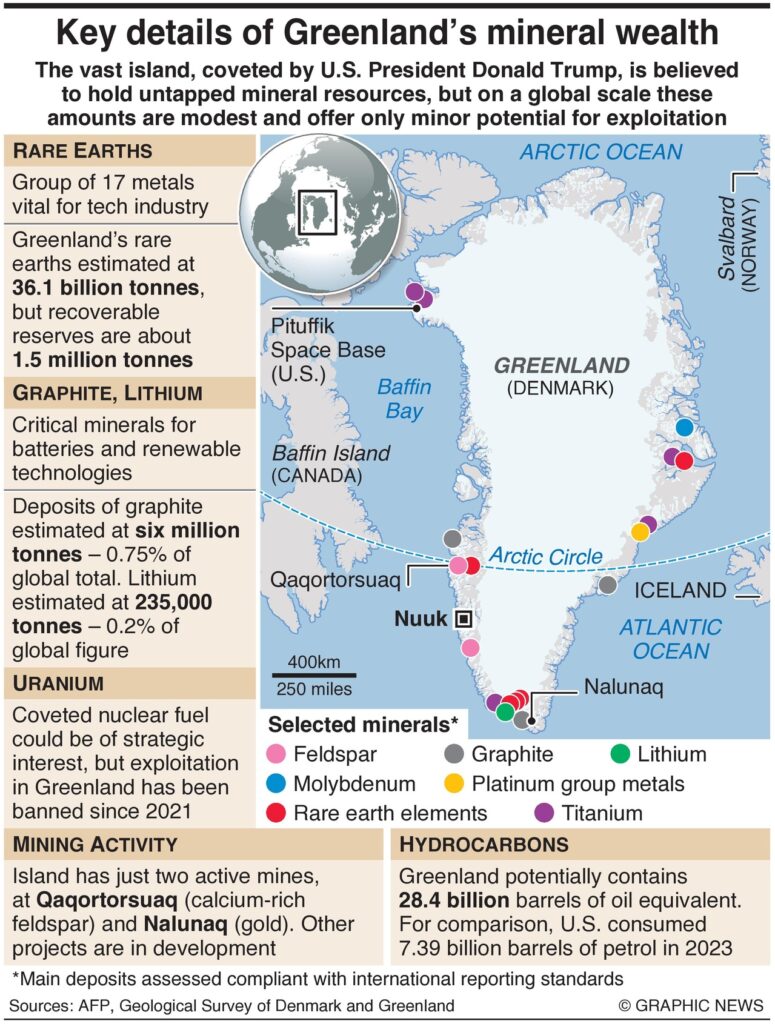
Greenland’s rare earths are estimated at 36.1 billion tons by the Geological Survey of Denmark and Greenland (GEUS). Demand for these 17 metals vital for the tech industry is expected to surge in the future, and they are also needed for drones, wind turbines, hard drives, electric cars, telescope lenses and advanced jet fighters.
Greenland also hosts graphite, lithium and copper, three minerals defined by the International Energy Agency (IEA) as critical for the energy transition.
Finally, the massive, autonomous island that is still a territory of Denmark could also hold hydrocarbons roughly equivalent to 28.43 billion barrels of oil, according to GEUS, Greenland’s National Oil Company (Nunaoil) and Greenland’s Mineral Resources Authority.
In conjunction with Ukraine’s massive natural resource reserves, Greenland’s resources add to the bigger picture of making the U.S. less reliant on China and able to compete in the vital high-tech sector, critical for economic growth as well as national security.
The opinions expressed in this article are those of the author and do not necessarily reflect the positions of American Liberty News.
READ NEXT: Influential Congressman Passes Away























For Defense & Industry to drive the EVs etc
I remember in my youth where the MSM touted America’s strength was due to the natural resources that we had. Now that the MSM has been taken over by Communist entities they aren’t happy that the US is offering foreign nations help to unearth theirs. China, eat your heart out.