

Or will he just move most of them around to different countries? And what will Europe need to do to replace the U.S. presence? President Donald Trump’s push to have Europe defend itself is increasing European fears that the U.S. could reduce its military presence on the continent.
Or eliminate it altogether.
Yet, this comes after U.S. officials from both parties have been urging their European allies to do more for their own defense for 50 years, and President Emmanuel Macron of France’s warnings in 2019 about a diminishing U.S. commitment to NATO, that largely went unheeded.
But now things are finally getting real.
Prominent members of the administration have repeatedly expressed interest in downsizing the American military footprint in Europe to focus on China in the Indo-Pacific. Meanwhile, the outcome of the Trump administration’s efforts to negotiate a peace deal between Russia and Ukraine remains uncertain.
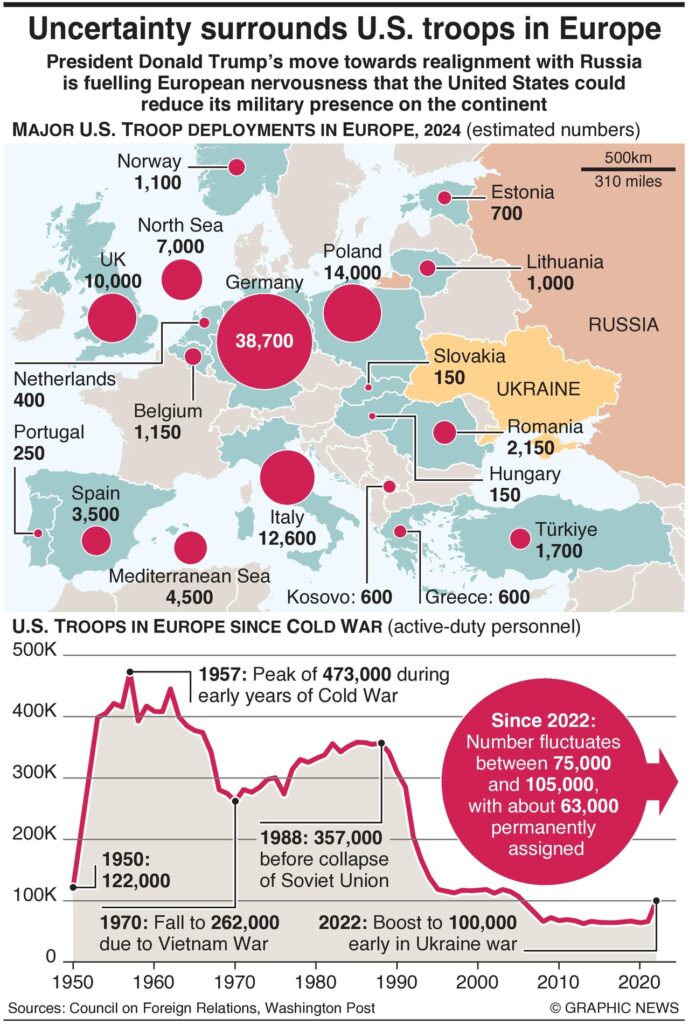
In the event of a peace deal, analysts and European officials have voiced concern that Trump will withdraw the 20,000 U.S. troops that have been deployed to Eastern Europe since 2022. Trump has also hinted that he would consider withdrawing the United States from NATO entirely.
For now, according to The Telegraph, Trump is considering pulling U.S. troops from Germany and redeploying them to Eastern Europe, likely Russia-friendly Hungary.
Viktor Orbán, the Hungarian prime minister, has maintained a relatively close relationship with Russia, often opposing EU sanctions on Moscow. Most recently, he vetoed a NATO commitment to increase support for Ukraine signed all other member states.
Trump also suggested last week that the U.S. might not protect NATO members that he believed were not paying enough for their own defense, calling it “common sense.”
And even many Europeans agree.
Prime Minister Donald Tusk of Poland put it simply last week, saying: “500 million Europeans ask 300 million Americans to protect them from 140 million Russians.” What Europe lacks, he said, is “the belief that we are truly a global force.”
Overall, the U.S. president is considering withdrawing some 35,000 active-duty troops and support personnel out of Germany.
But what if Trump decides to remove all U.S. troops from Europe and have the U.S. leave NATO altogether?
As The New York Times reported:
The answer comes down to money, personnel, time and cooperation with Washington, said Ivo Daalder, a former American ambassador to NATO and a coauthor of a recent report from Harvard’s Belfer Center on how to create “a strong European pillar” in the alliance.
The central problem is that NATO was built as an American-dominated alliance, intentionally dependent on American leadership, sophisticated weaponry, intelligence and airlift. The current NATO command structure is essentially owned and operated by the United States, led by Gen. Christopher G. Cavoli.
“The United States is the linchpin of the alliance so we could control our allies and get them to do what we want,” Mr. Daalder said. More practically, the United States military is the skeleton of NATO, and “if you suddenly pull out the skeleton, the body dies.”
To keep that from happening, Europe needs to spend a lot more money on defense. A lot more. The Harvard study recommends that European nations spend at least 3.5 percent of GDP per year on defense; currently just five of 32 NATO members, including the U.S., spend above 3 percent.
And while the Europeans already own a lot of high-end military hardware, they also need a lot more sophisticated weapons, now largely provided by the U.S., especially integrated air and missile defense and long-range precision strike capabilities.
As I have written previously, Europe also lacks “strategic enablers,” such as transport aircraft, sophisticated drones, satellites and other vital systems for intelligence, surveillance and reconnaissance.
Then, there are people. Europe would need to field a much larger military force.
“European armies are too small to handle even the arms that they’ve got now,” said Jim Townsend, a former U.S. deputy assistant secretary of defense.
“It doesn’t matter how good you are if there aren’t enough of you.”
But fixing that will likely require conscription. Right now, only a handful of European nations still have conscription forces. Still, a few European countries including Germany and Poland have recently discussed this option.
Finally, there is the critical issue of nuclear weapons. And even there we are seeing positive signs. France has again offered to extend its nuclear deterrent to the rest of Europe. Along with Britain’s nuclear force, this could prove to be a great start, though they would need to grow their nukes well beyond their current levels.
Let’s see what Europe does next.
But the truth is that Europe has waited far too long to respond to clear signaling from Trump during his first term, not to mention his comments during both his last campaigns. It is well past the due date for Europe to defend itself.
Trump is only pushing them to do what they long needed to do.
The opinions expressed in this article are those of the author and do not necessarily reflect the positions of American Liberty News.
READ NEXT: Unthinkable Violence: Conservative Journalist ‘Brutally Murdered’

















Send forces Home or to Pacific
I couldn’t believe how much we were spending in Germany in the 1960s when I was stationed there. This is waaaaaay past due. Conscription for Europe? Oh, the poor snowflakes. How about us having been conscripted to protect them?
Why not they do and say what they can to disgrace the US.
I compare what the USA was doing in Ukraine to the Lend-Lease program of the late 30s. What would have been the outcome if we stopped supplying GB, and told them we were going to have high level talks with Germany? Meanwhile, letting Germany hammer away at GB, but threatening possible sanctions against Germany