

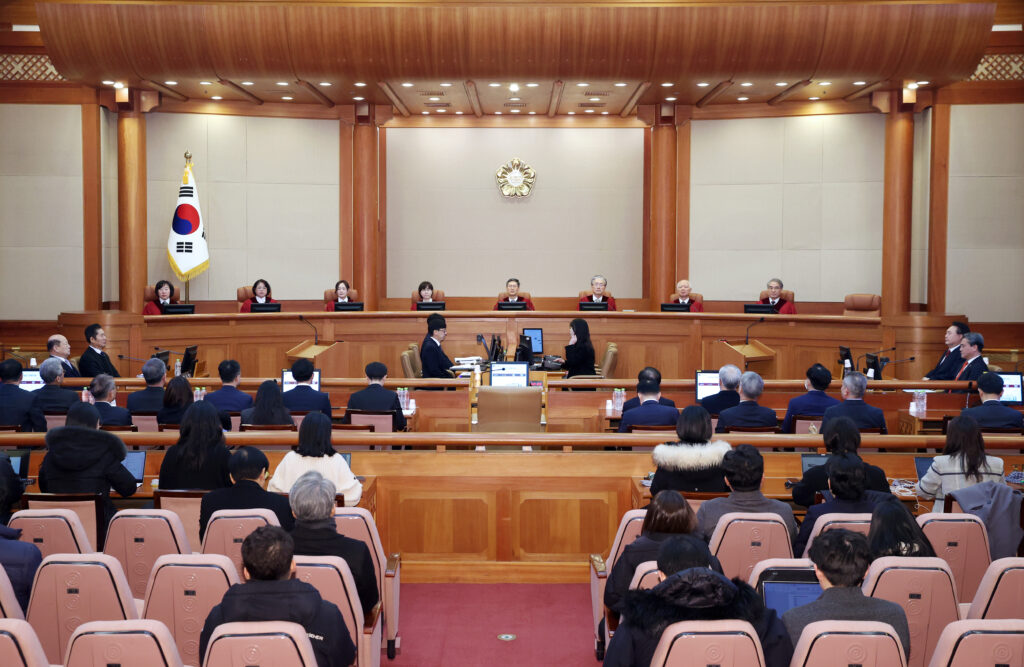
A Seoul court has sentenced former President Yoon Suk Yeol to life in prison after convicting him of leading an insurrection tied to his attempt to impose martial law in December 2024.
The ruling marks a dramatic fall for the former leader and closes a turbulent chapter in South Korean politics, at least for now. Yoon has said he plans to appeal.
Former South Korean President Yoon Suk Yeol has been sentenced to life in prison for his imposition of martial law in December 2024. pic.twitter.com/hD3KfmzjL0
— Pop Base (@PopBase) February 19, 2026
The Seoul Central District Court found Yoon guilty of rebellion for mobilizing military and police forces and briefly declaring martial law in what judges described as an illegal attempt to seize power.
In its decision, the court concluded that Yoon’s actions undermined constitutional order and democratic institutions. Prosecutors had sought the death penalty, arguing the gravity of the offense warranted the harshest punishment available under the law.
Judges instead imposed a life sentence, signaling the seriousness of the crime while stopping short of capital punishment.
Six Hours of Martial Law
The crisis began on Dec. 3, 2024, when Yoon declared martial law and deployed troops to the National Assembly.
The move came as he faced an opposition-controlled legislature that had blocked key parts of his agenda. According to the court, Yoon sought to bypass the Assembly by using military authority.
The decree lasted about six hours. Lawmakers convened and voted to lift the order, forcing its withdrawal.
It specifically included the following provisions:
Suspension of Political Activities
- Complete Prohibition: All political activities were banned, including activities related to the National Assembly, local legislatures, and political parties.
- Restrictions on Gatherings: The decree prohibited the formation of political organizations, as well as all rallies and demonstrations.
- Targeting Opponents: President Yoon claimed these measures were necessary to “eradicate” what he termed “anti-state forces” and “North Korean communist forces” within the domestic opposition.
Control over Media and Publications
- Command Oversight: All media outlets and publications were placed under the direct control of the Martial Law Command.
- Censorship of Content: The decree specifically prohibited the dissemination of what the command deemed “fake news,” “manipulation of public opinion,” and “false propaganda”.
- Specific Instructions: Reports later revealed that just hours before the announcement, Yoon had instructed police leadership to take control of specific media organizations, such as the public broadcaster MBC.
Arrests and Legal Procedures
- Warrantless Actions: Anyone found violating the martial law decree could be subjected to arrest, detention, and search and seizure without a judicial warrant.
- Arrest Orders: During the crisis, Yoon reportedly ordered the arrest of key political figures, including the National Assembly Speaker and the leaders of both the ruling and opposition parties.
- Medical Professionals: The decree also ordered striking medical personnel and trainee doctors to return to work within 48 hours or face punishment under the Martial Law Act.
During that time, troops were ordered to surround the National Assembly, a move that stunned the country and triggered widespread public backlash.
Army Chief of Staff Gen. Park An-su was appointed to lead the Martial Law Command following the issuance of the decree.
Despite military blockades surrounding the National Assembly, approximately 190 lawmakers were able to reach the chamber and unanimously voted to lift the measure.
The vote effectively nullified the martial law order under constitutional provisions.
Political Fallout
The declaration sparked massive protests and plunged South Korea into a brief yet profound political crisis.
Eleven days later, the National Assembly voted to impeach Yoon for violating the Constitution. The vote immediately suspended his presidential powers.
On April 4, 2025, South Korea’s Constitutional Court unanimously upheld the impeachment in an 8-0 decision, formally removing Yoon from office.
The criminal trial that followed focused on whether his use of military force amounted to rebellion. The court ultimately concluded that it did.
What Comes Next
Yoon has indicated he will appeal the verdict.
His legal team is expected to argue that the martial law order, while controversial, did not rise to the level of insurrection. Prosecutors have maintained that the deployment of troops against a functioning legislature crossed a clear constitutional line.
The case is likely to remain a flashpoint in South Korean politics, testing public confidence in democratic institutions and the rule of law.
READ NEXT: Allegations Lead To Department Ban For Cabinet Secretary’s Husband










Many American politicians deserve the same sentence.