

Random people versus registered voters, the so-called experts don’t differentiate. And the way questions are asked matters a lot. The legacy media, always in cahoots with the Democrats and the left, is in overdrive trying to show that President Trump’s strikes on Iran are unpopular among Americans.
Just one in four Americans says they back U.S. strikes on Iran, says Reuters. CNN reports that 59% of Americans disapprove of Iran strikes and most think a long-term conflict is likely.
And to make it very clear, Trump’s airstrikes on Iran are unpopular, exclaims The Washington Post. One Reuters/Ipsos poll found only 27% approval of Trump’s strikes on Iran. This helps create a convenient, but false left-wing narrative such as this graphic:
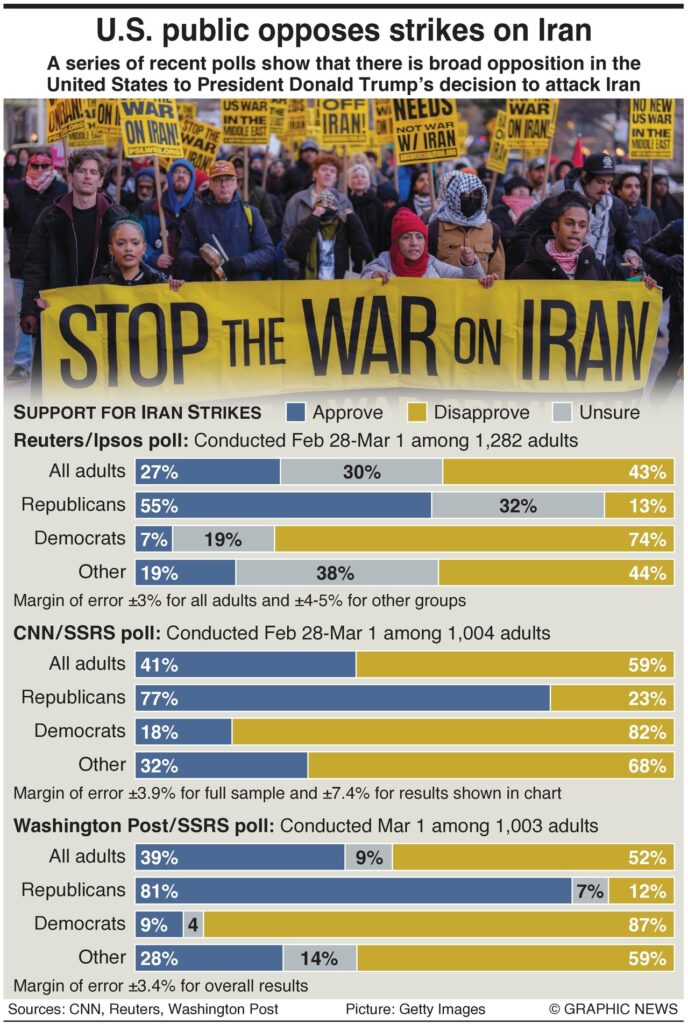
However, there are many ways to skew poll results, intentionally or not.
For example, none of those polls above focused on registered voters. They only surveyed “Americans,” which could easily include anyone living here, including illegal aliens and foreigners.
In terms of elections and political impact, only registered voters, and more specifically, surveys of registered “likely voters,” actually matter.
One credible poll that did focus on registered voters showed that voters are evenly divided, with roughly 41% to 42% of registered voters viewing the U.S.-Israeli strikes as necessary, while a similar number preferred diplomacy: a very different political reality from what much of the media is spinning.
In one case that did show favorable support, Newsweek reported a “surge” in “Americans’ Support for Donald Trump’s Iran War” based on Fox News and Politico’s Playbook surveys of “voters.”
However, it wasn’t a surge; it was just based on surveys of registered voters rather than just surveys of random people, which Newsweek doesn’t seem to pick up on.
The Fox News poll above, conducted March 3, shows a 50-50% split in voter approval versus disapproval.
Meanwhile, Politico’s Playbook summarized an OnMessage poll, showing support and opposition essentially tied at 49% to 48%, and showed how the sample did not skew pro-Trump but was accurate.
And even the polls from CNN and NPR/PBS News/Marist that found that 59% of Americans opposed the strikes on Iran, also showed that 56% of Americans supported them — not as big a difference as CNN’s headline above proclaimed.
The way the surveys’ questions are worded also determines outcomes, with results often varying based on how the questions are framed and the specific timing of the surveys following the Feb. 28 start of “Operation Epic Fury.”
Support levels fluctuate depending on whether a poll asks about “strikes” generally, “overthrowing the government,” or “initiating an attack.”
And even among those who some approve of air strikes, support drops significantly — often by 40 points or more — when asked about sending “boots on the ground” or if the conflict causes fuel prices to rise.
“Unsure” Options: Polls that do not offer a “not sure” option (like CNN/SSRS) often show higher disapproval numbers than those that do (like Reuters/Ipsos). Sadly, if asked, a significant number of Americans can’t find Iran on a map and know squat about it or why we are striking the regime.
While some major polls indicate a big majority opposes the current conflict, beware. The Reuters/Ipsos poll noted earlier, for example, that found only 27% approval was notably accompanied by a high percentage (29%) of “unsure” respondents.
That means one third of those asked had no clue what they believed.
There is also, of course, a massive “chasm” between parties. NBC News reports that 77% of Republicans support the strikes, while 89% of Democrats and 58% of independents oppose them.
So, my advice is to take all these polls with a grain of salt. They don’t tell us that much.
Ultimately, the only thing current polling (as of this weekend) regarding U.S. military action against Iran accurately shows is a divided American public nearly evenly split, like it is on everything else.
The opinions expressed in this article are those of the author and do not necessarily reflect the positions of American Liberty News.
READ NEXT: Key Republican Announces Exit Months After Vowing Not To Quit






















If you are unsure of this action against Iran, think of Nazi Germany in the 1930s. If the free countries of the west had gotten involved in putting Hitler in his place ( taken away his ability to grow his military forces ), there would have most likely have been NO WWII. Neither Italy or Japan would have tried to ‘go it alone’.
If we had let Iran grow their missile and nuclear bomb capabilities, there would have been, in our lifetimes, an atomic war with them with us being hit by a great number of these bombs.
That would have left a lot of dead Americans in this country and in Israel, as well as in countries all over Europe, Asia, the near east, and wherever they wanted to destroy our and their way of life.
This relatively small war will most certainly put an end to the probability of a much larger war in the near future.