

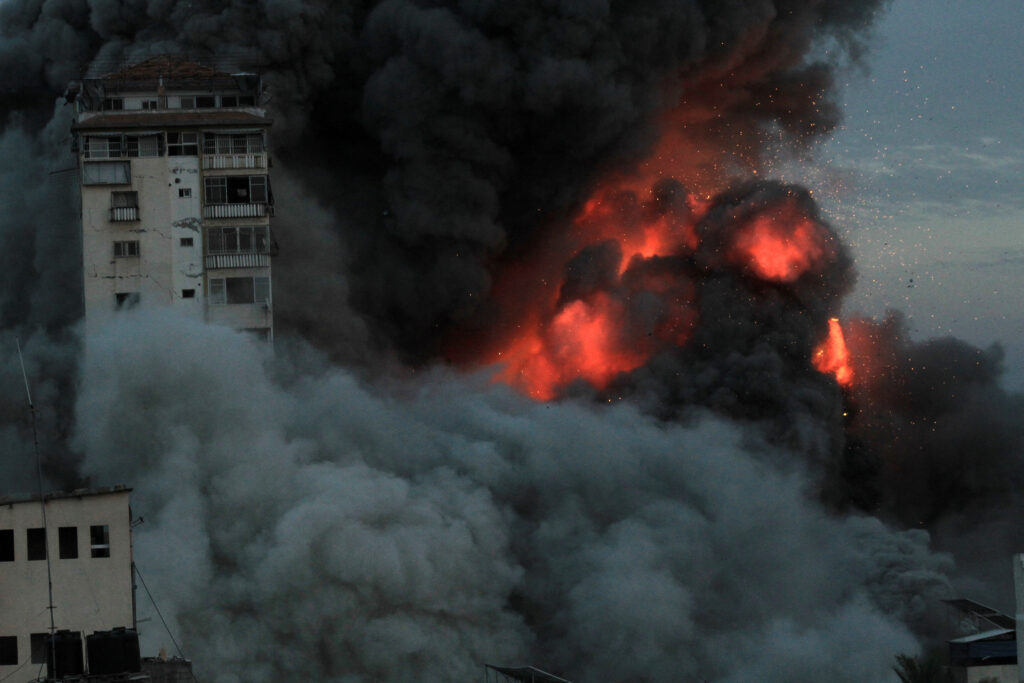
TEHRAN — Iran announced Saturday that it is closing the Strait of Hormuz, accusing the United States and Israel of acting in bad faith and violating the terms of a recently established ceasefire arrangement through continued military operations in Lebanon.
The announcement was delivered by Iran’s Khatam al-Anbiya Central Headquarters on state television, marking a dramatic escalation in regional tensions and threatening renewed disruption to the world’s most crucial energy transit corridor.
Iranian officials said the decision was prompted by what they described as repeated ceasefire violations following Israeli airstrikes in southern Lebanon. Lebanese authorities and independent civil defense agencies reported that at least 18 people were killed overnight in strikes near Nabatieh. Israel said the operations were conducted in response to overnight rocket attacks attributed to Hezbollah.
The Khatam al-Anbiya Central Headquarters of the Iranian Armed Forces has issued a warning to all vessels attempting to transit the Strait of Hormuz, stating that the Strait is currently closed due to “U.S. breaches of the war-ending deal and ongoing Israeli ceasefire… pic.twitter.com/k84R2CmGxY
— OSINTdefender (@sentdefender) June 20, 2026
The closure comes just three days after the Strait of Hormuz had reopened under a U.S.-Iran memorandum of understanding intended to reduce military tensions and restore freedom of navigation through the strategically vital waterway.
Commercial shipping traffic had only recently begun recovering from earlier disruptions when Iranian authorities announced the renewed shutdown. Iran’s Islamic Revolutionary Guard Corps Navy later warned vessels against approaching the strait, stating that ships attempting to transit the area could be treated as targets.
The move has immediately cast doubt on planned diplomatic efforts aimed at preserving the fragile agreement. Follow-up negotiations scheduled to take place in Switzerland between U.S. and Iranian officials are now uncertain, with diplomatic sources indicating talks could be further postponed amid the rapidly deteriorating security situation.
The Strait of Hormuz remains the single most important maritime chokepoint for global energy markets. Under normal conditions, it handles roughly 20 million barrels of crude oil and petroleum products per day.
"A bad agreement for Israel."
— Al Jazeera English (@AJEnglish) June 15, 2026
"Netanyahu stands… weak, ill, as an isolated and ineffective person."
Israeli politicians, including Itamar Ben-Gvir and Bezalel Smotrich, have criticised the US-Iran deal, which is expected to end fighting, including in Lebanon. pic.twitter.com/mfHnAglFt0
Energy traders and government officials are closely monitoring developments as the renewed blockade threatens to disrupt global supply chains, increase transportation and insurance costs, and inject fresh volatility into commodity and financial markets.
The latest closure represents one of the most serious setbacks since the U.S.-Iran understanding was reached earlier this week. Analysts warn that prolonged disruption could have far-reaching consequences for energy-importing nations across Europe and Asia while further complicating efforts to stabilize a region already strained by multiple overlapping conflicts.
Neither Washington nor Jerusalem had announced any immediate policy changes following Iran’s declaration.
According to a release from the Pakistani Ministry of Foreign Affairs, “technical-level” negotiations between the U.S. and Iran will be held in Switzerland tomorrow, the 21st. The announcement comes amidst Iran’s closure of the Strait of Hormuz, citing Israel’s operations against… pic.twitter.com/c4UMwk7i1M
— OSINTdefender (@sentdefender) June 20, 2026
This is a breaking news story. Please check back for updates.
READ NEXT: View Host Surprises Audience With Support For White House Visit




















This is a threat against the whole world.
Threats deserve an answer … one that teaches a lesson.
One like what they got not long ago.
But in a clear and certain way. Loud and clear!