

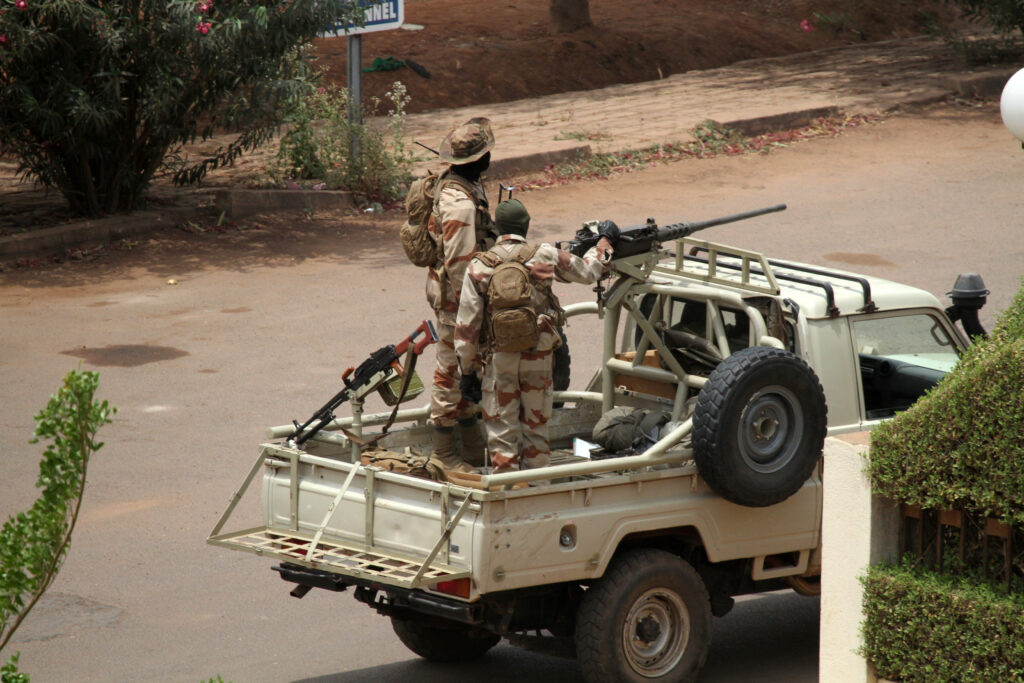
Mali’s defense minister, Gen. Sadio Camara, was killed Saturday during a wave of coordinated attacks by jihadist fighters and Tuareg separatist rebels, dealing a major blow to the country’s military government and complicating ongoing U.S. efforts to rebuild security ties.
The attacks reportedly involved Jama’at Nusrat al-Islam wal-Muslimin (JNIM), an al-Qaida-linked coalition, and the Azawad Liberation Front, a Tuareg-led separatist alliance.
Fighting targeted multiple locations, including the capital, Bamako, and the northern city of Kidal, which was seized by rebel forces — a significant setback for the ruling junta.
Camara had been a key figure in negotiations with the United States, and his death creates a leadership vacuum that could stall efforts to finalize a new security agreement.
Mali’s defense minister was killed in a suicide attack on his home during a coordinated assault by an al-Qaeda affiliate across several locations in the West African country https://t.co/66rATjk10s
— Bloomberg (@business) April 27, 2026
Washington has been pursuing a renewed partnership with Mali focused on counterterrorism, including potential drone surveillance operations aimed at combating jihadist groups and countering Russian influence in the region.
The push follows the 2023 withdrawal of U.N. peacekeepers and ongoing concerns about the effectiveness of Russian-backed forces operating in the country.
In a sign of shifting strategy, the U.S. lifted sanctions earlier this year on several Malian officials, including Camara, in an effort to rebuild trust and advance cooperation.
A Complex Conflict
The violence highlights the evolving nature of Mali’s conflict.
JNIM, formed in 2017 from several jihadist groups, has expanded its reach across Mali and neighboring countries, targeting military and civilian sites.
Meanwhile, Tuareg separatists have long sought autonomy for northern Mali, a region they say has been neglected by the central government.
While the two groups have different goals, their coordination in the latest attacks signals a potentially dangerous alignment against the government and its allies.
Why It Matters
The fall of Kidal is particularly symbolic.
The city had been retaken by Malian and Russian-backed forces in 2023, and its loss now raises fresh questions about the junta’s control over the north.
Newly released footage of Malian rebel FPV drone strikes on Russian Africa Corps forces in Kidal over the weekend. pic.twitter.com/AzBDZk5SHJ
— OSINTtechnical (@Osinttechnical) April 27, 2026
The broader situation underscores growing instability across the Sahel, a region already considered one of the most volatile in the world.
What Comes Next
U.S. officials have condemned the attacks and urged Americans in Mali to shelter in place as fighting continues near key infrastructure, including the capital’s airport.
The crisis threatens to derail Washington’s efforts to counter both jihadist expansion and the influence of Russia and China in the region.
READ NEXT: Suspect’s Manifesto Reveals One Trump Official Wasn’t Targeted















‘They’ never quit.
Forces for freedom and democracy can’t ever quit either!
To lose in one situation is to eventually lose in all!
In the 1960s, we didn’t do anywhere nearly enough to stop this stuff.
This had better be stopped now or ‘they’ll’ eventually take over the world!
Russia, China, North Korea, the Muslims, etc., want to make us all communists ( and the Muslims want to make us all Muslims, or to be dead )!
If they are allowed to continue with this, it is what they will have!
We must ‘grow a set’ and stop them … NOW!
The religion of peace at work as usual.