

ANALYSIS – In what appears to be a blunt message to America as we enter the final, most intense phase of our elections, and our allies, China has just fired a DF-31 or DF-41 nuclear-capable intercontinental ballistic missile (ICBM) into the Pacific Ocean.
Both versions are some of China’s most powerful and far-reaching nukes.
While this missile reportedly carried a dummy warhead as its payload, western intelligence believes the three-stage solid-fuel DF-41 can carry a payload of 5,500 lbs. (2 ¾ tons), including up to 10 Multiple Independently-targetable Reentry Vehicles (MIRVs).
The road mobile rocket has a range of 3,400 miles, putting China’s nukes within striking range of Hawaii and the U.S. mainland.
These capabilities allow one missile to strike different targets with essentially ten different warheads halfway across the globe.
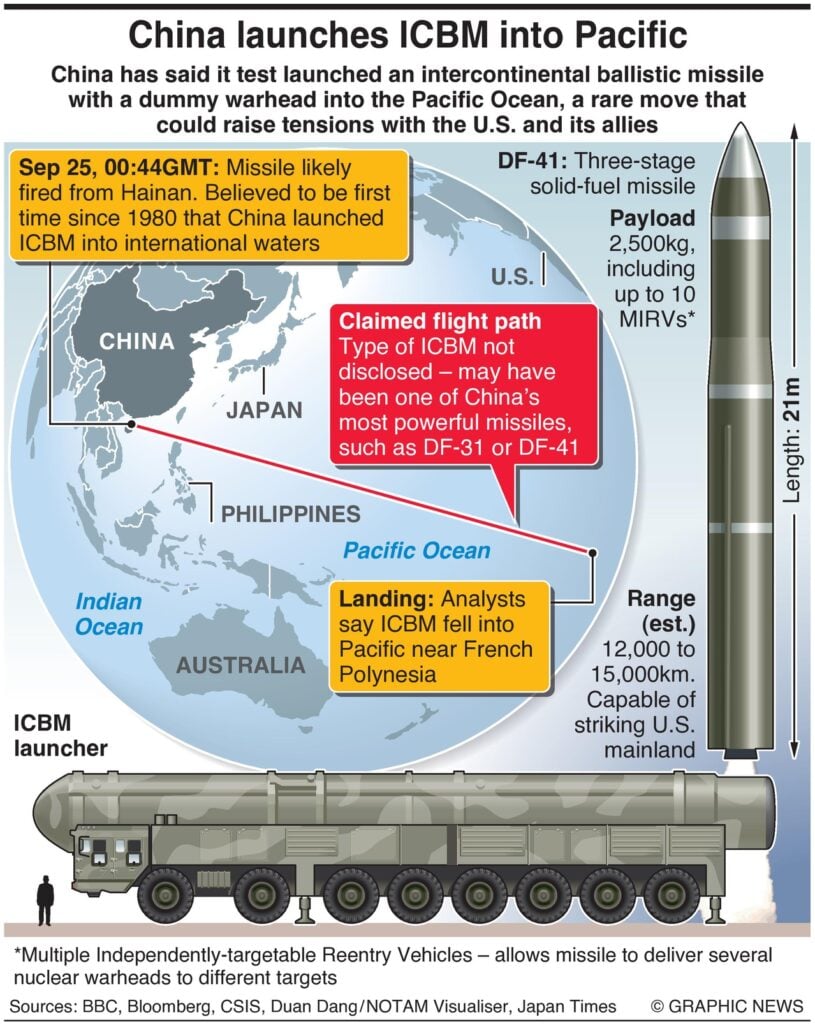
The ICBM was launched at 08:44 local time on Wednesday and “fell into expected sea areas”, according to Beijing’s defense ministry, adding that the test launch was “routine” and part of its “annual training.”
However, this tryp of launch is far from routine. The last time the communist nation fired an ICBM into international waters was 1980, almost five decades ago.
China’s nuclear weapon tests usually take place domestically and it previously test-fired ICBMs west into the Taklamakan Desert in the Xinjiang region.
But China’s message is also directed at America’s regional allies which Beijing has been bullying mercilessly.
Leif-Eric Easley, an international relations professor at Ewha Women’s University in South Korea, noted that for U.S. allies in Asia, the “provocative test… demonstrates China’s capabilities to fight on multiple fronts simultaneously.”
BBC News reported:
“Timing is everything,” Drew Thompson, a visiting research fellow at the Lee Kuan Yew School of Public Policy in Singapore, wrote on X.
“[China’s] statement claims the launch does not target any country, but there are high-levels of tension between China and Japan, Philippines, and of course perpetual tension with Taiwan.”
While the relationship between Beijing and Washington has improved in the past year, China’s increasing assertiveness in the region remains a sticking point. Tensions have ramped up between China and the Philippines as their ships have repeatedly collided in disputed waters.
Last month, Japan scrambled fighter jets after it accused a Chinese spy plane of breaching its air space, a move that it called “utterly unacceptable.”
It is also telling that Beijing did this just as the United Nations General Assembly was meeting in New York.
The missile’s flight path remained unclear, but Chinese state media said Beijing had “informed the countries concerned in advance.”
But Japan said it had not received a warning and expressed strong concerns, along with Australia and New Zealand.
Analysts say the rocket was likely launched from Hainan island off of China’s southern coast and splashed into the ocean near French Polynesia.
China is on a tear building up its long-range nuclear capabilities. Its crash program reportedly intends to double, if not triple its nuke arsenal by 2030, nearing parity with the United States. Beijing is reminding everyone that the global power dynamics are shifting rapidly.
And by everyone, I clearly mean the China-compromised team of Kamala Harris and Tim Walz.
READ NEXT: ‘Mobster’ Celebrity Launches Into Uncontrollable Anti-Trump Tirade

















WW3 Coming closer