Remote Nevada tremors spark questions tied to a place long defined by secrecy…
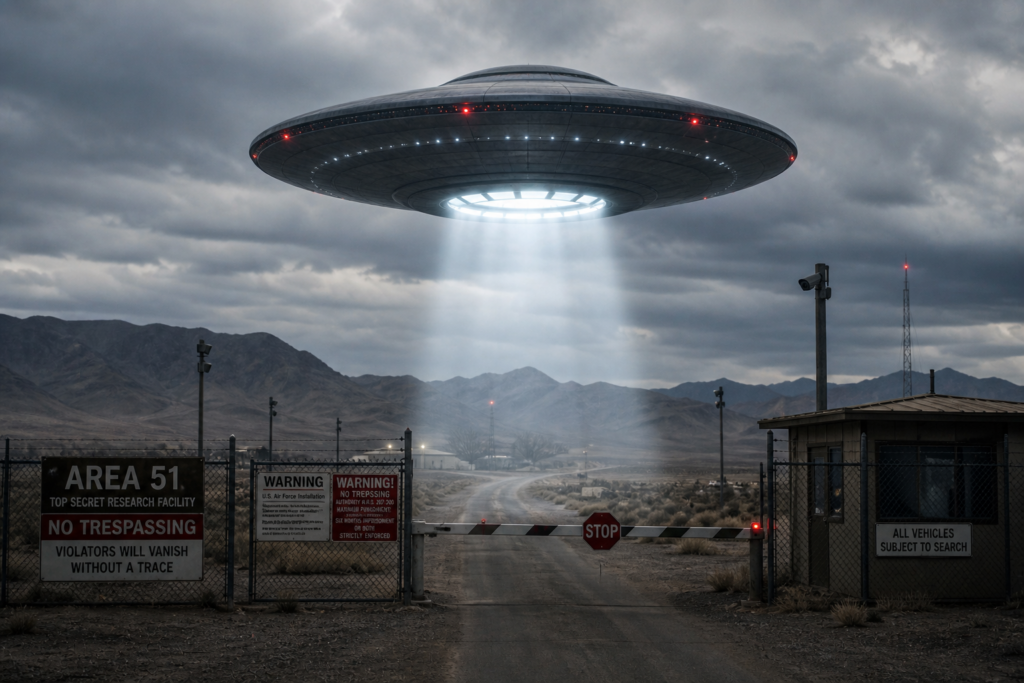
A short burst of earthquakes in southern Nevada this week might have passed with little notice if it had happened almost anywhere else. But this wasn’t just anywhere. It was near Area 51.
Over a 24-hour stretch, at least 17 earthquakes were recorded in a remote part of the Nevada desert. The strongest reached magnitude 4.4. The sequence began with a shallow tremor about 2.5 miles below the surface and continued into the early morning, with the last event logged just before 5:40 a.m. local time. More than 100 people reported feeling the shaking, though no damage has been reported in the sparsely populated area.
In most places, that would be the end of the story. Here, it’s just the beginning.
A familiar pattern in an active region
From a geological standpoint, there’s little mystery.
The quakes occurred within the Basin and Range Province, a broad region where the Earth’s crust is slowly pulling apart. That stretching creates faults, and those faults occasionally shift. When they do, they sometimes release energy in clusters rather than a single large quake. That’s what scientists call an earthquake swarm.
It’s not unusual. It’s not especially rare. And in most cases, it doesn’t point to anything beyond natural processes underground.
Why this location changes the conversation
Still, location matters.
Geophysicist Stefan Burns described the site as “an unusual place to get an earthquake,” noting both the area’s relative seismic quiet and the exceptionally shallow depth of the initial tremor, which fueled online speculation about underground testing.
He said the swarm is “most likely a natural earthquake,” but added there is “some ambiguity” in the early data.
That ambiguity comes from a technical reality. Earthquakes and underground explosions can sometimes look similar on seismic readings, especially when the energy release is sudden and close to the surface.
Burns said the data is “worth discussing” in that context, including the possibility — however unlikely — of a covert underground test.
That kind of caution is standard in early analysis. But near Area 51, it carries more weight than usual.
A site where secrecy shapes perception
Area 51 has spent decades as both a classified military installation and a cultural symbol. Built in 1955, it played a role in developing aircraft like the U-2 and A-12. Over time, it also became shorthand for hidden government activity, fueled by limited access and long periods of official silence.
That history still shapes how events in the region are understood.
Even routine occurrences can take on a different tone. A minor anomaly doesn’t stay minor for long. It gets filtered through decades of speculation about what might be happening behind closed doors.
Some of that perception has been reinforced by the government itself. A Pentagon report released in 2025 found that officials during the Cold War deliberately encouraged UFO rumors to distract from classified weapons programs. In some cases, fabricated images were circulated to support those narratives.
The strategy worked. It didn’t just hide specific projects. It helped create a lasting expectation that unexplained events might point to something extraordinary.
A broader backdrop of renewed interest
Recent moves in Washington have added to that atmosphere.
In March 2026, the federal government registered domain names including alien.gov and aliens.gov as part of its public outreach on unidentified anomalous phenomena. A month later, on April 29, President Donald Trump said his administration would release as much information as possible about UFOs in the near future.
That kind of messaging has helped keep public attention focused on the unknown, especially when events — like a cluster of earthquakes — leave even a small amount of room for interpretation.
For now, experts say the simplest explanation still holds.
READ NEXT: Scrutiny Mounts On Republican Strategy For Upcoming Midterms