

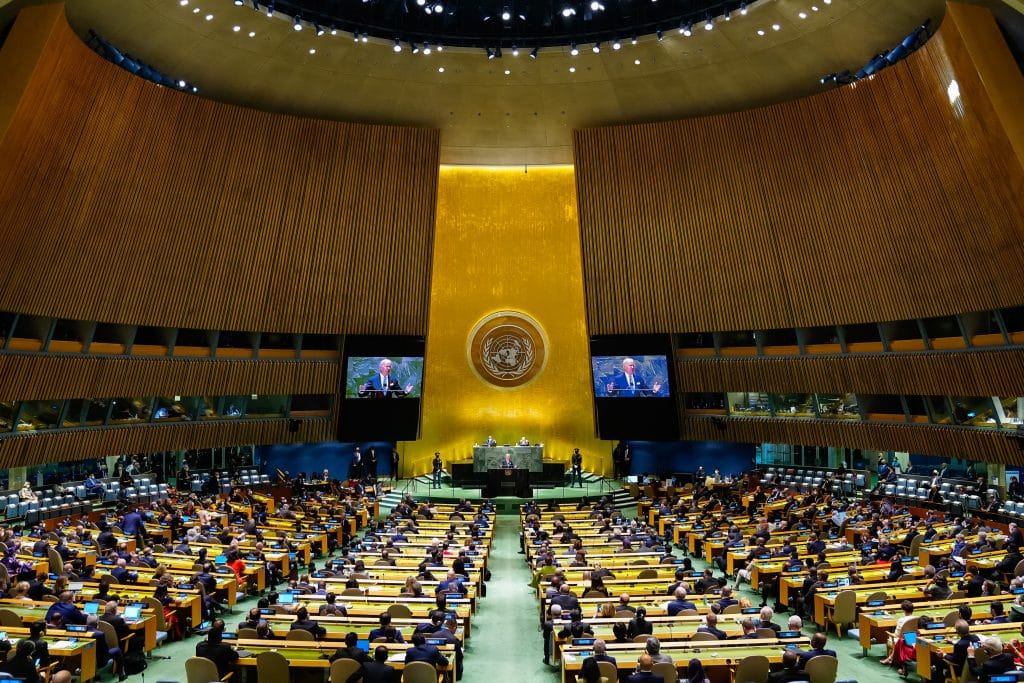
NEW YORK — In a major diplomatic win for Washington, the United Nations Security Council voted Monday night to approve the U.S.-backed resolution pushing forward President Donald Trump’s sweeping 20-point peace plan for Gaza. The measure passed 13-0, with Russia and China abstaining.
The resolution authorizes an International Stabilization Force, or ISF, to operate in Gaza for two years. Their mission is to secure the enclave’s borders, safeguard humanitarian access, and oversee a controlled demilitarization process.
The plan also calls for the creation of a transitional governing body, the Board of Peace, to be led by Trump. The body would oversee reconstruction, manage civilian governance, and chart a path toward Palestinian self-determination.
A two-year mandate covers both the ISF and the transitional structure. The plan includes benchmarks for an Israeli withdrawal and the dismantling of non-state armed groups. A reference to a future Palestinian state was added during negotiations, which helped secure support from Arab and Muslim-majority nations.
For the United States, the adoption reflects a strategic breakthrough. The plan now carries the weight of the Security Council, giving Washington a leadership role in shaping what comes next in Gaza.
Still, Israel has raised concerns about references to Palestinian statehood and the authority of the Board of Peace. Officials in Jerusalem are seeking clearer limits on how the ISF and the transitional government will operate.
Hamas has also rejected key elements of the proposal. Its refusal to accept demilitarization and the governance terms threatens the plan before it even begins.
Legal and logistical challenges remain as well. Deploying an international security force, securing troop commitments from Muslim-majority countries, and coordinating with Israel and Egypt all pose significant obstacles. Questions also linger about what happens after the two-year mandate expires and who would assume responsibility for long-term security and administration.
What Comes Next
The United States and participating regional governments must now finalize troop commitments, mission rules, and operational guidelines for the ISF.
Israel and Egypt will need to coordinate closely with the force, including on border procedures and the timetable for an Israeli pullout.
Reforms within the Palestinian Authority and the setup of the Board of Peace will be critical for legitimacy and stability.
While international diplomats say the regular reviews are meant to keep pressure on all parties, the process will also test whether the Security Council can maintain unity on an issue that has historically exposed deep divisions among major powers.
READ NEXT: Trump Makes Appearance At Event With Unusually Personal Stakes



















So where is this mythical country of Palestine? I can’t find it on any map?