

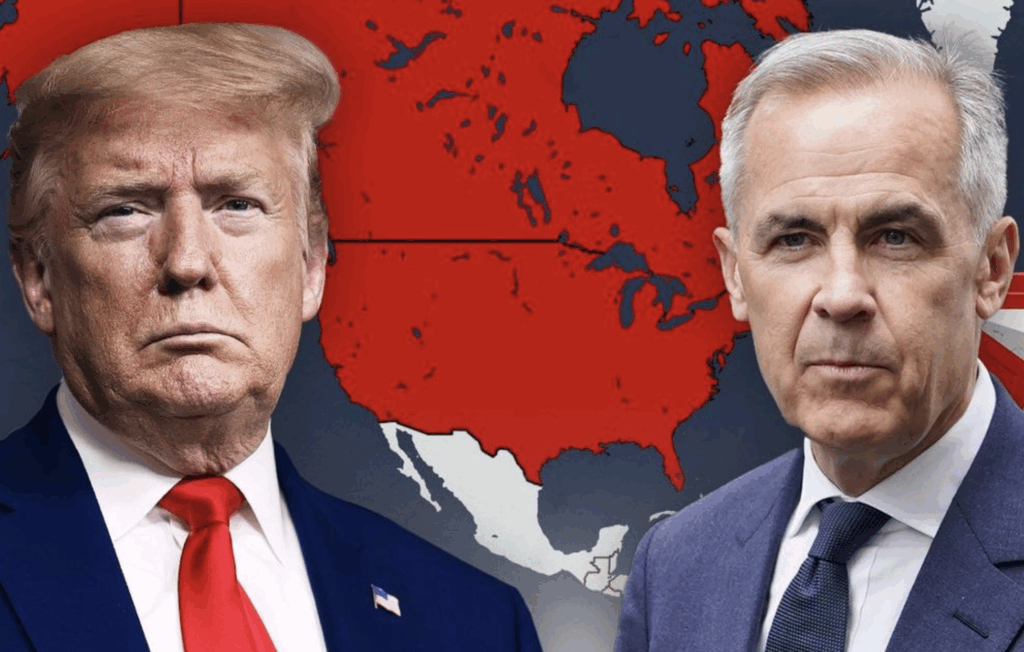
The difference between negotiation and humiliation lies not in the power one holds, but in the wisdom with which it is exercised. Nowhere is that truth more painfully evident than in the recent trade conflict between the United States and Canada. Mark Carney, Canada’s prime minister and erstwhile financial savant, has just discovered the high cost of arrogance, hubris, and above all, amateurism in the face of a world-class negotiator.
Donald J. Trump, returned to office in January 2025 with a clarity of vision and the wind of electoral mandate at his back, imposed a devastating 35 percent tariff on Canadian goods. No warning, no grace period, no summit photo-op. Just a hard slap. The kind one earns, not stumbles into. And to drive the point home, Trump added an escalator clause: any attempt to dodge the tariffs would trigger an additional 40 percent fine. This wasn’t mere retaliation; it was strategic enforcement, the kind that sends a message far beyond North America.
Compare that with Mexico. Despite holding a weaker economic hand and facing the same impending tariffs, Mexico’s President Claudia Sheinbaum Pardo secured a 90-day negotiation window. That alone reveals the kernel of Trump’s strategic posture: when treated with respect, the United States will negotiate; when mocked, it will punish.
So why did Canada receive the diplomatic equivalent of a public spanking? The answer begins with Carney’s cardinal error: treating negotiation with the United States as a performance rather than a process. His government, cloaked in moral superiority and wielding retaliatory tariffs on bourbon and Harley-Davidsons like blunt instruments, misread Trump as a man who responds to theatrics. In reality, Trump responds to leverage. And Canada, for all its bravado, has none.
To be precise, Canada sends roughly 75 percent of its exports south. That figure alone renders Canadian threats of economic reprisal laughable. When your entire economy hinges on access to a single market, the one thing you cannot afford is brinkmanship. And yet, brinkmanship was Carney’s chosen strategy. Trump’s response, then, wasn’t petulant. It was rational. A client state pretending to be a co-equal must be reminded of the terms.
Mexico, in contrast, chose prudence. As the deadline loomed, Sheinbaum took Trump’s call. She signaled flexibility. She acknowledged US concerns over trade imbalances and cross-border enforcement. The White House characterized the discussion as “productive,” a term often mocked by cynics but here it meant everything. In diplomacy, tone often precedes substance. Mexico struck the right tone. Carney, by contrast, struck poses.
What makes Carney’s blunder so striking is that he could have learned all of this from a single book: The Art of the Deal. Trump telegraphs his negotiating tactics, not through covert memos, but bestselling books and decades of televised boardroom theater. He believes in reciprocity, in flexibility matched by flexibility, and in punishing betrayal. Carney either didn’t read the book or, worse, read it and thought himself above it.
Then there is the matter of trust. For months, Trump’s trade team engaged with Canada to resolve long-simmering disputes over maple syrup cartels, dairy quotas, digital taxes, and softwood lumber barriers. Each time, Ottawa failed to meet deadlines. Each time, promises were made and then diluted in bureaucracy or tossed aside. Trump does not suffer flinchers, and by midsummer, he made clear it would be “very hard” to finalize a deal with Canada. That was not a bluff. It was an invitation to reform behavior. It was ignored.
— @amuse (@amuse) August 3, 2025
Meanwhile, Canada had been quietly drifting from ally to antagonist. It imposed $155 billion in retaliatory tariffs targeting politically sensitive US exports. Its digital services tax, written to disproportionately affect American tech companies, flagrantly violated the spirit if not the letter of USMCA. And at every turn, Canadian officials grandstanded on global stages, scolding the US for everything from climate policy to border enforcement. It was less a partnership than a public scolding.
To make matters worse, Canada has become a new front in the fentanyl crisis. While attention has long focused on the southern border, seizures at the northern border have more than doubled since 2023. Canadian ports are now known entry points for precursor chemicals arriving from Asia, which are then trafficked south via loosely monitored routes. Despite repeated US urgings, Canada has refused to impose aggressive interdiction policies or cooperate on joint enforcement.
In short, Carney’s Canada has behaved not like a trusted neighbor, but like a self-important NGO with nuclear family problems. And Trump, faced with a recalcitrant northern partner and an increasingly unstable hemisphere, chose clarity. The 35 percent tariff is not merely economic policy. It is a line in the sand.
Critics will call this unilateralism. They will claim Trump is undermining alliances. But an alliance without trust is a fiction, and diplomacy without leverage is theater. Carney played for applause. Sheinbaum played for results. Trump rewarded one and punished the other.
There is a broader lesson here for any world leader navigating the new American posture. Trump is not interested in endless summits or statement-signing ceremonies. He is interested in outcomes. If you come to the table willing to solve problems, you get time. If you come to the table with lectures and lawsuits, you get tariffs.
That might sound harsh. But it is not new. From Hamilton to Reagan, the American tradition has always favored those who meet its strength with sincerity, not sanctimony. Mexico grasped that. Canada, tragically, did not.
If Carney wishes to recover from this debacle, he must begin by discarding the soft-power conceits of globalist diplomacy and start thinking like a partner rather than a petitioner. Read the room. Read the book. And above all, read the numbers: when 75 percent of your exports depend on the goodwill of a single country, the term “ally” becomes less a description than a necessity.
Trump understands leverage. Sheinbaum respects it. Carney mocks it. That is the difference between policy and punishment, between negotiation and defeat.
If you enjoy my work, please consider subscribing: https://x.com/amuse.
Sponsored by the John Milton Freedom Foundation, a nonprofit dedicated to helping independent journalists overcome formidable challenges in today’s media landscape and bring crucial stories to you.
READ NEXT: VIP Named In Epstein Probe — Quietly Emerges In Shocking Facility



















Canadians consistently elect leaders that are EU wannabes. They disregard time and again the needs and desires of great swathes of western Canada in order to promote the same kind of agenda that the mayors of Portland, San Francisco and Chicago as well as London and Paris. This guy that now is the Canadian Prime Minister is a lightweight who is incapable of matching Trump’s agenda. The fact that he doesn’t yet know that demonstrates his incompetence.
Carney makes Trudeau look like Einstein. Why do scum like this subhuman imbecile exist?
YOUR EXPLANATION FOR CANADA TARIFF LOBBYING IS VERY WELL LAID OUT. I APPRECIATE IT AND GLADLY PASS IT ON
I continue to admire the wisdom conveyed in your political articles and look forward to your writings each week. I believe the Trump administration is appreciative of your insights. I am hoping a whole slew of younger generation scholars are learning similar techniques in examining world and local problems and will use this knowledge for the good of our society and become the leaders of the future. Additionally, prayers are given that this common sense logical manner of dealing with problems will infiltrate Democratic party thinking and they will soon come to their senses rather than drift towards Socialist and Communistic approaches to problem solving.
After 40 years of trade debt because of the US being dupped with tariffs by other countries, President Trump is using them on behalf of the American people to get our jobs back that we lost and our manufacturing that we lost to China and other countries.
I’m thankful for what President Trump is doing for Americans!
Carney is an ideologue just like Trudeau was. NEither is very realistic in looking at the situation. Carney is going to screw around and really hurt Canada rather then recognize how unlevel trade between our two countries has been and negotiate a deal both countries can live with. I thought Trudeau wasn’t a very smart leader but Carney is worse yet.