

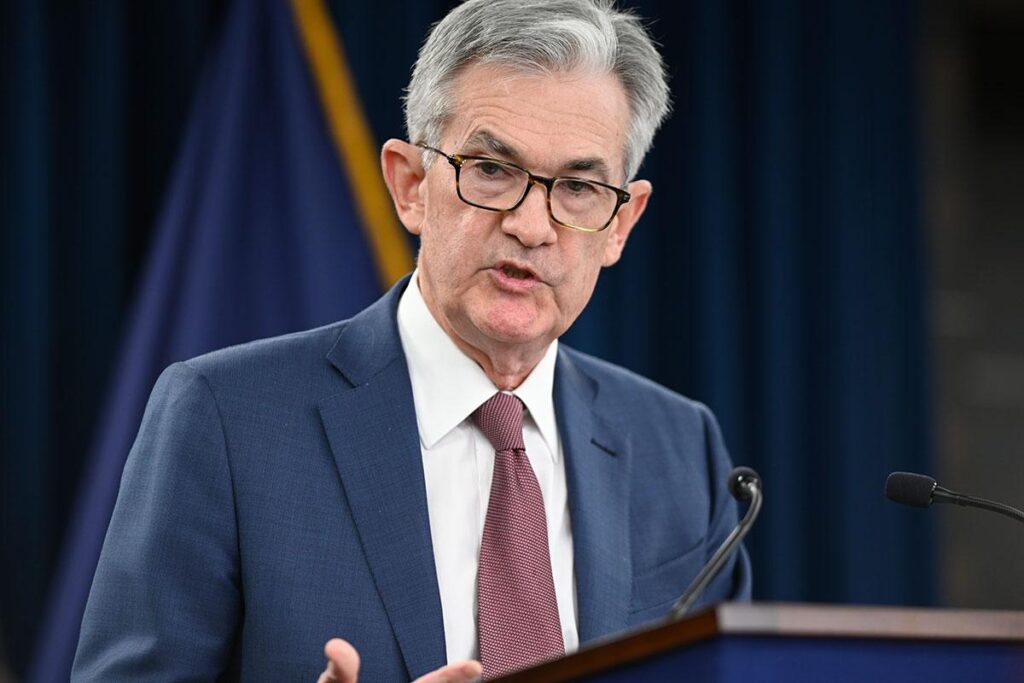
Federal Reserve Chair Jerome Powell signaled a potential shift in monetary policy Friday, suggesting that a slowing job market may outweigh concerns over inflation. His comments, delivered at the central bank’s annual symposium in Jackson Hole, Wyoming, have fueled expectations that the Fed could cut interest rates as soon as its next meeting, sparking a rally in equities.
A Different Backdrop From Last Year
A year ago at Jackson Hole, Powell’s message was straightforward and market-friendly. Inflation was easing, job growth was slowing, and the unemployment rate was rising at a pace that traditionally signals recession. After hiking its key interest rate to a 23-year high to fight a pandemic-induced inflation spike, Powell told his audience the Fed was poised to begin lowering rates. Stocks surged in response.
This year, however, the picture is far more muddled. Inflation remains above the Fed’s target, even as job creation has slowed sharply. Economists are split over whether Powell will telegraph a likely rate decrease in September or maintain the central bank’s cautious wait-and-see approach.
Minutes of the Fed’s July 29-30 meeting underscored that divide, showing that most officials still regard high inflation — not a weak labor market — as the larger risk.
According to Bloomberg, “…a majority of the 18 policymakers… judged the upside risk to inflation as the greater of these two risks.”
Some dissenting members (namely Governors Waller and Bowman) prioritized labor market weakness, but they were in the minority.
Signs of Weakness in the Labor Market
The jobs picture has darkened considerably over the summer. Employers added just 73,000 jobs in July, significantly below forecasts, and prior gains for May and June were revised down by a combined 258,000. The revisions left job growth averaging a meager 35,000 per month over the last three months. The unemployment rate rose from 4.1% to 4.2% — still low by historical standards but drifting higher.
That softness has futures markets betting heavily that the Fed will move in September. As of mid-August, CME FedWatch assigned an 84.4% probability to a quarter-point cut, reflecting a growing consensus that the central bank must step in to cushion the economy.
Powell himself acknowledged the risks, noting that the labor market shows “a curious kind of balance that results from a marked slowing in both the supply of and demand for workers.” He warned that if those risks materialize, “they can do so quickly in the form of sharply higher layoffs and rising unemployment.”
Balancing Inflation and Growth
The Fed chair’s remarks come after months of holding policy steady while waiting to assess the effects of tariffs and earlier rate moves. While Powell was clear that the Fed is ready to act if the labor market deteriorates further, he also tempered expectations of an aggressive series of cuts by pointing to inflation concerns.
He noted that “the effects that tariffs are having on consumer prices are now clearly visible” and likely to accumulate. The key question for the Fed, he said, is whether those increases will “materially raise the risk of an ongoing inflation problem.”
Powell voiced greater confidence than before that tariff-driven price hikes would not create a lasting inflation spiral, describing them as a “one-time” increase that would take time to filter through supply chains. And given that the labor market is not particularly tight, he suggested the risk of wage-driven inflation is low.
Still, inflation data offers mixed signals. Overall consumer prices held steady last month at 2.7%, but the Fed’s preferred core measure ticked up from 2.9% to 3.1%. Some economists see that as a warning sign that inflationary pressures could reaccelerate as tariffs continue driving up input costs across supply chains.
Austan Goolsbee, president of the Chicago Fed and typically considered dovish, said he was concerned about “big price increases in categories such as airfares and dental services that may reflect a more fundamental and persistent inflation rise.” Others, like David Seif of Nomura, argue that “we don’t see any real sign of tariff-induced inflation” and that the Fed now has room to ease.
Market Response
Wall Street responded swiftly to Powell’s shift, unleashing a broad rally across asset classes. The Dow Jones Industrial Average jumped more than 900 points, a gain of 2.01%, while the Nasdaq Composite surged 413 points, or 1.96%. The S&P 500 added over 100 points (+1.61%), and the small-cap Russell 2000 led the way with an outsized 3.74% advance.
Other indexes echoed the optimism: the DJ Transportation Average climbed 3.18%, the S&P MidCap 400 gained 2.81%, and the NYSE Composite added 1.62%. Meanwhile, volatility collapsed, with the CBOE VIX tumbling more than 12%, reflecting investor confidence that the Fed will soon move to cushion growth.
Markets had already been showing signs of optimism in recent weeks, but Powell’s words poured fuel on the rally. Investors interpreted his message as a clear signal that the Fed is preparing to act decisively if economic conditions deteriorate further.
The chair’s careful balance — acknowledging both inflation risks and labor market fragility — gave traders confidence that the central bank will step in to protect growth without letting prices spiral.
A Standing Ovation, and a Legacy in Focus
Powell’s remarks carried additional weight because of their setting and timing. His speech came before an audience of central bankers, economists, and international peers gathered in Grand Teton National Park. Multiple sources reported Powell received a standing ovation from both colleagues and former policymakers in attendance.
The reception underscored how Powell has navigated one of the most complex economic environments in recent memory — balancing inflation, growth, and credibility. With his term as chair set to expire next May, his Jackson Hole comments may come to define the final chapter of his tenure.
Proceeding Carefully
Powell emphasized that the Fed would remain vigilant about inflation expectations, a critical anchor for long-term price stability. “Come what may, we will not allow a one-time increase in the price level to become an ongoing inflation problem,” he said.
At the same time, he left no doubt that the Fed stands ready to act if conditions worsen. “The upshot is that the risk of higher inflation, even if temporary, and a softening in the labor market puts the Fed in a challenging situation,” Powell said.
Because the Fed already lowered rates by a full percentage point compared with last year, Powell said the current setting is “somewhat less restrictive” and allows policymakers to “proceed carefully as we consider changes to our policy stance.”
Still, the combination of a cooling labor market and an economy weighed down by tariffs may force the Fed’s hand. As Powell concluded, “the combination of a still-restrictive interest-rate stance given the changing economic outlook may warrant adjusting our policy stance.”
A Shift in the Fed’s Framework
Beyond the immediate rate-cut debate, Powell is also expected to signal a broader policy shift. In 2020, the Fed adopted a flexible framework that allowed inflation to run moderately above 2% for a period of time to make up for past undershooting. That framework gave the central bank more leeway to prioritize job gains, particularly for lower-income and minority workers.
But critics argue that the willingness to let inflation run hotter contributed to the post-COVID price surge. With inflation still running above target, Powell is expected to return to a stricter 2% goal, once again treating deviations on either side as problematic. The shift would mark a reversal of one of the most significant changes in Fed strategy in recent decades.
The Road Ahead
For markets, the message was clear: the era of “higher for longer” may be nearing its end. Investors, who had been anxiously watching inflation data and jobs reports, now see growing evidence that the Fed will cut rates to cushion the economy.
While Powell stopped short of promising an aggressive cutting cycle, his remarks suggest that the central bank is preparing to act more swiftly than before. If labor market data shows further weakness in the coming weeks, the Fed may use its September meeting to deliver the first of what could be several adjustments.
For now, markets appear to be betting that Powell will follow through. The run-up in stocks reflects renewed confidence that the Fed is willing to protect growth, even in the face of lingering inflation risks. With indexes across the board rallying on Powell’s remarks — and volatility falling sharply — the market appears to be pre-positioning for a September rate cut.
READ NEXT: Unstable Leader Pushes Reckless Nuclear Gamble

















I don’t know why the Fed is stuck on a 2% inflation rate since the average inflation rate over the last 100 years has been 3.27 to 3.29%.
My thinking is that Powell might have already reduced rates had it not been for Trump’s constant haranguing.