

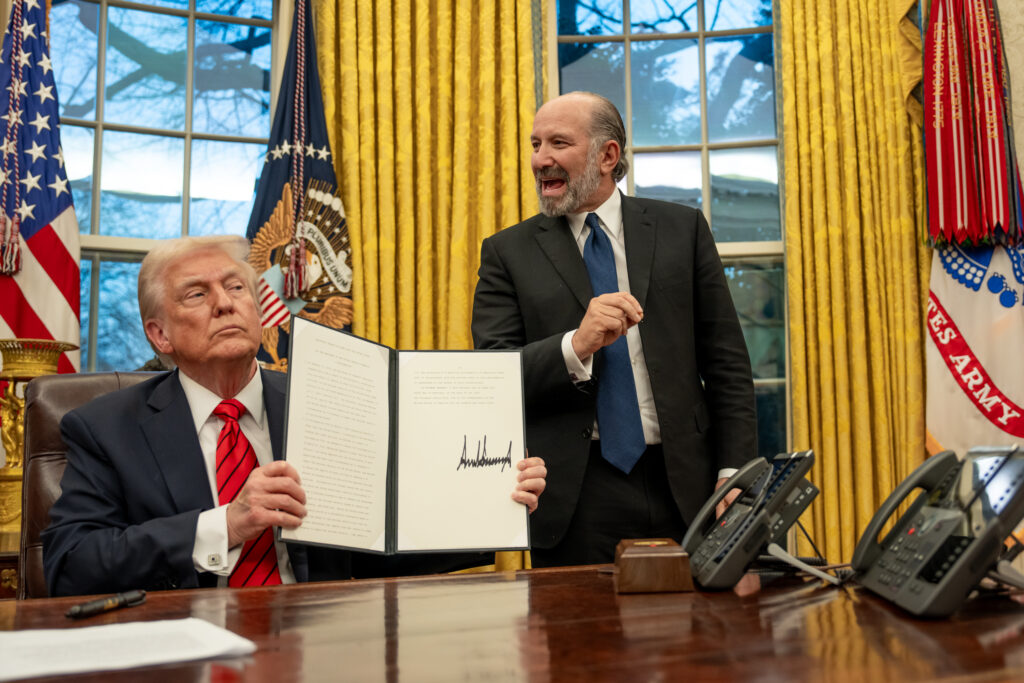
Suppose a man pays himself to dig a hole and fill it back in. He labors. He earns. Money changes hands. Yet, though activity occurred, has anything of economic value been created? This is the central paradox animating Secretary of Commerce Howard Lutnick’s proposed reform to Gross Domestic Product (GDP). By excluding non-productive government spending from GDP calculations, Lutnick is not merely fiddling with an economic dial; he is challenging the epistemology of growth itself. And he is right to do so.
Currently, GDP includes virtually all government expenditures, regardless of their utility. It makes no distinction between spending on highways and spending on bureaucrats who produce neither roads nor ideas. Under the expenditure approach (GDP = C + I + G + NX), the “G” component counts as economic output regardless of whether it funds infrastructure or idle administrative meetings. Lutnick’s insight is devastatingly simple: not all government spending constitutes production. Recognizing this forces us to abandon the fiction that all dollars spent by the state are inherently virtuous or growth-inducing.
Predictably, opponents cry foul. They warn that redefining GDP will erode investor confidence, complicate international comparisons or become a political tool. Some even invoke Keynes, arguing that government spending is a stabilizing force during downturns. But these objections confuse the map for the territory. GDP is not reality itself; it is a tool. And like any instrument, it must be judged by whether it serves its purpose: to reflect economic vitality.
Consider this: If a family cuts its cable subscription, has it grown poorer? On the contrary, it may be optimizing. Similarly, when a government trims wasteful programs, the economy does not necessarily shrink—except under the old GDP model, which treats every dollar spent as sacrosanct. Lutnick’s reform corrects this distortion. It decouples the illusion of growth from the mere act of spending, allowing policymakers to make cuts without conjuring recessionary shadows.
The practical implications are profound. Imagine a GDP that distinguishes between the construction of a bridge and the convening of yet another DEI symposium. Under Lutnick’s plan, only the former would be counted. This not only clarifies what constitutes real economic value but also emboldens policymakers to pursue fiscal discipline without fear of being labeled as anti-growth. The reform is as much about public psychology as it is about statistics.
Some will object that defining “non-productive” is too subjective. And yes, drawing lines between productive and non-productive expenditures invites disagreement. Is basic research productive? What about welfare programs or military R&D? But complexity is not a sufficient reason for inertia. We already distinguish between public and private investment, between fixed capital formation and consumption. Economists routinely disaggregate data to refine insight. The burden is not to avoid subjectivity altogether, but to manage it transparently and rigorously.
Critics point to the figure Lutnick proposes—25% of current GDP as non-productive—and scoff. But this protest is rhetorical rather than substantive. If total government spending hovers around 35-40% of GDP, and much of it is devoted to transfers, administration, or regulatory compliance, then the estimate is plausible. The real issue is not the number itself, but the principle: Should GDP measure what is produced, or what is spent?
Take a thought experiment. Imagine two nations: Atlantis and Borealia. Atlantis spends lavishly on committees, consultations and conferences. Borealia invests in ports, roads and semiconductors. Under the current GDP measure, both might report similar growth. Under Lutnick’s revised measure, Borealia would emerge as the true engine of prosperity. In other words, Lutnick restores economic measurement to its moral purpose: to illuminate genuine progress, not to flatter political appetites.
Detractors might also worry about global comparability. If America changes how it calculates GDP while others do not, won’t we appear weaker? Perhaps, but only to the lazy observer. Transparency trumps conformity. If America clearly states both its traditional and revised GDP figures, investors and allies can adjust. Indeed, publishing both metrics for 20 years, as Lutnick proposes, offers an elegant solution. It transitions the world gradually, inviting others to follow rather than forcing immediate compliance.
More subtly, Lutnick’s proposal strikes at the heart of the modern technocratic conceit: that the state, by expanding its fiscal footprint, can manufacture prosperity. For decades, GDP growth has been used to justify sprawling bureaucracies and endless subsidies. By redefining growth to exclude what does not, in fact, grow anything, Lutnick delivers a philosophical rebuke to the managerial state. He asserts that real wealth arises from enterprise, not entitlement.
This echoes older American ideals. Jefferson understood the difference between activity and productivity. Hamilton, for all his statist leanings, knew that wealth required manufactures and trade, not just taxes and tithes. In a more recent era, Reagan argued that government is not the solution to our problem; government is the problem. Lutnick operationalizes this maxim, carving it into the metrics by which we understand ourselves.
Of course, care must be taken. The process must be methodical, with independent panels defining productivity in ways that transcend partisan bias. We must protect against the temptation to label all disfavored programs as “non-productive.” But these are implementation details, not reasons to reject the concept. Transparency, peer review and open data can keep the reform grounded.
Moreover, this is not a denial of the state’s role. It is a recalibration. Government can fund defense, education, infrastructure—and such expenditures should remain in GDP if they demonstrably produce value. What Lutnick targets is the spending that props up apparatchiks, consultants and sinecures. He aims to tell the truth about our economy, even if it offends the bureaucratic class.
Ultimately, GDP is not scripture. It is a convention. Like any convention, it must evolve. In an age where the federal government can conjure trillions with a keystroke, we must ask whether economic metrics built for the 20th century still serve us. Lutnick’s proposal is an act of epistemic hygiene. It purifies our numbers, aligns them with reality, and empowers reform.
No doubt the plan will be misrepresented—as anti-science, anti-poor, anti-government. But its true character is anti-fraud. It declares that digging holes and filling them in again, metaphorically or literally, is not growth. It is waste. And it is time our national accounting said so.
Sponsored by the John Milton Freedom Foundation, a nonprofit dedicated to helping independent journalists overcome formidable challenges in today’s media landscape and bring crucial stories to you.
READ NEXT: The ‘Secret’ Team Trump App: Why It’s DC’s Hottest Insider Tool




















Then wheres Congress on this??
No action seen
Cleaning up accounting for the government is an excellent idea. Eliminate what is not necessary and redefine what is. As an accountant and retired CPA, BSA, Programmer I would add not to eliminate the areas defined as unnecessary for a period of at least a year to assure that category really is unnecessary. Too many times in the zeal to clean and eliminate unnecessary items one finds there is that once in a while expense or income that was basically so rare those new to the process had no knowledge of them. So patience in accounting sometimes is a virtue not a liability when your are updating the accounting process for any entity. After more that forty years I would encourage patience in the cleanup!
Logical. Flawlessly logical!