

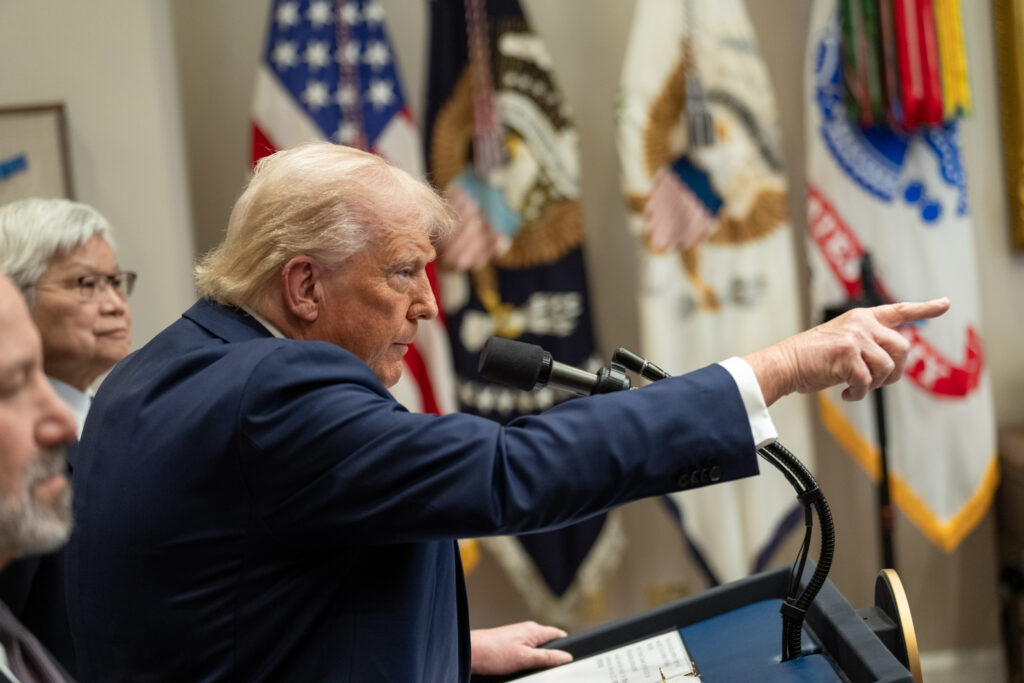
The Wall Street Journal (WSJ) has issued an editorial urging legal action to prevent President Donald Trump from imposing tariffs on Canada and Mexico, claiming that he does not possess the authority to do so without congressional approval. The newspaper, which has been more neutral in its coverage of Trump than its peers, has expressed firm opposition to Trump’s tariff strategy, arguing that the tariffs would harm the North American economy and lead to higher consumer prices.
In its editorial, the WSJ criticized Trump’s use of the International Emergency Economic Powers Act (IEEPA), a 48-year-old law that grants the president the authority to regulate imports and exports during a declared national emergency. The WSJ argues that Trump’s imposition of tariffs on Canada and Mexico does not qualify under the emergency provisions of the law, and that such significant economic measures should be authorized by Congress rather than carried out unilaterally by the executive branch.
The editorial board insists that Trump’s attempt to use IEEPA to impose tariffs was a “fundamental revision” of the statute and went far beyond the law’s intended scope. Originally, the IEEPA was designed to allow the president to regulate imports and exports in response to “unusual or extraordinary threats” to national security. Trump justified his tariff decision by citing the flow of fentanyl and other drugs across the U.S.-Mexico border, declaring it a national emergency. However, the WSJ argued that there was no evidence of a significant increase in drug trafficking compared to past decades to justify an emergency declaration.
The WSJ also reasons that the IEEPA was never intended to give the president sweeping tariff powers, and that the law instead allows the president to block, regulate, or prohibit imports and exports that are tied to foreign threats or actions. Tariffs, as the WSJ highlights, are not explicitly mentioned in the IEEPA, bringing into question whether Trump’s actions were legally justified.
The Wall Street Journal’s editorial detailed the history of how presidents have used the IEEPA in the past, including the use of sanctions, freezing assets, and restricting trade with hostile nations. However, it emphasized that no U.S. president has ever used the law to impose tariffs without congressional approval. They pointed to Joe Biden imposing sanctions on Russia after its invasion of Ukraine in 2022, but refraining from using the IEEPA to impose tariffs and instead sought Congressional approval.
The editorial concluded by urging that Trump’s tariff plan should be challenged in court. It emphasized that if Trump is allowed to impose tariffs unilaterally, it would set a dangerous precedent for future presidents, whether Democratic or Republican. The WSJ warned that a future Democratic president could exploit the same emergency powers to impose tariffs or take other unilateral actions on issues like climate change or social policy, bypassing Congressional oversight.
The editorial board raised concerns about the broader implications of expanding executive powers through emergency declarations, pointing to other instances in which presidents have tried to bypass Congress, such as Biden’s attempts to impose COVID-19 vaccine mandates, eviction moratoriums, and student loan forgiveness—all of which were blocked by the Supreme Court.
READ NEXT: Wall Street Journal Editor Confronts MSNBC Host With His Hypocrisy

















I agree with this WSJ article. Trump has exceeded his powers regarding the tariffs. I am very concerned about the separation of powers issue in his regime generally, even though I like much of what has transpired so far especially re the border.
Really – Canada and China has tariffs on us. Wall Street Journal is out of line – there is no were in the US CONSTITUTION that says that. We do not have fair trade – I remember Reagan did the same thing.
Unsubscribe from WSJ, scrap it