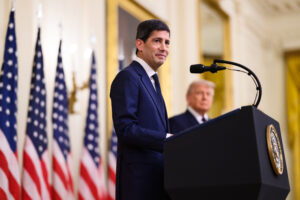
President Donald Trump announced Friday that he intends to nominate former Federal Reserve Governor Kevin Warsh as the next chairman of the Federal Reserve, setting the stage for a high-profile return to the central bank for one of its most outspoken critics of recent monetary policy.
“I have known Kevin for a long period of time, and have no doubt that he will go down as one of the GREAT Fed Chairmen, maybe the best,” Trump wrote on Truth Social. “On top of everything else, he is ‘central casting,’ and he will never let you down.”
Warsh, 55, is expected to succeed current Fed Chairman Jerome Powell when Powell’s term expires in May, pending Senate confirmation. A lawyer by training, Warsh would become the second attorney in a row to lead the central bank. He previously served on the Fed’s Board of Governors from 2006 to 2011 and has advised Trump on economic policy in recent years.
The nomination marks a political and professional comeback for Warsh, who was widely considered for the Fed’s top job during Trump’s first term but ultimately passed over in favor of Powell. Since leaving the Fed, Warsh has emerged as one of the most prominent and persistent critics of the central bank’s balance-sheet expansion, low-interest-rate policies, and internal culture.
Appointed by President George W. Bush in 2006 at just 35 years old, Warsh became the youngest Fed governor in history. During the 2008 financial crisis, he played a key behind-the-scenes role as a liaison between the Fed, Wall Street executives, and Republican lawmakers. According to reporting from The Wall Street Journal, Warsh’s influence during the crisis was such that Fed staffers often asked, “Have you run it by Warsh?” before advancing key decisions.
Warsh resigned from the Fed in 2011 shortly after the central bank launched a second round of large-scale bond purchases. In the years that followed, he became an outspoken opponent of quantitative easing and the Fed’s growing balance sheet, warning that prolonged emergency measures would distort markets and eventually fuel inflation.
In a 2021 Wall Street Journal op-ed, Warsh cautioned that the Fed was “sowing the seeds of inflation” by continuing to purchase Treasurys and mortgage-backed securities long after the crisis had passed. “The Fed should declare victory over the crisis and begin to unwind its extraordinary interventions before they sow the seeds of the next one,” he wrote. Those warnings gained credibility as inflation surged in 2022 and 2023, forcing the Fed into one of the most aggressive tightening cycles in decades.
Warsh has placed reform of the Fed’s roughly $6.6 trillion asset portfolio at the center of his monetary vision. He has argued that shrinking the balance sheet more aggressively would give the Fed greater flexibility on interest rates while restoring a more neutral role in financial markets. He has also called for a clearer division between monetary and fiscal policy to protect the Fed’s independence.
Despite his criticism of Powell-era policies, Warsh has long defended the principle of central bank autonomy. In a 2010 speech titled “Ode to Independence,” he warned that governments are often tempted to pressure central banks into keeping monetary policy loose to help finance public debt. He has also cautioned that the Fed risks undermining its own independence when it strays beyond its narrow mandate of price stability and maximum employment.
Warsh will take over a Federal Reserve grappling with internal divisions. The Fed cut interest rates three times in late 2025 but left them unchanged this week at a range of 3.5% to 3.75%. Some policymakers remain wary of further cuts with inflation still above the Fed’s 2% target, while others argue that easing is necessary amid signs of labor-market weakness.
He has criticized what he calls “groupthink of the guild” inside the Fed and urged reforms to encourage more rigorous debate among policymakers. Warsh has also questioned the central bank’s reliance on abstract economic models, including the so-called neutral interest rate, warning against policy decisions driven by unobservable assumptions.
His confirmation, however, may face obstacles. A recently launched Department of Justice probe into the Fed related to Powell’s 2025 congressional testimony has prompted some Republican senators to threaten to block new Fed appointments. Sen. Thom Tillis (R-NC) said Friday he will oppose Warsh’s confirmation until the investigation is resolved.
Warsh emerged as Trump’s pick after reportedly beating out contenders including White House National Economic Council Director Kevin Hassett, Fed Governor Christopher Waller, and BlackRock executive Rick Rieder.
He is married to Jane Lauder, granddaughter of Estée Lauder and daughter of Republican donor Ronald Lauder, a longtime Trump associate. Since leaving the Fed, Warsh has been affiliated with Stanford University’s Hoover Institution, served on the board of United Parcel Service, and advised prominent hedge fund manager Stanley Druckenmiller.
If confirmed, Warsh will confront a complex economic landscape marked by lingering inflation pressures, shifting trade policy, the rise of artificial intelligence, and the growing influence of digital currencies. While the Fed chair wields significant influence, Warsh will need to build consensus within a divided Federal Open Market Committee as he seeks to implement his vision for a leaner, more disciplined central bank.
READ NEXT: Trump Should Name His Fed Chair Replacement Now, Not Later