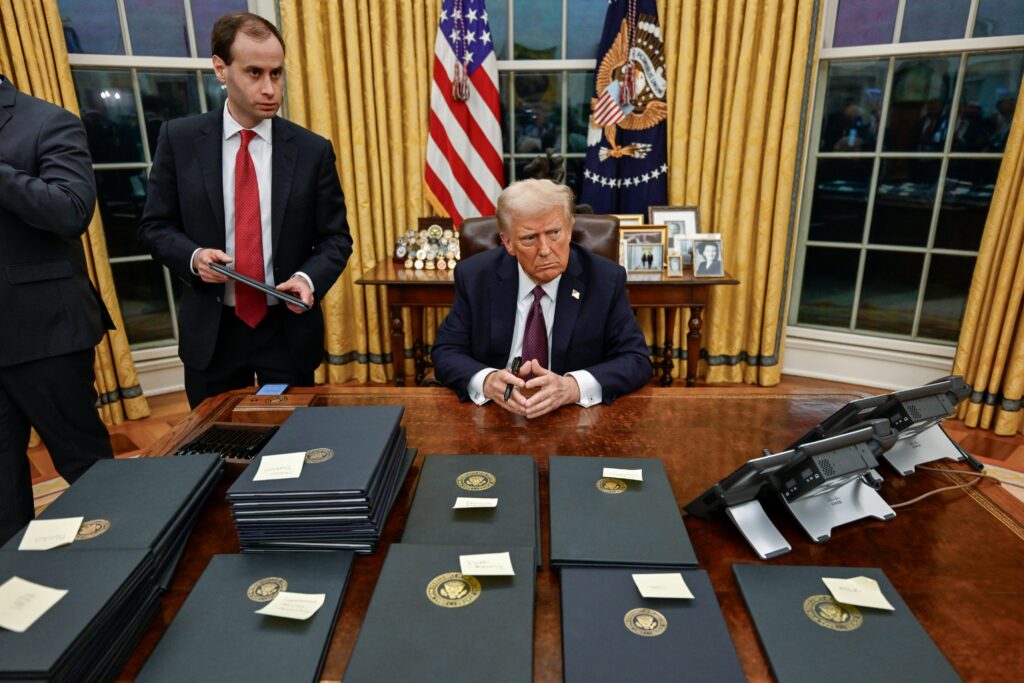
WASHINGTON, D.C. — President Donald Trump has directed federal agencies to study the implementation of reciprocal tariffs on U.S. trade partners, signaling a push for more balanced trade relationships but stopping short of immediate enforcement.
President @realDonaldTrump announces RECIPROCAL TARRIFFS! 🇺🇸 pic.twitter.com/3gdw11RkC6
— Margo Martin (@MargoMartin47) February 13, 2025
The Wall Street Journal reported that Trump “signed a memo on reciprocal trade, directing federal agencies to study how to adjust U.S. tariff rates to match the duties and certain economic barriers enforced by other nations.”
The order stops short of actually imposing the tariffs immediately, as many foreign capitals feared, and instead directs the Commerce Department and U.S. trade representative to deliver reports on the steps to be taken to achieve reciprocal trading status.
What Are Reciprocal Tariffs?
The concept behind reciprocal tariffs is straightforward: if a country imposes tariffs on U.S. exports, the U.S. would match those tariffs on imports from that country. The goal, according to Trump, is to create a level playing field in international trade.
Speaking from the Oval Office, Trump reinforced his stance:
“No more, no less. In other words, they charge us a tax or tariff, and we charge them the exact same tax or tariff.”
While the president has long criticized trade imbalances, this latest move suggests his administration is weighing policy changes without rushing into immediate action.
A Historical Precedent: The Reciprocal Tariff Act
Trump’s push for reciprocity echoes principles established in the Reciprocal Tariff Act (RTAA) of 1934, signed into law by President Franklin D. Roosevelt. Enacted during the Great Depression, the RTAA allowed the executive branch to negotiate bilateral trade agreements aimed at reducing tariffs by up to 50% in exchange for similar concessions from trading partners.
The law was a direct response to the Smoot-Hawley Tariff Act of 1930, which had raised U.S. tariffs and contributed to a sharp decline in global trade. By shifting some trade authority from Congress to the president, the RTAA sought to foster mutually beneficial agreements and prevent trade wars.
What Comes Next?
While Trump has not yet implemented new tariffs under this framework, his directive signals a potential shift toward more aggressive trade policies. Whether the administration will take action in the coming months depends on the findings of the federal review—and on the response from U.S. trading partners.
READ NEXT: Senate Democrat Blows 2026 Race WIDE OPEN With Abrupt Announcement