

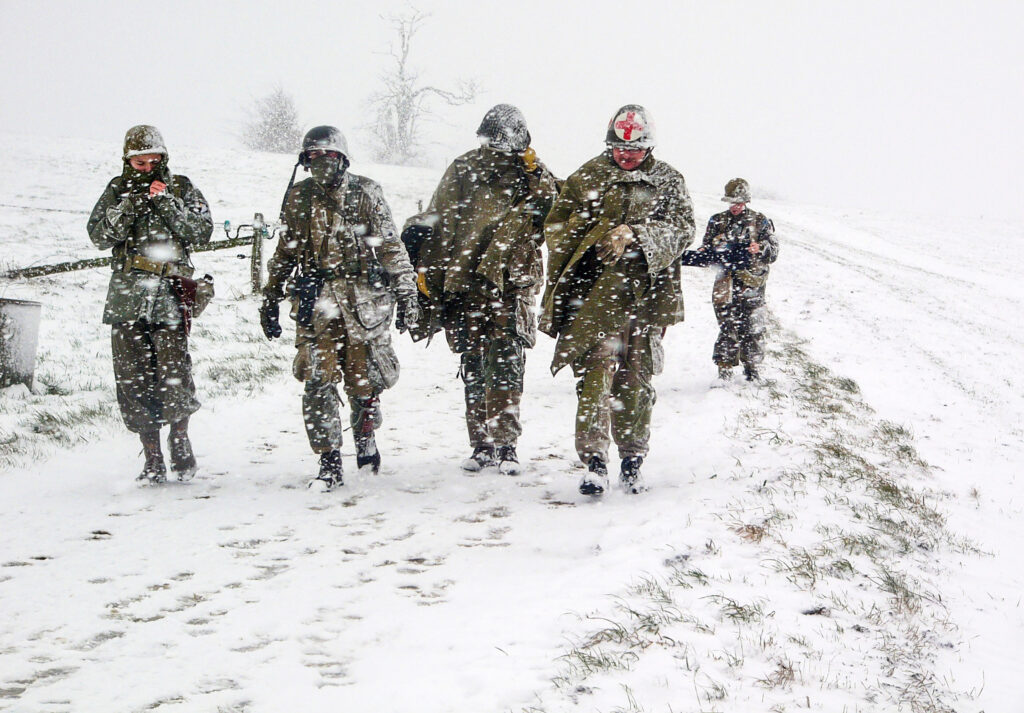
At a pivotal moment in the Battle of the Bulge, General George S. Patton’s Third Army faced a daunting challenge: the race to relieve the encircled 101st Airborne Division in Bastogne, Belgium. Bastogne was more than just a Belgian town in the rugged Ardennes Forest; it was a critical crossroads whose control was essential to Germany’s ambitious goal in Operation Wacht am Rhein: the seizure of the Port of Antwerp. Securing Antwerp would have split Anglo-American forces and disrupted their ability to counterattack.
The situation in Bastogne was dire. Outnumbered nine-to-one in critical sectors, the American defenders were battered, low on supplies and teetering on the brink of collapse. Their resources, including food and ammunition, were nearly exhausted. Yet they held firm, delaying the Wehrmacht’s advance in freezing, punishing conditions. Could they have held out much longer against German armor without Patton’s intervention? It’s uncertain, but the cost in lives would have been immense.
Adding to the defenders’ plight, the Allies had temporarily lost their air superiority due to relentless wintry weather. Heavy fog, snow and icy rain grounded the Allied air force, allowing German forces to press their advantage. These unfavorable conditions had been integral to Germany’s initial success in the Ardennes, shielding their columns from the devastating power of Allied fighter-bombers.
Amid this crisis, Patton turned to an unconventional weapon: prayer. He asked Rev. Msgr. James Hugh O’Neill, the Third Army’s chaplain, to compose a prayer for better weather. O’Neill delivered the now-famous “Weather Prayer,” which Patton had printed and distributed to every soldier under his command. It read:
“Almighty and most merciful Father, we humbly beseech Thee, of Thy great goodness, to restrain these immoderate rains with which we have had to contend. Grant us fair weather for Battle. Graciously hearken to us as soldiers who call Thee that, armed with Thy power, we may advance from victory to victory, and crush the oppression and wickedness of our enemies, and establish Thy justice among men and nations. Amen.”
On the reverse side of the prayer card, Patton added a personal Christmas message:
“To each officer and soldier in the Third United States Army, I wish a Merry Christmas. I have full confidence in your courage, devotion to duty, and skill in battle. We march in our might to complete victory. May God’s blessings rest upon each of you on this Christmas Day. — G.S. Patton, Jr., Lieutenant General, Commanding, Third United States Army.”
What happened next has become the stuff of legend. The 1970 film Patton depicts an almost immediate response to the prayer: clearing skies that allowed Allied aircraft to unleash a devastating barrage on German forces, forcing their armored units into the woods and crippling their ability to push toward the Meuse River. Historical accounts, however, paint a more nuanced picture. While the weather did improve shortly after the prayer, the battle’s outcome had already begun to turn due to the sheer resilience of the American forces at towns like Bastogne and Saint Vith as well as the redeployment of Patton’s Third Army.
Ultimately, the combination of Patton’s relentless leadership, the tenacity of the American defenders and the clearing skies sealed Germany’s fate in the Ardennes. The advance faltered, and the Allies regained the strategic initiative, never to lose it again. The prayer itself became a symbol of hope, faith and determination in the face of overwhelming odds—a reminder that even in the darkest moments, belief can inspire victory.
READ NEXT: Shocker! Sleepy Joe Makes Dumbfounding Call To Expand Key Constitutional Right















Prayer for Clearing skies for Allies