

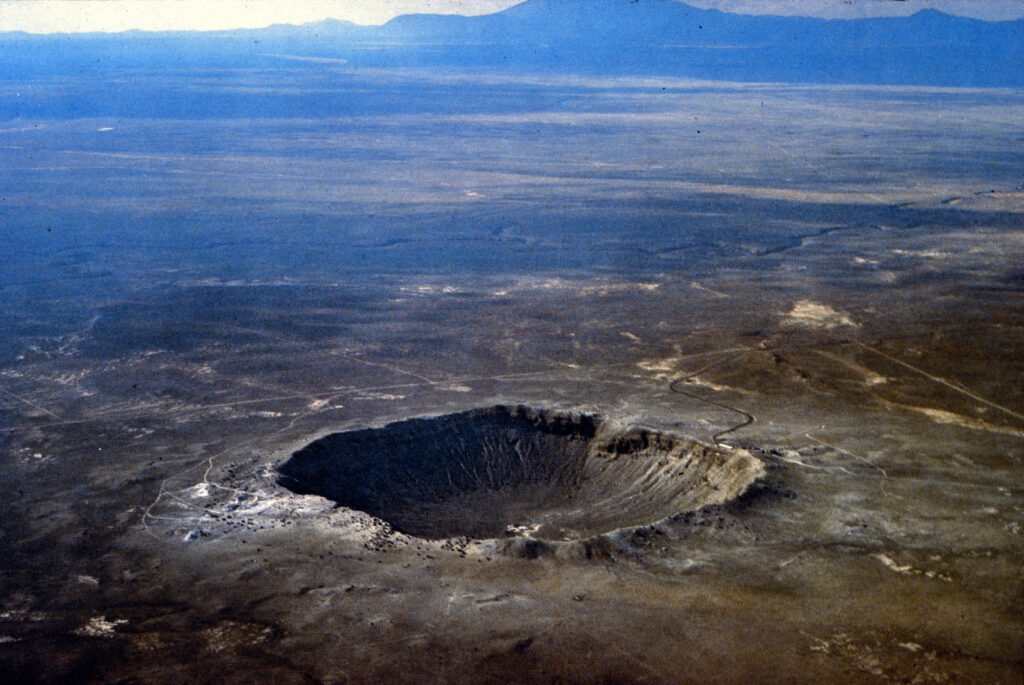
And the odds that it will hit us just went up, according to NASA. An asteroid impact greater in magnitude than the massive Tunguska event, that flattened 80 million trees across 1,336 square miles of Siberia in 1908, could strike the Earth in 2032.
Despite exploding in the air, that impact was equivalent to detonating 50 million tons of TNT.
NASA’s Asteroid Terrestrial-impact Last Alert System (ATLAS) in Chile discovered the new “mansion-sized” asteroid, named 2024 YR4, on December 27, 2024.
If Earth were to be hit by YR4, the blast would be equivalent to eight megatons of TNT, roughly 500 times the power of the atomic bombs dropped on Hiroshima and Nagasaki during WWII.
Since “it’s probably a stony asteroid, a bunch of bits of other things that have slowly coalesced together,” former Canadian astronaut Chris Hadfield told the New York Post that this asteroid would likely hit Earth in pieces rather than in its entirety—meaning multiple impacts.
Depending on the size of the fragments, each could cause devastating shockwaves that would flatten entire cities.
There is also a possibility that the asteroid could explode in mid-air similar to the 1908 Tunguska impact.
Measuring somewhere between 131 and 295 feet wide, YR4 is currently speeding away from Earth at 30,000 miles per hour but will be back for a near-Earth flyby in around four years when it currently has a 3.1% chance of smacking Earth in December 2032, says NASA.
Those odds are nearly two times higher than when it first cropped up on the space agency’s radar just three months ago.
As the asteroid’s chances of hitting Earth climbed, well-known Astrophysicist Neil deGrasse Tyson took to X to advise against defunding science programs that could be vital to protect against the potentially catastrophic space rock.
At the moment, mansion-sized Asteroid 2024-YR4 has a one-in-fifty chance of hitting Earth in the next eight years.
— Neil deGrasse Tyson (@neiltyson) February 15, 2025
Now might be a bad time to reduce spending on Science. Just sayin’. pic.twitter.com/hzmIjEJRBr
According to NASA’s Center for Near Earth Object Studies, 2024 YR4 has a chance of colliding with our planet at 1400 GMT on Wednesday, Dec 22, 2032—possibly striking a narrow corridor that spans eight of the world’s most populated cities—including Bogota in Colombia, Lagos in Nigeria, Yaoundé in Cameroon and Mumbai and Chennai in India—with the total at-risk population totally upwards of 110 million people.

The asteroid ranks as a ‘three’ on the Torino Impact Hazard Scale, indicating a ‘close encounter’ that merits attention from astronomers because there is a 1% or greater chance of deep impact in the next decade from a NEO (Near Earth Object) that measures over 65 feet in diameter.
The only asteroid ever to receive a higher rating is Apophis, which rated a four on the Torino scale but was later downgraded as it poses no threat for at least a century.
The New York Post reported:
The [US] space agency [NASA] claimed that the dangerous space rock now has a 1-in-38, or 2.6%, chance of hitting home — the highest probability of a collision yet…
When the asteroid was initially discovered in December 2024, the odds of a strike clocked in at 1-in-83, before increasing to 1-in-67, to 1-in-53, to 1-in-43 and now, the current frightening figure. Meanwhile, the European Space Agency’s odds are slightly lower at around 2.4%.
NASA has recently updated the impact probability of asteroid 2024 YR4, estimating a 3.1% (or 1-in-32) chance of collision with Earth, making it the most dangerous one monitored by contemporary forecasts.
Fortunately, experts say we don’t have to worry just yet since the odds could come back down in the future.
“Just because it’s gone up in the last week, doesn’t mean that it’s going to continue to do that,” assured Hugh Lewis, a professor of astronautics at the University of Southampton, U.K.
“YR4 could still be ruled out as an impact hazard, as has happened with many other objects that have previously appeared on NASA’s asteroid risk list,” seconded NASA’s Molly L Wasser in a blog post. “It is also possible its impact probability will continue to rise.”
But even if this asteroid is heading toward Earth, there is hope for planetary defense.
According to a separate piece in the New York Post:
Thankfully, NASA has a developmental asteroid repellant of its own called the Double Asteroid Redirection Test.
In September 2022, the space agency used a spacecraft to alter an asteroid’s orbit by letting it collide with the space rock. It was the first test of the kinetic impactor technique, which could be used to force asteroids on a different path in the future.
“If you [hit] it early enough, then a tiny angular change will cause it to miss the Earth. At least we know that we’re capable of saving the Earth,” Hadfield said.
READ NEXT: Trump Stages Unexpected Intervention Ahead Of Foreign Ally’s Potential Imprisonment


















I find it very interesting that this story just comes out in the wake of Doge possibility looking at NASA.