

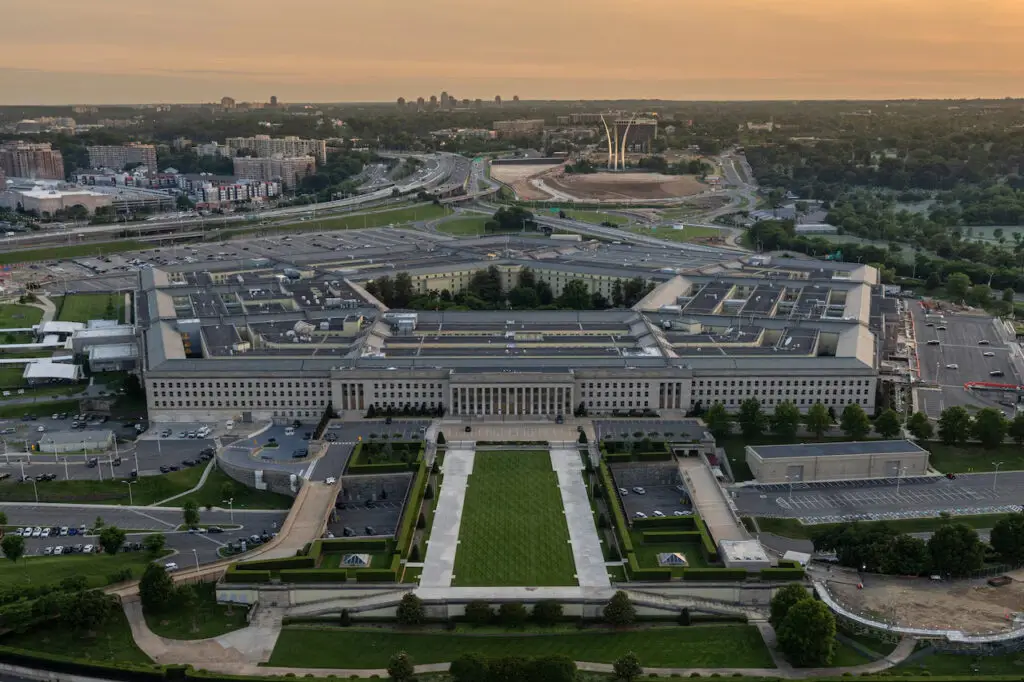
In a shocking undercover investigation, Jamie Mannina, a former FBI Special Agent and Pentagon advisor to the Joint Chiefs of Staff, disclosed a series of covert efforts aimed at influencing public perception and undermining the presidency of Donald Trump. The revelations, made during private conversations captured by O’Keefe Media Group investigative journalists, highlight a network of retired military leaders and insiders working behind the scenes to counteract the Trump administration, even at the highest levels of government.
Mannina, who served as an advisor within the Pentagon’s Joint Chiefs of Staff, admitted to working with retired generals and admirals to develop strategies to limit the impact of Trump’s policies. “I’ve been in conversation with a couple of retired generals to explore what we can do,” he acknowledged during the undercover exchange. These discussions reportedly took place in high-security rooms, such as “The Tank,” a secure space within the Pentagon reserved for critical defense-related deliberations.
The context of these meetings, taking place within the Pentagon’s most secure rooms, adds a layer of intrigue and raises questions about the extent of coordination among top military officials.
Mannina’s efforts went beyond military strategy, extending into the realm of public perception and political advocacy. He acknowledged his role as a “ghostwriter” for the National Security Leaders for America, a 501(c)(4) advocacy group aimed at swaying public opinion against Trump. “We tried to explain to the American people the national security consequences of another Trump presidency,” Mannina said, revealing that he contributed to more than 100 op-eds designed to influence the electorate.
The use of ghostwritten op-eds by influential figures within the national security establishment raises serious ethical questions about the intersection of government service, political influence, and media manipulation. While the National Security Leaders for America is a legal advocacy group, the idea of senior officials within the military and intelligence community actively working to shape public opinion against Trump has raised concerns over partisanship and the potential abuse of power.
Following the undercover revelation, the Department of Defense issued a brief response confirming Mannina’s involvement with the Joint Chiefs of Staff. “Yes, he did work [on the Joint Staff],” said Joseph Holstead, a spokesman for the Joint Staff, when asked about Mannina’s role. However, the Department of Defense did not offer further details on the nature of his termination following the undercover investigation.
Holstead did confirm that Mannina, a contractor with Booz Allen Hamilton, had been dismissed, stating, “Yeah, that’s the standard practice with contractors. This is obviously someone speaking out of turn and falsely in public.” The response suggests that the Department of Defense is distancing itself from Mannina’s actions, while also emphasizing the “standard practice” of removing contractors who are seen as violating protocol.
The Pentagon’s focus on security and confidentiality may also make it harder for the public to fully understand the extent to which partisan influences have permeated military and national security operations. As national security concerns become more intertwined with political ones, the line between defense policy and electoral strategy grows increasingly blurred.
While the immediate fallout has been Mannina’s removal from his advisory position, the long-term consequences may include heightened scrutiny of political influence within the Department of Defense and other agencies.
James O’Keefe and O’Keefe Media Group confronted Mannina, a former senior Pentagon advisor and FBI special agent, over his controversial comments regarding efforts to undermine President-elect Donald Trump. The exchange, captured on video, escalated quickly as O’Keefe pressed Mannina about statements he made in hidden camera footage.
The encounter, which took place in Washington, D.C., began with O’Keefe approaching Mannina and confronting him with the undercover footage. The video, which had been released by OMG, appeared to show Mannina discussing political activities that involved retired generals plotting against Trump. As soon as O’Keefe brought up the footage, Mannina became visibly defensive.
“I didn’t say anything,” Mannina repeatedly claimed, despite O’Keefe’s insistence that the video captured his exact words. “You’re on video saying these things,” O’Keefe stated firmly, pointing to the evidence in front of him. However, Mannina continued to deny the accusations, attempting to discredit the footage and deflect responsibility for his statements.
Throughout the tense exchange, O’Keefe remained composed, emphasizing the importance of public transparency and the right of citizens to be informed about the actions of government officials. “There’s a First Amendment in this country,” O’Keefe reminded Mannina, referencing the constitutional rights that protect free speech and the public’s right to know about government activity. Mannina, however, repeatedly claimed that he did not give permission for the footage to be used, trying to downplay the significance of the revelations.
As the confrontation intensified, Mannina resorted to personal attacks, labeling O’Keefe “a known liar” and “a known fraud.” O’Keefe, unfazed, pressed Mannina to clarify what exactly he had lied about, asking him, “What have I lied about?” However, Mannina avoided providing specific examples of any false reporting, instead repeating his personal accusations against O’Keefe. The tension reached a boiling point as Mannina, seemingly unable to defend his actions, made a hasty retreat, leaving the scene to avoid further questioning.
READ NEXT: O’Keefe Undercover: Obama’s Decision On Running For President Revealed