

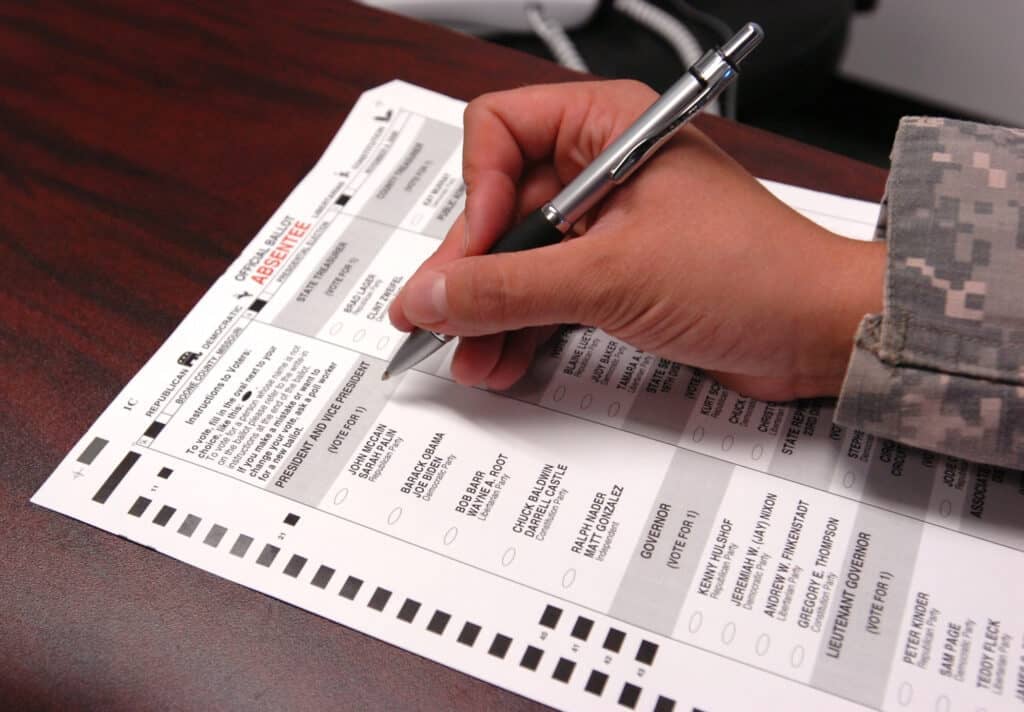
The Supreme Court on Monday dealt a setback to President Donald Trump and the Republican National Committee, ruling 5-4 that states may continue counting mail-in ballots that arrive after Election Day in federal elections, provided they were postmarked by Election Day.
The closely watched decision preserves laws in more than a dozen states that allow election officials to accept ballots for several days after polls close, rejecting Republican arguments that federal law requires every ballot to be received by Election Day.
Justice Amy Coney Barrett authored the majority opinion, joined by Chief Justice John Roberts and the court’s three liberal justices.
“The election-day statutes say nothing about ballot receipt, and we cannot add to the words Congress chose,” Barrett wrote for the court.
Justices Clarence Thomas, Samuel Alito, Neil Gorsuch and Brett Kavanaugh dissented.
The ruling represents a significant legal defeat for Trump, who has spent years criticizing widespread mail voting and arguing that elections should be decided on Election Day rather than through ballots that continue arriving afterward.
Trump has repeatedly maintained that extended ballot-counting periods undermine public confidence in elections, even as election officials in states using the practice have said safeguards such as postmark requirements help ensure legally cast ballots are counted.
The case, Watson v. Republican National Committee, centered on a Mississippi law allowing absentee ballots postmarked by Election Day to arrive up to five business days later and still be counted.
The Republican National Committee and the Libertarian Party of Mississippi challenged the law, arguing that Congress established a single national Election Day for federal races and that ballots arriving after that day should not be included in the final tally. Mississippi Secretary of State Michael Watson, a Republican, defended the law, arguing that voters who cast their ballots on time should not lose their vote because of delays within the U.S. Postal Service.
The Supreme Court ultimately agreed.
Writing for the majority, Barrett concluded that while federal law establishes the day on which voters must cast their ballots, it does not specify when election officials must receive or count those ballots.
“The election-day statutes say nothing about ballot receipt,” she wrote.
The ruling leaves intact similar laws in 14 states, including California, Illinois, Maryland, Massachusetts, New Jersey, New York, Oregon, Virginia and Washington, along with Republican-led Alaska, Mississippi, Nevada, Texas and West Virginia.
Many additional states also allow ballots from military members and Americans living overseas to arrive after Election Day under separate federal laws.
Another Setback For Trump’s Election Agenda
The decision comes as Trump continues pursuing a broad overhaul of federal election policy during his second administration.
Earlier this year, the president signed an executive order directing federal agencies to strengthen voter citizenship verification, tighten standards governing mail voting, and encourage states to adopt stricter election procedures.
That executive order is currently tied up in litigation in multiple federal courts.
Trump’s Justice Department backed the Republican National Committee’s challenge before the Supreme Court, arguing that Congress intended federal elections to conclude on a single Election Day.
Monday’s ruling rejects that interpretation.
The decision also arrives as Republicans prepare for another high-stakes election cycle, with control of Congress expected to be fiercely contested in November.
Election rules governing absentee ballots have become one of the GOP’s top priorities since the 2020 election, when expanded mail voting was widely adopted during the COVID-19 pandemic.
Republican lawmakers in many states have since pushed to shorten ballot receipt deadlines, tighten voter identification requirements and increase election security measures.
Democrats have generally defended post-Election Day ballot deadlines, arguing they protect voters whose ballots are delayed through no fault of their own.
Republicans Divided
Although the Republican National Committee sought to strike down Mississippi’s law, the state’s own Republican secretary of state defended it throughout the legal battle.
Watson argued that voters who followed every legal requirement by mailing their ballots on time should not lose their votes because of postal delays.
Mississippi received support from the Democratic National Committee, the NAACP, the League of Women Voters and several voting-rights organizations.
The RNC, meanwhile, was backed by the National Republican Congressional Committee, Citizens United and several Republican-led states. The legal battle began after a federal district court upheld Mississippi’s law. A divided panel of the Fifth U.S. Circuit Court of Appeals later sided with Republicans before the Supreme Court agreed to hear the case.
Monday’s ruling reverses that appeals court decision and establishes a nationwide interpretation of the federal Election Day statutes.
READ NEXT: Supreme Court Declines Trump Appeal In E. Jean Carroll Case, Leaving $5 Million Verdict Intact



















Not a setback for the president, setback for the entire country, which will probably be a communist controlled third world entity soon!