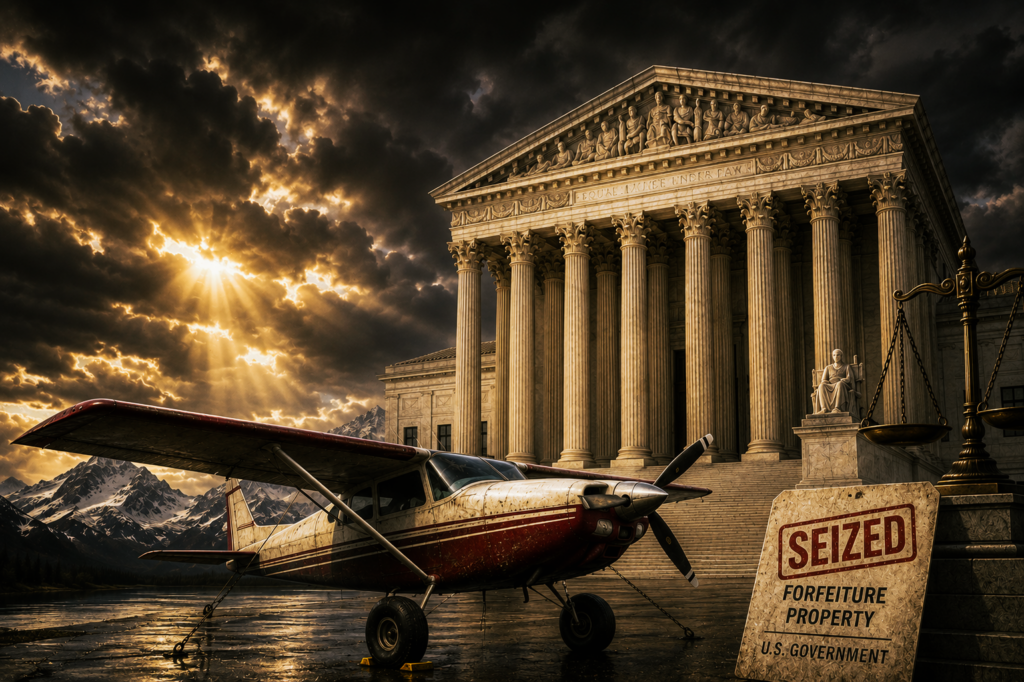
Six visible cans of Budweiser have become the focus of a 14-year constitutional battle over whether Alaska can confiscate an elderly bush pilot’s $95,000 airplane for a first-time misdemeanor.
The U.S. Supreme Court agreed Monday to hear Kenneth Jouppi’s challenge to the attempted seizure of his 1969 Cessna, giving the justices an opportunity to further define the limits the Eighth Amendment places on government asset forfeiture.
Jouppi, now in his 80s, argues that taking an airplane worth nearly 10 times the maximum fine authorized for his offense would violate the Constitution’s Excessive Fines Clause.
“I’m thrilled that the U.S. Supreme Court has agreed to hear this case, because this case isn’t just about me or my airplane anymore,” Jouppi said in a statement released by the Institute for Justice, which represents him.
“I’m in my 80s now, and I’ve been fighting this for over a decade because I see it as my duty to ensure that the Bill of Rights actually means something in protecting against government overreach,” he added.
The dispute began in April 2012, when Jouppi was preparing to fly a passenger from Fairbanks to Beaver, a remote Alaska community that prohibits the importation, sale and possession of alcohol.
The passenger had packed approximately 72 beers among her groceries, according to the Alaska Supreme Court’s account of the case. State troopers searched Jouppi’s aircraft before takeoff and found one six-pack visible inside a plastic shopping bag.
Jouppi maintained that he did not know alcohol was among the passenger’s belongings. Prosecutors, however, argued that he had deliberately ignored what was being loaded onto his plane.
The alcohol was intercepted before the aircraft departed, meaning none of it ever reached Beaver. Alaska law nevertheless defines transportation to include an attempt to deliver alcohol to a dry community.
The passenger pleaded guilty, while a jury convicted Jouppi and his air taxi company of knowingly transporting alcohol into the village. Jouppi was sentenced to three days in jail, fined $1,500 and placed on probation for three years. His company was also ordered to pay $1,500 after most of a $10,000 fine was suspended.
The state then moved to seize Jouppi’s Cessna under an Alaska law mandating the forfeiture of an aircraft used in an alcohol-importation offense — even when the case involves a first-time misdemeanor.
At sentencing, Judge Patrick Hammers suggested the punishment could serve as a warning to other pilots, according to the Fairbanks Daily News-Miner.
“A message that if you do it and get caught, you lose your airplane,” Hammers said. “A message that it’s not worth it.”
A trial court later determined that confiscating the $95,000 aircraft would be grossly disproportionate to Jouppi’s offense. The Alaska Supreme Court reached the opposite conclusion in April 2025, ruling that the forfeiture would not violate the Eighth Amendment.
The state court acknowledged that the aircraft was worth 9.5 times the maximum $10,000 fine Jouppi could have received. It nevertheless held that the seizure was justified by the broader damage illegal alcohol can cause in rural Alaska.
“Within this context, it is clear that the illegal importation of even a six-pack of beer causes grave societal harm,” the court wrote.
Jouppi’s attorneys contend that the court improperly focused on alcohol abuse across rural Alaska instead of examining his individual conduct, the amount involved and whether his offense was connected to a larger criminal operation.
“Few excessive fines cases will present the issue so sharply; a decision upholding the forfeiture of an airplane for a six-pack is a self-recommending candidate for review,” the Institute for Justice argued in its Supreme Court petition.
The Cato Institute, which filed a supporting brief, similarly accused Alaska’s highest court of considering the collective harms associated with illegal alcohol trafficking rather than the circumstances of Jouppi’s first offense.
Alaska has urged the justices to leave the ruling intact, arguing that airplanes are often the only practical way to smuggle alcohol into remote communities and that the legislature deliberately imposed stronger forfeiture rules on aircraft.
“Alcohol abuse is a serious problem in rural Alaska, and airplanes are sometimes the only realistic means to commit the crime of alcohol importation,” state attorneys wrote.
The case follows the Supreme Court’s unanimous 2019 decision in Timbs v. Indiana, which held that the Excessive Fines Clause applies to state and local governments. In that ruling, the Court described the protection as a safeguard against abuses of government punishment and the use of forfeitures to generate revenue. The Court’s opinion traced that principle as far back as Magna Carta.
The justices will now decide whether courts reviewing a forfeiture must focus on the defendant’s actual conduct and circumstances — or whether the broader societal harms associated with an offense can justify a dramatically larger financial penalty.
Arguments in Jouppi v. Alaska are expected during the Supreme Court’s next term.
READ NEXT: Trump Approves Landmark Nuclear Agreement With Saudi Arabia