The Trump administration has opened another legal front against local resistance to its immigration crackdown, suing Milwaukee over a city ordinance that restricts federal agents from wearing face coverings while on duty.
The Department of Justice filed its complaint Thursday in the U.S. District Court for the Eastern District of Wisconsin, naming Milwaukee, Mayor Cavalier Johnson, City Attorney Evan Goyke and Police Chief Jeffrey Norman as defendants.
The administration argues that Milwaukee is attempting to dictate how federal law enforcement officers perform their duties—authority the DOJ says belongs exclusively to the federal government.
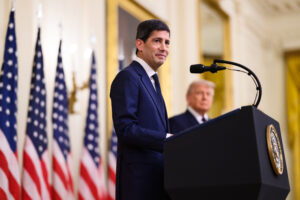
“State and local leaders cannot tell Federal officers how to do their job,” Associate Attorney General Stanley E. Woodward Jr. said in a DOJ statement.
Milwaukee’s “Law Enforcement Identification” ordinance prohibits local, state and federal officers from wearing opaque face coverings while interacting with the public. It also requires officers acting in an official capacity to display their agency and identifying information or provide those details verbally upon request.
Anyone who knowingly violates the ordinance could face a penalty ranging from $5,000 to $10,000, according to the Milwaukee city code.
Exceptions are included for undercover officers, SWAT members wearing protective equipment, extreme weather, medical masks and gear required for hazardous conditions.
Milwaukee officials approved the measure this spring amid Democratic-led opposition to President Donald Trump’s intensified immigration enforcement campaign. Supporters say masked and unidentified agents can frighten residents, undermine accountability and make it more difficult for the public to distinguish legitimate officers from impostors.
The city ordinance applies to all law enforcement officers operating within Milwaukee—not only Immigration and Customs Enforcement agents or other federal personnel.
That distinction could become important as the case proceeds. A federal judge previously blocked California’s mask ban in part because it applied to federal agents but exempted state law enforcement. The judge concluded that the unequal treatment likely violated the Constitution’s intergovernmental immunity doctrine, although California’s separate identification requirement was allowed to proceed. The ruling left open the possibility of a broader law applied equally to federal, state and local officers.
The Trump administration nevertheless argues that even a generally applicable local ordinance cannot directly control federal operations.
In its 17-page complaint, the DOJ accused Milwaukee of violating the Constitution’s Supremacy Clause by imposing local uniform and identification requirements on federal officers.
“This Court should join the growing number of others” blocking what the administration described as unconstitutional regulation of the federal government, the lawsuit states.
Federal attorneys said agencies such as ICE and Customs and Border Protection need the flexibility to decide when agents should conceal their faces or personal information. Those decisions can depend on the risks associated with a particular arrest, surveillance assignment or other operation, the government argued.
The lawsuit also alleges that publishing agents’ identities can expose them and their families to harassment, doxxing and retaliation. According to the complaint, photographs of federal officers have been run through facial-recognition programs to locate personal information and identify relatives.
“Law enforcement historically has been a dangerous job but now is even more so,” the DOJ argued, citing what it described as an increasingly volatile political environment surrounding federal operations.
Milwaukee has refused to back down.
The Justice Department warned city officials earlier in July that enforcing the ordinance against federal personnel would violate the Constitution. Goyke rejected that argument in a July 17 response and pledged that his office would prosecute properly issued citations.
“We will not advise our clients to exempt federal law enforcement officers from the Ordinance,” Goyke wrote in the letter.
Goyke maintained that the ordinance is a lawful public-safety measure that does not prevent federal agents from carrying out their duties. He argued that unidentified, armed individuals conducting arrests create risks for residents, particularly amid reports of criminals impersonating ICE officers.
The Milwaukee lawsuit is part of the Trump administration’s broader campaign against state and local measures that it says interfere with federal law enforcement. The DOJ has pursued related challenges in California, Virginia, New York, New Jersey and Philadelphia.
Federal judges have already temporarily blocked mask restrictions in Virginia and Philadelphia. In the Philadelphia case, a judge ruled that the city’s requirements likely ran afoul of the Supremacy Clause while the litigation continued. JURIST reported that the ordinance would also have required agents to use marked vehicles and reveal identifying information.
The Milwaukee case now sets up another showdown over whether Democratic-led cities can impose transparency requirements on federal agents — or whether those measures unlawfully intrude upon the president’s authority to enforce federal law.
READ NEXT: New Round of Trump Tariffs Takes Effect, Targeting 60 Trading Partners