
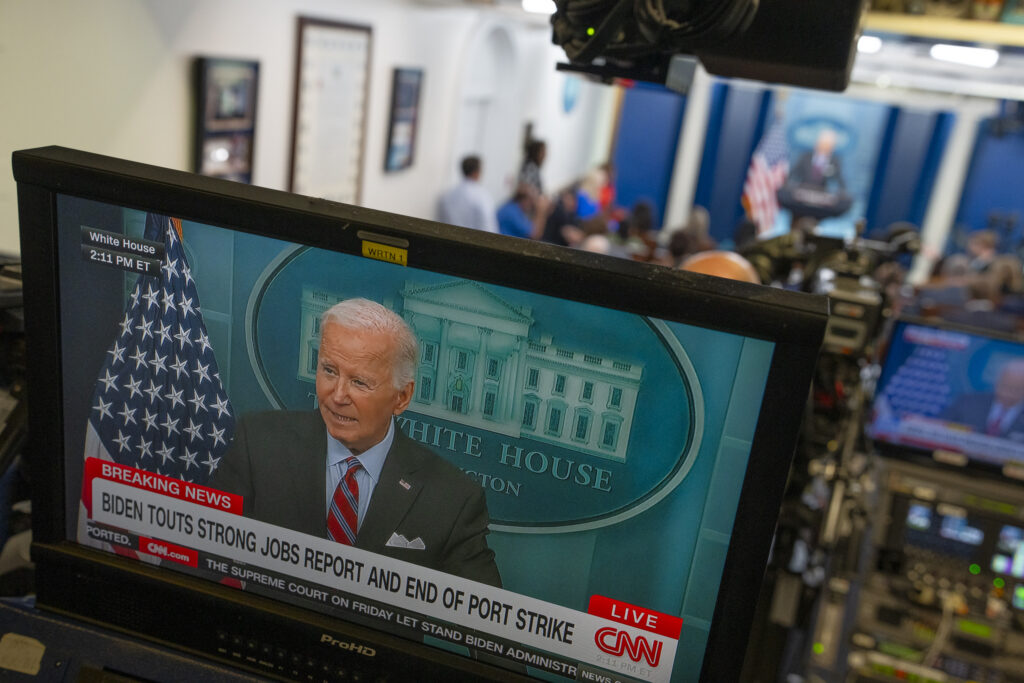
With 2024’s horizon nearing and the Trump campaign firing on all cylinders for a second term, the question arises: should his next press secretary host the melodramatic spectacle of televised briefings, or should we, perhaps, turn off the cameras and actually get to work? It’s time to reconsider the approach taken by Trump’s former press secretary—the third in his administration—who adopted a brief yet brilliant strategy: a media blackout that denied our beloved press corps their favorite televised soapbox. Her approach, a tactical avoidance of televised scrimmages, served as an intelligent maneuver to limit distractions, tamp down sensationalism and, shockingly enough, focus on governing.
Press Briefings as Modern Vaudeville: Trump’s Third Press Secretary’s Intervention
Trump’s third press secretary took the podium—without actually taking it. From July 2019 to April 2020, she consciously decided that some traditions are simply relics of a more naive age—like paying heed to journalists who are more interested in personal branding than in public service. She rightly understood the televised press briefings were, at best, theater. Instead of endlessly answering “gotcha” questions posed by a self-aggrandizing press, she found a better use for her time: she made the radical choice to avoid this farce altogether.
Reporters like CNN’s Jim Acosta and PBS’ Yamiche Alcindor used these opportunities as performative displays, seeking viral notoriety over genuine accountability. As Eddie Scarry of The Federalist pointed out, many White House correspondents became characters in their own political drama rather than the staid deliverers of facts they should have been. Under Trump’s third press secretary, the White House effectively shut down the media circus. By excluding these actors from their favorite stage, the Trump administration shifted the focus back to policy—a term apparently forgotten amid the glitzy whirl of modern journalism.
A New Paradigm: Government Without Gratuitous Performances
Consider this: do we actually need cameras in the briefing room? Since when did the press secretary become a character on reality television? We’ve seen what televised briefings have become—pulp for media outlets that thrive on conflict and controversy, not clarity. The media, the self-appointed “watchdogs,” now prefer bone to nourishment; they need controversy to thrive. And what does it yield for the public? Soundbites without substance.
The rise of digital communication platforms like Trump’s X feed—unfiltered, direct, much to the mainstream media’s chagrin—offers a solution that, frankly, just works better. The president’s own digital megaphone, immune from mainstream rehash, transmits his message with the precise clarity of a signal sent directly from the Oval Office to Americans’ screens—without the intermediaries who fancy themselves arbiters of truth.
Abandoning Theatrics: A Thoughtful Restructuring
Imagine a press secretary not performing daily for prime-time entertainment but, instead, sharing information in a way that focuses on the content, not the chaos. Would the media have to adjust? Surely. And what a joy that would be! Gone would be the Jim Acostas of the world, strutting about the stage as if they were tragic heroes challenging tyranny, instead of overcompensating reporters jousting with windmills. Limiting press briefings to private, off-camera events prevents the so-called “gotcha” moments that have become the currency of cable news contracts.
A limited model—occasional, necessary briefings—would require media organizations to return to the essence of journalism: reporting facts, not orchestrating melodrama. This model isn’t about censorship but about reclaiming the White House’s narrative from those who would distort it for their own gain. When everything’s a show, you start to forget the substance of governing. This adjustment serves as a reminder to journalists that their purpose is to inform, not to indulge in spectacles at the expense of substance.
Eliminating Manufactured Controversy
Beyond the benefits of focusing on substance, there’s another crucial payoff: fewer briefings, fewer needless controversies. With President Trump, every word becomes a headline—whether that word is “covfefe” or “bigly.” In his first term, an innocuous statement about border security could transmogrify into a news cycle of hysteria. By opting out of live televised briefings, the White House can leave the stage empty for the press’s obsession with clickbait while redirecting its own energies to advancing policy that matters.
The Democrat-aligned media prefers briefings to produce “gotcha” moments rather than any genuine dialogue. They found gold in trivialities, treating Trump’s offhand comments as fodder for moral outrage and letting crucial policy accomplishments fade into the background noise of manufactured scandals. With off-camera briefings, the Democrats’ friendly news outlets will need to engage with the administration on policy, not personal feuds.
Bringing the Drama to a Close: The Future Press Secretary
The Trump of 2024 isn’t the Trump of 2016, nor are his supporters naive to the tricks of media. For a successful second term, Trump needs a press secretary who understands that the briefing room has become a comedy club. For all intents and purposes, the next press secretary must take a page from his third press secretary’s book—recognizing that the old rules need not apply.
Picture it: a press secretary holding select, strategic briefings—only when there’s genuine information to disseminate, and only when the news merits an occasion for broadcast. Not only would this reduce the stage for media theatrics, but it would also allow the administration to craft its narrative without filtering it through the sensationalist lens of reporters auditioning for airtime on cable news.
The challenge lies not merely in managing information flow; it lies in controlling the spectacle. The Biden-Harris regime’s failure on this front could not be more apparent—their stammering, incoherent approach to crisis management (take your pick—Afghanistan, Ukraine, border debacles) betrays a reluctance to lead. By eliminating frequent televised sparring matches, Trump can protect his administration’s message, sharpen its effectiveness, and deliver on promises without getting mired in irrelevant controversies drummed up by a hostile press.
Conclusion: A Return to Substance Over Spectacle
There was a time when the press secretary’s role was to inform, not entertain. What we need today, should Trump return, is an abandonment of the performative politics that have defined recent White House press strategies. This change isn’t about shutting out the press but about maintaining control of the conversation—ensuring that public communication remains focused on truth rather than trending hashtags.
In the end, if the American people are fed up with performative journalism, why give the journalists a stage? It’s not censorship to deny them their camera; it’s a return to discipline, dignity, and, dare I say it—real news. And that, in the long run, is the change we all could use.
Sponsored by the John Milton Freedom Foundation, a nonprofit dedicated to helping independent journalists overcome formidable challenges in today’s media landscape and bring crucial stories to you.
READ NEXT: Senate Republicans Explode Over Schumer’s DIRTY Political Move















All I can say is PERFECT!
Oh No how will we ever do with out Fake News?
I don’t know about you but I am sick of deceiving titles for articles I do not want to read.
I for one would appreciate the truth.
Use Zoom then right