
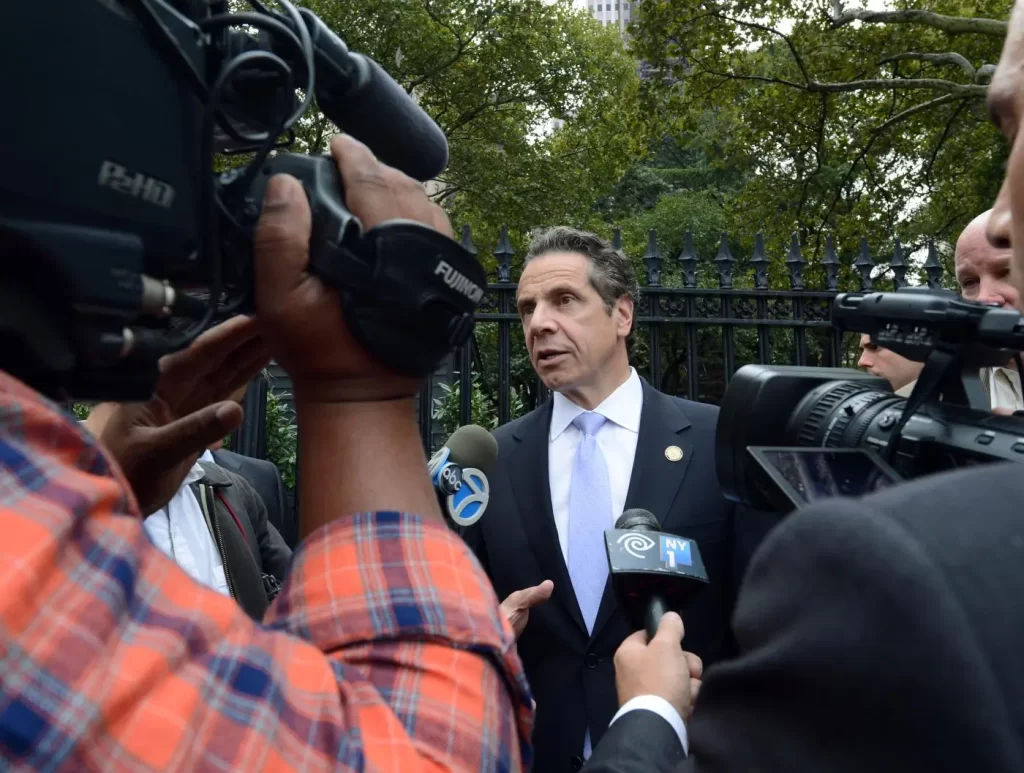
In a dramatic turn of events in the New York City Democratic mayoral primary, former Governor Andrew Cuomo (D) conceded Tuesday night to progressive Assemblyman Zohran Mamdani (D–Queens), who surged ahead in first-round voting and now leads in the city’s ranked-choice process.
Speaking to supporters, Cuomo acknowledged the shifting tide: “Tonight was not our night. Tonight was Assemblyman Mamdani’s night.” He praised Mamdani’s campaign for energizing young voters and building grassroots momentum, calling it “a movement that clearly resonated.”
With 91% of the votes counted, Mamdani holds a solid lead, securing 43.5% (428,995 votes) to Cuomo’s 36.4% (358,740), according to the Associated Press. New York City Comptroller Brad Lander trailed in third with 11.3% (111,440 votes).
Although no candidate surpassed the 50% threshold required to clinch victory outright, Cuomo’s concession effectively acknowledges Mamdani’s strong position heading into the next rounds of ranked-choice tabulation. The official winner may not be declared for several days as the Board of Elections eliminates lower-ranking candidates and redistributes their voters’ next choices.
Mamdani, a Democratic Socialist of Indian and Ugandan descent who represents Astoria in the State Assembly, campaigned on a platform sharply focused on “economic equity,” “housing justice,” and public ownership of essential services. One of his most headline-grabbing proposals involves the creation of city-owned grocery stores, a highly scrutinized response to the cost of food across the five boroughs.
Mamdani argues that city dollars currently subsidizing private grocers—many of which don’t accept SNAP or WIC—should instead fund a “public option” in food retail.
Mamdani’s campaign attracted high-profile support from Hollywood and the cultural left. Cynthia Nixon, actress and activist known for Sex and the City, campaigned with Mamdani, as did actor Kal Penn (Harold & Kumar) and pop star Lorde.
New York City’s ranked-choice voting system, now in its second mayoral cycle, allows voters to rank up to five candidates in order of preference. If no one wins a majority outright, the lowest-performing candidates are eliminated and their votes redistributed based on voters’ next-ranked choices. The process continues until one candidate surpasses 50%.
While Mamdani appears poised for victory, observers caution that ranked-choice voting can yield surprises depending on where second- and third-choice votes fall.
Ironically, the self-described socialist Mamdani, who campaigned on fighting for New York’s most marginalized communities, performed best among higher-income white voters in gentrified neighborhoods like Park Slope, Williamsburg, and parts of Manhattan. In contrast, Cuomo — long criticized by progressives as an establishment centrist — performed strongest among working-class black and Hispanic voters, especially those earning under $50,000.
READ NEXT: Ranked Choice Voting Could Install An Islamic Extremist In New York City Hall



















Like I have said,New York City Democrats are dead set to finish their suicide at the voter booths
Muslims long ago took over London. They have strong influence in Paris and Berlin. Control Amsterdam. Why is this a surprise?