
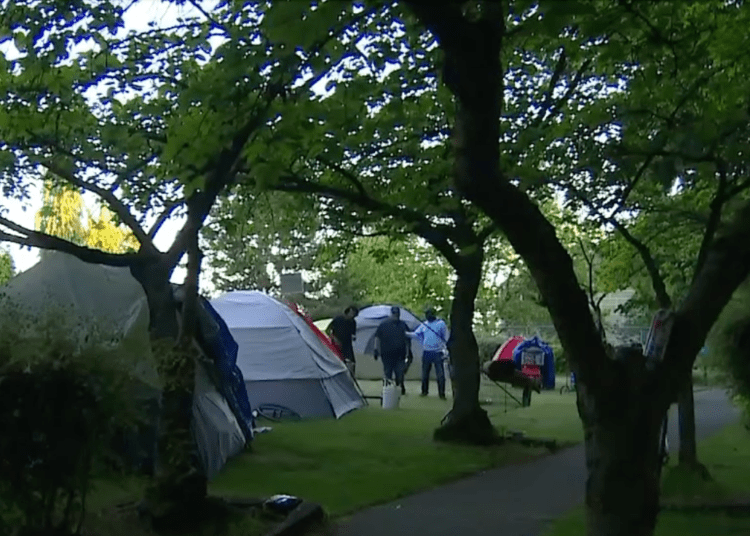
As part of his “Make America Safe Again” initiative, President Donald Trump signed a new executive order on Thursday designed to give cities and states expanded authority to remove homeless individuals from public spaces and place them into treatment and rehabilitation facilities.
The executive order, titled “Ending Vagrancy and Restoring Safety”, marks a high-profile federal push to address rising homelessness in urban areas. It comes as national homelessness levels reached a historic high of 274,224 individuals living unsheltered on a single night during the final year of the Biden administration, according to the Department of Housing and Urban Development (HUD).
Executive Action
The order directs Attorney General Pam Bondi to challenge and roll back judicial precedents and consent decrees that prevent or restrict local governments from clearing homeless encampments or enforcing loitering and urban camping laws.
It also mandates a redirection of federal funds toward programs that remove homeless individuals from public spaces and transfer them into treatment, rehabilitation, or other supportive facilities. Although exact funding levels were not disclosed, the order prioritizes federal support for states and cities that comply with new enforcement benchmarks.
Under the order, Health and Human Services Secretary Robert F. Kennedy Jr., HUD Secretary Scott Turner, and Transportation Secretary Sean Duffy are instructed to coordinate with the Justice Department to ensure federal grant programs favor jurisdictions that:
- Enforce bans on open drug use, squatting, and unauthorized encampments
- Track sex offenders
- Refuse to fund supervised drug injection sites or programs that permit illegal drug use
Context and Impact
Homelessness in the United States surged by 18% from 2023 to 2024, HUD’s most recent annual assessment reported. Cities such as San Francisco, Los Angeles, Portland, and Washington, D.C. have struggled with growing encampments, public safety concerns, and deteriorating public infrastructure.
Supporters of the executive order view it as a long-overdue response to what they describe as urban decay and policy inaction.
Others have raised concerns about the legality and ethics of forcibly relocating the homeless, especially those who have not committed a crime or expressed a willingness to enter treatment. A Democratic bill introduced in Congress earlier this year would block the federal government from clearing homeless encampments on public land without providing long-term housing alternatives.
Political and Legal Outlook
The order sets the stage for likely legal challenges from progressive groups, particularly over the issue of involuntary relocation and the reversal of longstanding court decisions, such as Martin v. Boise, which limits the ability of cities to criminalize homelessness without first offering shelter, though it appears the Executive Order will.
Trump’s administration argues that existing policies have failed to curb rising homelessness and have contributed to crime, drug use, and declining quality of life in major cities.
The administration’s next steps are expected to include detailed agency guidance, new funding directives, and potential legal action to overturn judicial rulings seen as obstacles to enforcement.
READ NEXT: Homeless ‘Caves’ Discovered Under Major US City
A ticking time-bomb set by Joe Biden and Kamala Harris to Hurt ElectionsThey Must Be Stopped! |














If this order is compassionately applied, it could result in employment for the homeless and reduce both drug sales/use and crime.
The homeless out on our streets are virtually all alcoholics, drug users, diagnosed with mental health issues, or a combination of these. This according to social workers who work with the homeless throughout the United States.
They are not in homeless shelters because they know those places will insist they address their addictions and mental health issues. They also have a life expectancy of 10 years if they don’t receive this help.
So, to save their lives they have to be compelled to address these problems—at least initially.