
The White House announced a hardline approach to addressing the growing homeless crisis in Washington, D.C., stating that individuals living in homeless encampments will soon face a clear ultimatum: accept treatment and shelter—or go to jail.
During a Tuesday press briefing, White House Press Secretary Karoline Leavitt outlined the Trump administration’s latest actions following President Donald Trump’s federal takeover of law enforcement operations in the nation’s capital. The press secretary explained the effort as part of a broader plan to clean up the city, restore public safety, and deal with what she described as a “humanitarian disaster” unfolding in plain sight.
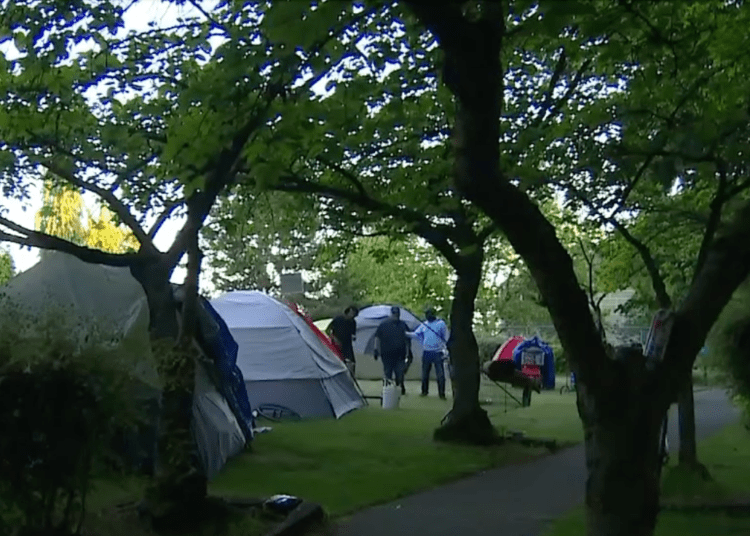
“Seventy homeless encampments have been removed by the U.S. Park Police,” Leavitt told reporters. “There are only two homeless encampments remaining in D.C. federal parks under the National Park Service’s jurisdiction, and the removal of those two remaining camps is scheduled for this week.”
When pressed on what options would be given to those still living in the remaining camps, Leavitt was clear: “Homeless shelters, for addiction and mental health services, or jail if they refuse, are the options on the table right now.”
Trump Administration’s Federal Response to D.C. Crime
The encampment clearings come amid a broader push by President Trump to combat violent crime and what he’s called the collapse of basic governance in the city. Trump recently invoked Section 740 of the D.C. Home Rule Act, placing the Metropolitan Police Department under direct federal control and mobilizing the National Guard to assist in securing city streets.
The president described the capital as being overrun by violent gangs, roving mobs, and “drugged-out maniacs,” promising that his administration would clean up D.C. and restore law and order.
“We have a capital that’s very unsafe,” Trump said. “You know, we just almost lost a young man—beautiful, handsome guy—that got the hell knocked out of him,” he added, referring to Edward Coristine, a former Department of Government Efficiency (DOGE) staffer who was the victim of a recent attempted carjacking.
Reactions and Policy Considerations
The new policy has drawn mixed reactions. While some D.C. residents and local business owners have expressed support for the clean-up and enhanced federal presence, others—including Democratic lawmakers and progressive advocacy groups—have criticized it as overly punitive and “lacking compassion” for the city’s “most vulnerable.”
Critics argue the crackdown doesn’t address the “root causes of homelessness,” which they cite as rising housing costs and underfunded mental health services. However, supporters of the policy counter that years of leniency and neglect by local leadership have only allowed the problem to grow.
The assertion that chronic homelessness is merely a symptom of “housing affordability” has been increasingly challenged by real-world outcomes. In California, for example, well-funded housing projects that provided free apartments to homeless individuals—without requiring sobriety or treatment—rapidly deteriorated into dangerous and unsanitary conditions. Many of these buildings became nearly unlivable within months, plagued by rampant drug use, property damage, and threats to staff and residents alike. Without addressing the underlying issues of addiction, mental illness, and personal accountability, simply handing out housing will continue to fail as a long-term solution.
The administration has also confirmed that relocating homeless populations outside of the city—an idea previously floated by Trump—is under consideration, though not yet finalized. That plan would involve creating secured shelter communities in rural or suburban areas with access to addiction and mental health care.
Conditions on the Ground
A tour by Fox News Digital showed that many once-populated homeless hotspots have been completely cleared, leaving behind discarded clothing, tents, and food containers. However, some encampments remain, particularly in areas near downtown parks and government buildings.
At one site, reporters observed around a dozen individuals still gathered with tents and belongings, some apparently unaware of the looming deadline. A dried red substance—possibly blood or food—was splattered across the sidewalk near the camp, underscoring the growing concern over sanitation and public safety.
A Divided Capital, A Federal Directive
As the administration moves forward with its aggressive clean-up plan, Washington, D.C. finds itself at the center of a national debate over crime, homelessness, and federal authority.
The Trump administration maintains that it is stepping in only because local leaders failed to act, allowing the capital city to deteriorate to dangerous levels.
“The American people deserve a capital city that’s safe, clean, and worthy of our nation,” Leavitt said. “That’s what we intend to deliver.”
Whether the current approach will lead to long-term solutions or more political battles remains to be seen.
READ NEXT: Chicago Clears Largest Homeless Encampment
















Send to MA CA VT ME MN CT DE OR WA