

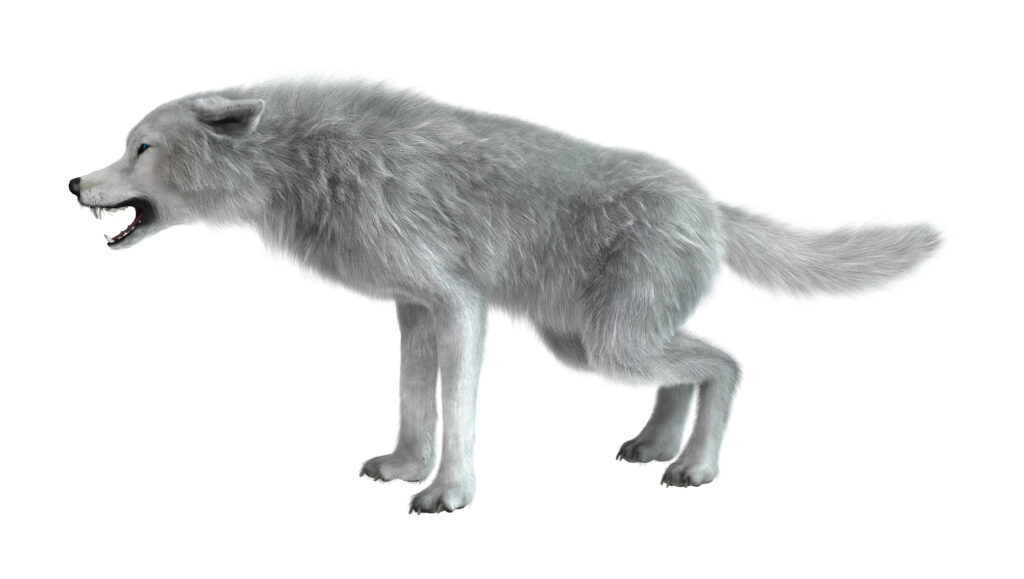
Scientists at Colossal Biosciences, a U.S.-based biotechnology and genetic engineering firm, have announced the birth of three genetically engineered wolf pups—Romulus, Remus and Khaleesi—that they claim exhibit key traits of the long-extinct dire wolf, which vanished roughly 13,000 years ago.
The breakthrough marks a major step in Colossal’s high-profile efforts to “de-extinct” lost species using advanced CRISPR (Clustered Regularly Interspaced Short Palindromic Repeats) gene-editing and selective breeding. The pups reportedly display characteristics linked to dire wolves, including robust skeletal structure, muscular build and unique fur patterns.
SOUND ON. You’re hearing the first howl of a dire wolf in over 10,000 years. Meet Romulus and Remus—the world’s first de-extinct animals, born on October 1, 2024.
— Colossal Biosciences® (@colossal) April 7, 2025
The dire wolf has been extinct for over 10,000 years. These two wolves were brought back from extinction using… pic.twitter.com/wY4rdOVFRH
How They Did It
Scientists analyzed DNA from two ancient dire wolf specimens—a 13,000-year-old tooth and a 72,000-year-old skull. From there, they pinpointed 20 key genetic differences between dire wolves and today’s gray wolves. Using CRISPR gene-editing tech, which allows for surgical-level precision in rewriting DNA, researchers altered gray wolf embryos to reflect those ancient traits. The edited embryos were implanted into domestic dogs—and three pups were born.
TIME's new cover: The dire wolf is back after over 10,000 years. Here's what that means for other extinct species https://t.co/LQtosdfiEf pic.twitter.com/bv8EbeefuW
— TIME (@TIME) April 7, 2025
TIME outlines how the opportunity arose:
The dire wolf once roamed an American range that extended as far south as Venezuela and as far north as Canada, but not a single one has been seen in over 10,000 years, when the species went extinct. Plenty of dire wolf remains have been discovered across the Americas, however, and that presented an opportunity for a company named Colossal Biosciences.
Relying on deft genetic engineering and ancient, preserved DNA, Colossal scientists deciphered the dire wolf genome, rewrote the genetic code of the common gray wolf to match it, and, using domestic dogs as surrogate mothers, brought Romulus, Remus, and their sister, 2-month-old Khaleesi, into the world during three separate births last fall and this winter—effectively for the first time de-extincting a line of beasts whose live gene pool long ago vanished. TIME met the males (Khaleesi was not present due to her young age) at a fenced field in a U.S. wildlife facility on March 24, on the condition that their location remain a secret to protect the animals from prying eyes.
The Authenticity Debate
The pups may look and act like dire wolves, but not everyone’s convinced. Critics argue they’re not true dire wolves, since no ancient dire wolf DNA was actually inserted into the embryos. Instead, they’re seen as genetically modified gray wolves—close, but not the real thing.
After reading the article, they aren’t de-extincting dire wolves. They are genetically modifying grey wolves to phenotypically resemble what they think dire wolves looked like.
— Cam Clow (@camthecowboyman) April 7, 2025
This is not a dire wolf. https://t.co/8SEntOXKPt
Big Questions: Ethics and Ecology
The development has sparked debate among experts about the ethical and ecological implications of de-extinction. Concerns include possible disruptions to modern ecosystems and the welfare of the animals created through this process.
Supporters of the research say it could help restore biodiversity and provide new insights into evolutionary biology.
Some skeptics have compared Colossal Biosciences’ efforts to a modern-day Barnum & Bailey Circus. However, the company maintains that its gene-editing technology has practical conservation benefits. According to TIME, researchers believe the techniques being developed could help protect existing endangered species.
For example, they say the work being done to recreate the woolly mammoth could lead to hardier elephant populations that are more resilient to climate change. Reviving the Tasmanian tiger, also known as the thylacine, could help preserve its close relative, the quoll. Similarly, genetic advances made through the dire wolf project could be used to support the endangered red wolf.
And these pups aren’t the end of the road. The company and its 130 scientists are feverishly working on reviving the woolly mammoth, Tasmanian tiger, northern white rhino and even the dodo.
Already in March, the company announced it had created a hybrid “woolly mouse” by inserting mammoth DNA into a rodent.The resulting animal developed long, wavy, woolly hair reminiscent of the mammoth and mimicked the extinct beast’s accelerated fat metabolism.
“We are an evolutionary force at this point,” says Beth Shapiro, Colossal’s chief science officer, speaking of humanity as a whole. “We are deciding what the future of these species will be.” The Center for Biological Diversity suggests that 30% of the planet’s genetic diversity will be lost by 2050, and Shapiro and Colossal CEO Ben Lamm insist that genetic engineering is a vital tool to reverse this. Company executives often frame the technology not just as a moral good, but a moral imperative—a way for humans, who have driven so many species to the brink of extinction, to get square with nature. “If we want a future that is both bionumerous and filled with people,” Shapiro says, “we should be giving ourselves the opportunity to see what our big brains can do to reverse some of the bad things that we’ve done to the world already.”
The woolly mouse, to a minor extent, and the dire wolves, to a scientifically seismic one, are first steps in that direction. But not everyone agrees. Scientific history is rife with examples of newly introduced species becoming invasive species—the doctrine of unintended consequences biting humans when we played too cute with other animals. An exotic pet escapes and multiplies, decimating native species. A toad brought in to kill off beetles ends up killing off the marsupials that eat the toads. And genetic engineering is still a nascent field. Nearly 30 years after Dolly the sheep was cloned, the technology still produces problems in cloned animals, such as large birth size, organ defects, premature aging, and immune-system problems. What’s more, cloning can be hard on the surrogate mother that gestates the cloned embryo.
READ NEXT: China Makes MAJOR Escalation In Trade War



















Is this company suggesting human beings drove Dire Wolves to extinction 10,000 years ago? Forests still covered North and South America 10,000 years ago. I know this might be an unpopular opinion in today’s political environment, but maybe, just maybe, Dire Wolves became extinct because they were an unsuccessful species? You know? The kind of unsuccessful that drives God’s design? 🤦