

Gulf States are reportedly denying the United States Air Force access to bases for a potential strike on Iran…
According to The Telegraph, a senior Iranian official has revealed that Tehran’s top military commanders—both from Iran’s regular armed forces and the Islamic Revolutionary Guard Corps (IRGC)—are being pushed to consider a “preemptive strike” on the U.S.-U.K. base at Diego Garcia. The proposed use of long-range ballistic missiles would be intended to deter President Donald Trump from ordering large-scale military action against Iran:
The official in Tehran told The Telegraph: “Top commanders are being urged to launch preemptive strikes on the island and its base if Trump’s threats become more serious.”
He added: “Discussions about the island have intensified since the Americans deployed bombers there.”
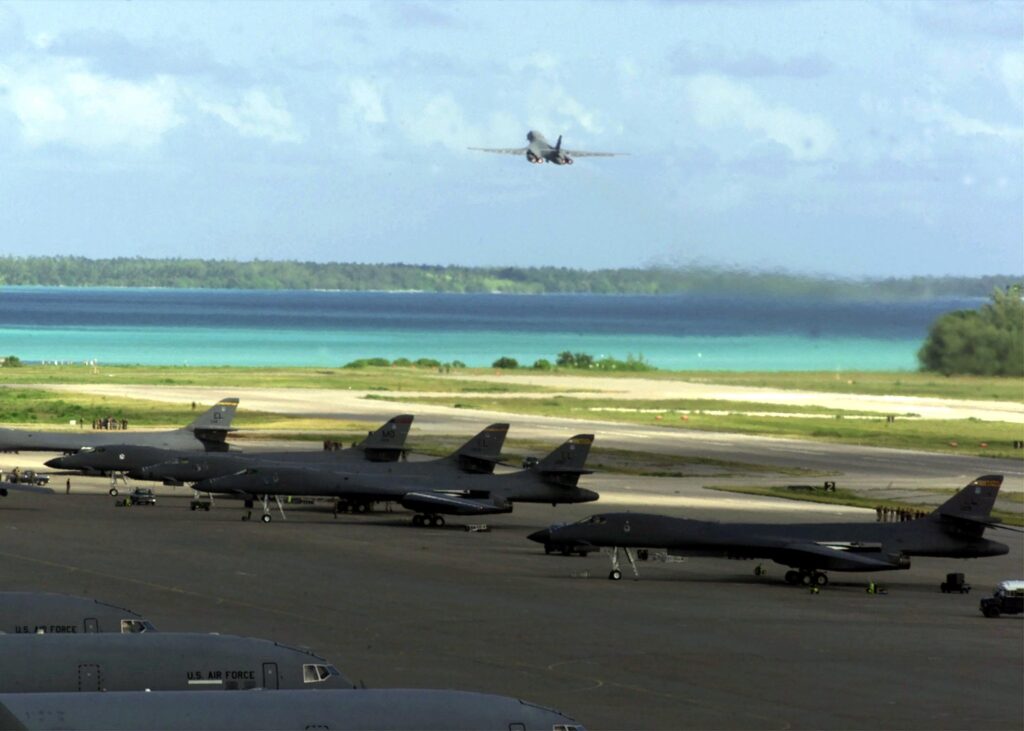
In recent weeks, the administration has quietly deployed several B-2A Spirit stealth bombers to Diego Garcia, a remote and highly strategic atoll in the Indian Ocean located roughly 300 miles from the Maldives.
The ongoing redeployment significantly boosts U.S. strike capabilities in the region, putting these nuclear-capable aircraft well within range of both Iran and Houthi targets.
Dubbed the “ghosts of the sky”, the B-2 bombers are capable of slipping past the most advanced air defences and delivering deadly payloads.
Diego Garcia is the main island in the Chagos Archipelago – the British-owned Indian Ocean territory which Sir Keir Starmer wants to return to Mauritius.
Meanwhile, the increasing saber-rattling from Iran comes as Saudi Arabia, Qatar and Kuwait have reportedly informed Tehran that they will not permit the United States to use their air bases for any potential military strike against Iran.
According to a Saudi source speaking to i24 News, this rejection includes not only direct combat operations but also support roles—such as aerial refueling and reconnaissance missions.
Fear of Retaliation Driving Gulf Reluctance
The Gulf states’ decision appears to be driven by growing concern over Iranian retaliation. A 2024 report from Middle East Eye highlights rising doubts among Gulf leaders about the reliability and risks of U.S. basing agreements amid heightened regional tensions. For Saudi Arabia and Kuwait, the calculus seems to be that any perceived cooperation with U.S. strike plans could make them immediate targets for reprisal from Tehran or its proxies.
Diego Garcia: A Strategic Insurance Policy
Diego Garcia has long been a fallback for U.S. military planners. The base has hosted B-52 bombers since 1987 and has been upgraded to accommodate B-1Bs and B-2s, including hardened shelters built after a 2001 B-2 accident. In recent weeks, five to nine B-2 long-range strategic stealth bombers have relocated from Whiteman Air Force Base in Missouri to the remote island destination, intensifying speculation about potential U.S. military action in the region.
Capable of delivering precision strikes while evading radar, these state-of-the-art aircraft put Iranian targets well within reach without relying on regional allies, especially after President Trump issued a letter earlier this month giving Tehran a “two-month deadline” to strike a new nuclear deal with the United States.
Not Just Bombers: Support Aircraft Critical to Success
Satellite imagery also indicates the presence of roughly half a dozen support aircraft at Diego Garcia—likely including KC-135 Stratotankers, C-17A Globemaster III transports and P-8A Poseidons. Each plays a key role in U.S. military operations:
-KC-135s enable long-range missions by refueling bombers midair, extending their operational reach.
-C-17As handle heavy logistics—moving personnel, equipment and munitions essential for sustained operations.
-P-8As, while primarily used for maritime patrol, can contribute to intelligence, surveillance and reconnaissance (ISR), helping build a real-time picture of enemy movements.
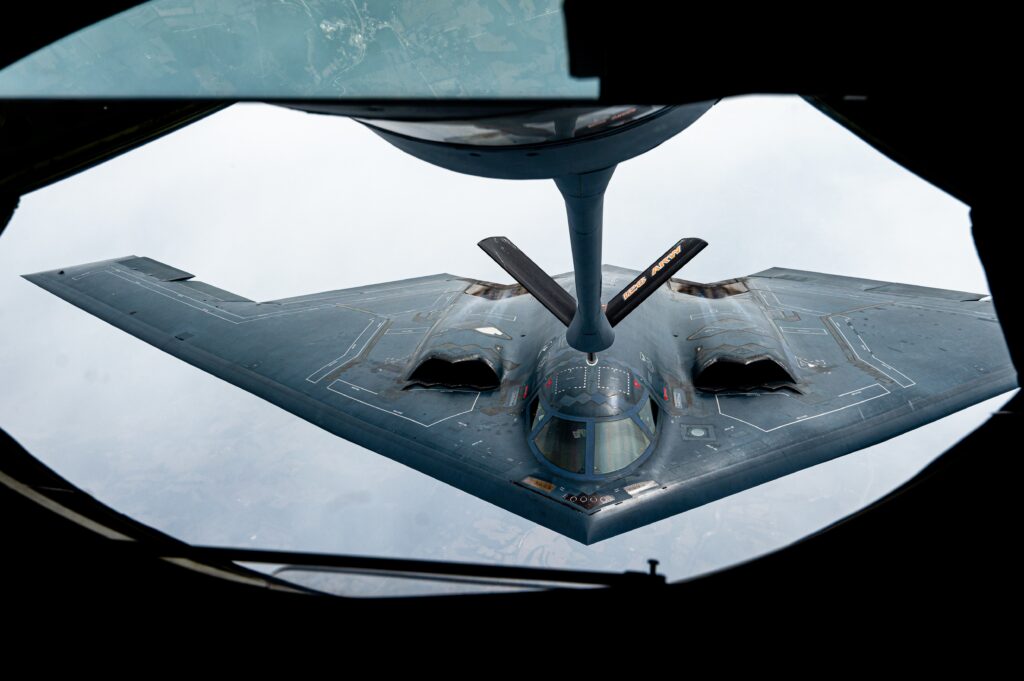
Together, these assets allow the U.S. to mount high-intensity, long-duration missions independent of nearby bases.
Should Washington opt for direct action against Iran’s nuclear facilities, the planning would be extensive. Targets are hardened, dispersed and in some cases buried. Strikes would need to be highly coordinated—combining stealth bombers, ISR support, electronic warfare, cyber capabilities and layered refueling logistics. Timing, sequencing and precision would be critical to disrupting Iran’s program without triggering uncontrolled escalation.
While the Air Force shifts focus to Diego Garcia, the Navy is reinforcing its presence in the region. The USS Carl Vinson carrier strike group is moving in from Guam, set to join existing U.S. forces countering Houthi attacks in the Red Sea.
Together, the decision-making from Washington paints a picture of the U.S. hedging its options—ready to project force but constrained by a shrinking coalition of willing regional partners.
READ NEXT: Smoke & Mirrors? Unpacking The Media’s Frenzy Over ‘Bombshell’ Trump News


















Something has to be done about Iran and soon.
I do believe the US has a much bigger stick than Iran could ever hope to have. Their airforce is old and old technology, their ICBM are just that BM as compared to the modern atomomous that precision plant the US supply. The US has two or three carrier groups stagically placed with all kinds of support ships and defense against anything in the Iranians have, There are several ships with cruise missles that will fly through a rural mail box if so programmed. All the bravodo and dancing that the Iranian military does and all the negativity their Imams put out are worthless when and unseen group of mutions start disassembling the Iranian leadership. Cawl in a hole and you just picked your own grave as many munitions do not detonate until well below ground level where the resulting shock waves will collapse and fill hiding places.
The military strikes can be very precise and not take out the Iranian public, just the leadership and military. It would be the Iranian Public to reset the values, rules, and consequences of such a catistrophic event against them by a leadership still stuck in the 12th century.
Iran is a bunch of talk I hope they do go after us So we can shoot down every aircraft that they own They talk a lot of smack but don’t have the balls to try Iran knows better than attack the US So for good reason we would shoot them down long before they would never get close to Diego Garcia They may try to pick on Israel but they know if they attack us they are a dead country Let the camels run wild
That would be a mistake of unimaginable proportions and i am 100% sure the Ayatollah’s understand that would be suicide.