

A newly surfaced video has sparked fears of increased foreign intervention in Ukraine’s ongoing war. The footage, shared by the X account @JayinKyiv, appears to show a train heavily loaded with artillery systems. According to the account’s claims, these are North Korean artillery systems headed directly into Ukraine to support Russian forces.
Miles of North Korean artillery units heading into Ukraine
By Boyko Nikolov for BulgarianMilitary.com
“Miles of North Korean artillery units heading into Ukraine. Imagine if Ukraine’s allies were as serious about letting Ukraine win as Russia’s allies are about destroying the western world,” wrote @JayinKyiv in a post accompanying the video.
While the video raises serious concerns about the involvement of North Korea in the conflict, BulgarianMilitary.com has not been able to independently verify the claims, nor has it confirmed the location or timing of the footage.
Miles of North Korean artillery units heading into Ukraine.
— Jay in Kyiv (@JayinKyiv) December 19, 2024
Imagine if Ukraine's allies were as serious about letting Ukraine win as Russia's allies are about destroying the western world. pic.twitter.com/JrRbcRqSxr
The potential implications of such a move would be massive, especially given the growing geopolitical stakes. If verified, this could mark a significant step in North Korea’s support for Russia and further complicate the situation for Ukraine and its Western allies.
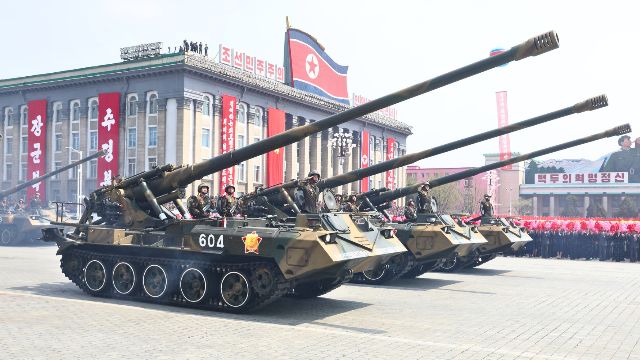
A recently surfaced video, while of low quality, has sparked intense speculation about the presence of North Korean artillery heading toward Ukraine. The poor resolution makes it nearly impossible to confirm the exact model of the weapons shown. However, military analysts and observers point out that the self-propelled artillery featured in the footage bears a strong resemblance to the M-1978 Koksan – a powerful weapon known for its exceptional range and devastating firepower.
The M-1978 Koksan is one of the longest-range conventional artillery systems in the world, capable of firing shells up to 60 kilometers when using rocket-assisted projectiles. If these units are indeed Koksan systems, their deployment could provide a significant boost to Russian firepower in Ukraine, especially in long-range engagements where precision artillery has played a decisive role.
Probably the first losses of the North Korean army in battles with the Ukrainian army.
— Ukraine News 🇺🇦 (@Ukrainene) December 16, 2024
Unfortunately, unlike Ukraine's allies, Kim Jong Un sent his soldiers to help Putin
Now Ukraine is fighting against two armies of two nuclear states at once pic.twitter.com/fP3qJ84D9R
As of now, the video remains unverified, and the exact timing and location of the footage are unclear. However, the possibility of North Korean military equipment entering the conflict underscores the increasingly global nature of the war in Ukraine and highlights the deepening ties between Pyongyang and Moscow.
The M-1978 Koksan, developed by North Korea in the 1970s, is one of Pyongyang’s most powerful artillery platforms. Officially revealed to the world during a military parade in 1985, this self-propelled artillery system is renowned for its extraordinary range, making it a strategic asset for North Korea. Its name, “Koksan,” is believed to derive from the city where the weapon was either developed or tested.
The M-1978 Koksan features a massive 170mm caliber, significantly larger than standard artillery systems. It can fire conventional high-explosive shells up to 40 kilometers. With rocket-assisted projectiles, its range extends to an impressive 60 kilometers, making it one of the longest-range conventional artillery systems in the world. This capability allows it to strike deep behind enemy lines, targeting infrastructure and logistical hubs with devastating effect.
The system is mounted on a modified tank chassis, granting it mobility on the battlefield. Early versions of the M-1978 Koksan lacked an onboard ammunition storage system and relied on accompanying trucks to transport shells. This design made it vulnerable in high-intensity combat, particularly if its logistical support vehicles were destroyed.
Later variants, known as the M-1989, addressed this limitation by incorporating an armored storage compartment capable of holding up to 12 rounds directly on the system. The M-1989 also featured improved armor protection for the crew and critical components. These versions reportedly integrated advanced targeting systems, enhancing accuracy for long-range engagements.
The Koksan is primarily designed for heavy artillery duels or sustained bombardments of strategic targets. North Korea is believed to have deployed a significant number of these systems near the Demilitarized Zone [DMZ] with South Korea, where they are positioned to put the South Korean capital, Seoul, within range. This gives the weapon not only tactical significance but also psychological leverage in the Korean Peninsula’s ongoing tensions.
🇰🇷🇰🇵🇺🇦| According to South Korean intelligence at least 100 North Korean soldiers were killed and around 1000 others were injured to varying degrees in the Ukrainian war.
— Eternal Glory (@EternalGlory0) December 19, 2024
The numbers seem a bit high to me. pic.twitter.com/PkGqz2r0ML
Internationally, the M-1978 Koksan has seen limited exports to North Korea’s allies. One notable recipient was Iran, which used the system during the Iran-Iraq War. In that conflict, it proved effective in prolonged sieges and destructive artillery strikes against enemy fortifications and supply lines.
Despite its impressive capabilities, the Koksan has several limitations. Its slow reload time, especially in early models, could limit its effectiveness in high-intensity combat. Additionally, its large size and limited mobility make it vulnerable to counter-battery fire or airstrikes if its position is pinpointed.
The Koksan remains an iconic weapon in North Korea’s arsenal, symbolizing its ambitions for military power and its ability to project threats beyond its immediate borders. Its potential deployment in conflicts outside the Korean Peninsula, as suggested by the video from Ukraine, would underscore North Korea’s growing role in global military dynamics.
Evidence continues to mount that North Korean military equipment is being used by Russian forces in Ukraine. While definitive proof remains elusive, recent developments, including satellite imagery, battlefield reports, and intercepted intelligence, point to a growing partnership between Moscow and Pyongyang in sustaining Russia’s war machine.
Satellite images analyzed by Western defense agencies reveal a notable increase in train traffic between North Korea and Russia. Several shipments, including large crates believed to contain artillery munitions, were observed crossing the border. These movements align with Russia’s ongoing struggles to replenish its ammunition stockpiles, depleted by the high-intensity fighting in Ukraine.
On the ground, photos and videos circulating on social media have sparked intense speculation. Crates marked with identifiers consistent with North Korean manufacturing have allegedly been spotted in Russian-controlled territories. While these images remain unverified, military experts highlight that the crate designs and labeling are near-identical to those used by North Korean artillery units.
Frontline reports add further weight to these claims. Ukrainian soldiers have reported recovering spent shell casings bearing markings associated with North Korean designs. These discoveries follow reports of unusually intense artillery barrages in certain sectors, suggesting a potential infusion of foreign munitions into Russian supply chains.
Statements from U.S. officials have also reinforced these conclusions. According to the White House, North Korea has provided Russia with significant quantities of artillery shells and rockets in recent months. This cooperation is reportedly part of a larger quid pro quo, with Moscow potentially offering food aid, energy resources, or advanced weapons technology in return.
The implications are troubling. North Korea’s artillery systems, such as the long-range M-1978 Koksan, could significantly bolster Russia’s ability to sustain protracted engagements. If verified, this development demonstrates how far Russia is willing to go to secure unconventional sources of military support.
Despite the mounting evidence, major questions remain unanswered. How extensive is North Korea’s contribution? Are we seeing a few token shipments, or has Pyongyang committed to a full-scale resupply effort? Without clear battlefield captures or irrefutable evidence, much of the discussion remains speculative.
Still, the signs are undeniable: North Korea’s involvement in Ukraine, even indirectly, represents a significant escalation. It underscores the growing international dimensions of the conflict and highlights the lengths to which Russia will go to prolong its war effort. As the situation develops, the role of Pyongyang as a potential game-changer in the conflict cannot be ignored.
***
Follow us everywhere and at any time. BulgarianMilitary.com has responsive design and you can open the page from any computer, mobile devices or web browsers. For more up-to-date news, follow our Google News, YouTube, Reddit, LinkedIn, and Twitter pages.
READ NEXT: Biden Admin Quietly Abandons Major Progressive Policy


















Can you imagine what would happen if a bridge collapsed at the right time?
Start a campaign of intense infiltration, and sabotage against North Korea both at home, and against in transit materials of war. Let no train reach Russia from North Korea. Infect their troops with some of Dr. Faucis evil nostrums.