



You might not recognize the name, but chances are, the Center for American Liberty has touched your life. It’s shaped the debates unfolding in your school board meetings, state legislatures, and social media feeds. Whether it’s the right of parents to make medical decisions for their children, the ability to speak freely without fear of reprisal, or the role of government during times of crisis, the legal battles waged by this nonprofit have had ripple effects across the country. The Center has been behind some of the most significant legal showdowns over civil liberties in recent years, challenging policies and practices that have taken hold of so many American institutions.
Founded in 2019 by Harmeet K. Dhillon, the Center for American Liberty was born out of a deep concern for the erosion of constitutional liberties in an increasingly hostile cultural and political climate. In just a few short years, it has become a legal powerhouse for Americans who have been sidelined, silenced, or punished for standing up for what they believe.
From defending the rights of churches shuttered during COVID-19 lockdowns to championing young women and girls targeted by doctors using them for profit and “educators” using them as political pawns, the Center has been at the forefront of some of the most controversial and consequential legal battles of our time. With a laser focus on free speech, religious liberty, and parental rights, the organization has carved out a unique space in the legal landscape—one that prioritizes individual liberty over government fiat, and the Constitution over cultural conformity.
Before her 2025 confirmation as Assistant Attorney General for Civil Rights in the Department of Justice, Dhillon built a reputation as one of the most formidable legal minds in the country on matters of First Amendment law and individual liberty. Nominated by President Donald Trump in late 2024 and confirmed by the Senate the following April, she was sworn in by Attorney General Pam Bondi in a moment that underscored just how far her influence had reached—from nonprofit litigation to one of the top posts at the DOJ.
Her legal work ranged from representing conservative students in clashes with university speech codes to pursuing civil rights claims against major tech platforms. She took on UC Berkeley over its campus speech policies, filed suits against Antifa affiliates over political violence, and frequently led challenges against government and corporate overreach.
Born in Chandigarh, India, and raised across three continents before settling in rural North Carolina, Dhillon brought to her work a deeply personal understanding of what makes America so unique. A precocious student who graduated high school at 16, she went on to edit The Dartmouth Review, graduate from the University of Virginia School of Law, and clerk for federal appellate judge Paul Niemeyer—all experiences that shaped her relentless commitment to principled advocacy and constitutional order.
At the helm of this operation is CEO Mark Trammell, a constitutional law expert and outspoken advocate for free speech and civil liberties. Trammell has expanded the Center’s litigation strategy and broadened its reach, ensuring that the stories of ordinary Americans—often overlooked by mainstream legal institutions—are given their day in court.
He clearly stated his intention as the new head of the organization: “Harmeet created a vision in this organization, and even though she’s [gone] to the DOJ, that vision is going to move forward.”
With a career grounded in the defense of individual rights, Trammell brings both legal precision and a deep philosophical commitment to the Center’s mission. Before joining the Center, he served as in-house counsel for Young America’s Foundation, where he became a key advocate for students confronting censorship on college campuses—cases that often placed him on the front lines of the national free speech debate.
Trammell also previously practiced with Liberty Counsel and taught nonprofit law as an adjunct professor at Liberty University, further cementing his expertise in constitutional advocacy. A graduate of Liberty University School of Law and Union University, he is licensed to practice in both Maryland and Virginia and currently serves on the Board of Trustees for Gateway Seminary of the Southern Baptist Convention. His leadership at the Center reflects a steady hand and a clear vision: that civil liberties must be actively defended in the courtroom if they are to survive the shifting tides of public opinion.
The Center for American Liberty doesn’t shy away from controversy—on the contrary, it often runs directly toward it. In doing so, it’s earned both fierce critics and fervent supporters. But regardless of where you stand politically, it’s impossible to ignore the growing influence of this small but mighty legal nonprofit. In recent years, its cases have reached state supreme courts and federal appellate benches, and its work has prompted real legislative and regulatory change.
Among the most emotionally charged and high-profile cases currently in the Center for American Liberty’s portfolio is that of Chloe Cole—a young woman who, at just 13 years old, was put on a path of irreversible medical intervention to transition to a male identity. Now detransitioned and living with lasting physical and emotional scars, Chloe has become one of the most recognizable faces of a growing movement demanding greater scrutiny of the systems facilitating this on a mass scale.
The Center, alongside the Dhillon Law Group, is representing Chloe in a landmark lawsuit against Kaiser Permanente and the physicians who oversaw her treatment. The case alleges medical negligence, coercion, and a failure to obtain proper informed consent before administering puberty blockers and performing a double mastectomy on a minor. According to the lawsuit and public statements from Cole and her attorneys, doctors gave her parents a grim ultimatum: “Would you rather have a dead daughter or a living son?”
The narrative is harrowing—and powerful. At age 13, Chloe was prescribed puberty blockers. At 15, surgeons performed a double mastectomy. Doctors allegedly told her and her family that the effects were reversible, that complications would be minor, and that transitioning would resolve her mental distress. Today, she lives with chronic pain, a deformed rib cage, recurring infections, and a host of lifelong consequences.
But beyond the personal tragedy is a legal battle aimed at accountability—and precedent. The Center for American Liberty hopes to establish that the medical industry’s approach to pediatric gender treatment is not above reproach, and that vulnerable children deserve greater protection from rushed or ideologically driven care. Trammell and his team argue that these interventions are often more about politics and profit than science or healing.
The lawsuit against Kaiser is just one part of a broader campaign the Center is waging in courtrooms and appeals circuits nationwide. Chloe, along with fellow detransitioners Luka Hein and Kaya Clementine Breen, has also submitted amicus briefs in support of Executive Order 14187, issued by President Trump to strip federal funding from hospitals that perform gender transition procedures on minors. Their testimonies serve as powerful counterpoints to the dominant cultural narrative, putting faces and names to debates that are too often argued in the abstract.
By combining legal action with individualized advocacy, the Center is reshaping both the jurisprudence and the public conversation. Its leaders argue that medical professionals and institutions must be held to account when they act without sufficient evidence, informed consent, or concern for long-term outcomes.
At its core, the Center’s approach echoes a larger principle embedded in its mission: civil liberties aren’t limited to speech and religion—they include the right to question prevailing medical orthodoxy, to raise your children according to your values, and to seek justice when those rights are violated.
Trammell said, “We’re going to increase our impact, we’re going to help families, we’re going to help parents whose kids are being socially transitioned behind their backs, in schools across this country… We’re going to continue to help young people like Chloe Cole, Layla Jane, Luka Hein, Clementine Green — these young women who have been victimized by the gender industrial complex that profits off of their bodies.”
For the Center, it’s about establishing consequences for what they allege is systemic malpractice—and about warning others before they fall into the same situation.
With the Center’s support, these young women are turning their personal pain into a public mission, determined to prevent others from experiencing the same fate.
“No teacher should attempt to persuade or coerce a student to undergo a gender transition,” Education Secretary Linda McMahon said in a statement. “No parent should be lied to or prevented from knowing what is going on with their child’s mental or physical health. We stand firmly alongside parents, professionals, advocates, and especially detransitioners, who understand firsthand the damage caused by indoctrinating kids to believe that they can ever be ‘born in the wrong body.'”
While other organizations are quick to dismiss California as a “lost cause,” for the Center for American Liberty, California has become not only a legal battleground but, increasingly, a warning sign for the rest of the country. After years of defending the Constitution–often in deep blue strongholds–the Center’s leadership knows that starts in California doesn’t stay there—it spreads far and wide, to red and purple states and counties too. As they see it, the state has become the Left’s policy laboratory, where radical ideas are tested, refined, and then exported to the rest of the nation.
In addition to sweeping policies allowing schools to “transition” children behind their parents’ backs, California implemented some of the most aggressive COVID-19 restrictions in the country. Houses of worship were shuttered while liquor stores and abortion clinics remained open. People were fined or threatened with power shutoffs for violating arbitrary gathering limits, even as the governor himself flouted the rules at private dinner parties without a mask in sight or any “social distancing” measures.
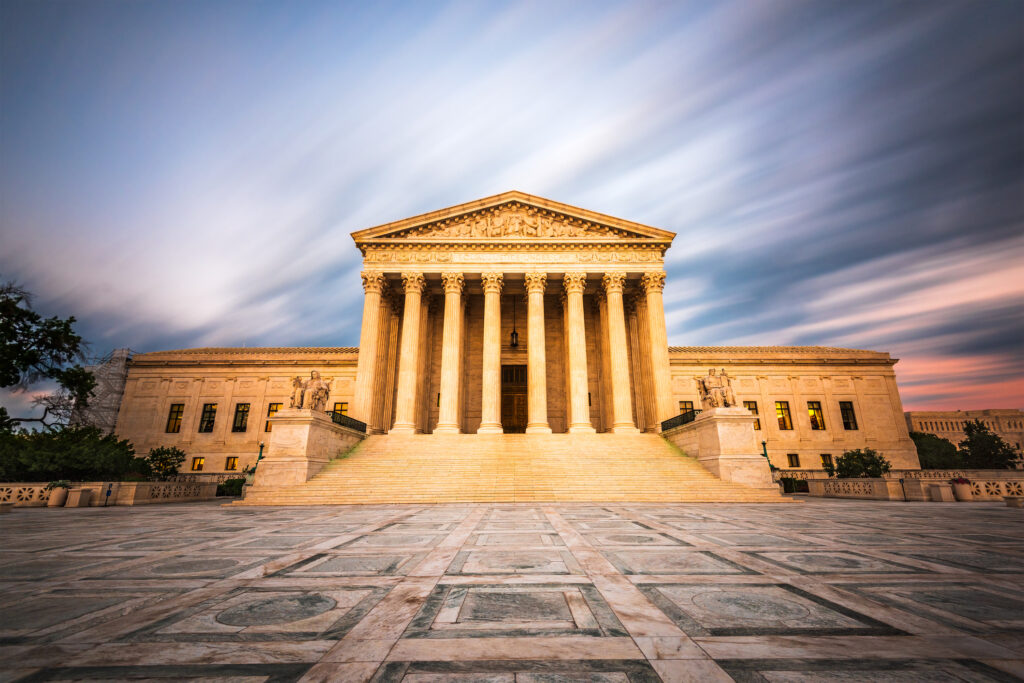
The Center’s response came in the form of high-impact litigation—three separate lawsuits filed by the Center for American Liberty against Newsom’s administration: Gish v. Newsom, Tandon v. Newsom, and South Bay United Pentecostal Church v. Newsom. Each case challenged the constitutionality of the state’s restrictions on religious gatherings, arguing that worshippers were being unfairly targeted and that their First Amendment rights were being trampled under the false pretense of public health. These weren’t symbolic lawsuits—they were hard-fought, uphill battles that ultimately made their way to the U.S. Supreme Court.
And the Center won.
In South Bay United Pentecostal Church v. Newsom, the Supreme Court ruled in favor of the church, setting a precedent that state officials could not impose more severe restrictions on religious institutions than on secular businesses. Tandon v. Newsom reaffirmed that principle, with the Court again siding with the plaintiffs and issuing an emergency injunction against the state. These victories didn’t just affect the parties involved—they helped clarify and reinforce constitutional limits on government power during emergencies nationwide.
Trammell explained, “We’ve won three cases at the United States Supreme Court. We’ve been involved–and continue to be involved–in some of the most consequential civil liberties cases of our time. President Reagan said it really, really well. ‘Freedom is a fragile thing, and it’s never more than one generation away from extinction.'”
He continued, “We all experienced that firsthand during COVID. We saw governors across the country robbing us of our civil liberties; shutting down our houses of worship, shutting down our places of business, shutting down our public forums for speech, debate, and to seek redress from the government. Just a few years ago, we all experienced this firsthand. If it happened a few years ago, it can happen again.”
While these wins were anchored in California, their impact resonated far beyond the state’s borders. They provided legal footing for other churches and religious groups across the country to challenge similar restrictions, forcing state governments to reconsider the scope of their executive powers. And they reinforced the principle that constitutional rights are not suspended in times of crisis—they are tested by them.
The Center’s legal strategy in these cases is a clear reflection of its broader philosophy: challenge unconstitutional policies early, where they’re most aggressively implemented, to prevent their spread nationwide.
Trammell concluded, “Unless there’s organizations like the Center for American Liberty to step in and to file these lawsuits. We’ve just scratched the surface…We’re not slowing down. We’re going to continue, and the impact is going to be felt this year, and in the years ahead.”
READ NEXT: Trump DOJ Vows Balanced Use of FACE Act as Congressional Republicans Push for Repeal