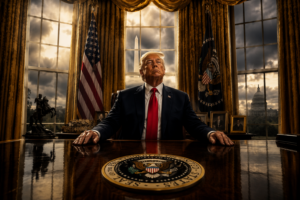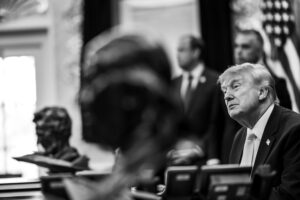
President Donald Trump is treating artificial intelligence as the next major arena of geopolitical competition, arguing that the United States holds a substantial lead over China while warning that the federal government is prepared to intervene if AI companies create national security risks.
In a wide-ranging interview with Axios, Trump described artificial intelligence as a transformative technology with the potential to reshape medicine, economics, national defense, and global power. He also suggested that his administration could use emergency authorities, including the Defense Production Act, if private companies fail to act responsibly.
“It is big,” Trump said. “Nobody’s. I mean, bigger than the internet.”
The comments provide one of Trump’s clearest views yet on artificial intelligence: encourage rapid innovation, maintain America’s technological advantage, and keep government intervention in reserve if companies threaten national interests.
Trump warns AI companies against crossing the line
While Trump emphasized the enormous benefits of artificial intelligence, he also made clear that his administration is monitoring the industry closely.
“You’re going to have medical cures coming up 25 years early because of it,” Trump said. “You’re going to have other things happening, but you have to watch.”
Trump pointed specifically to AI company Anthropic and its chief executive, Dario Amodei, when discussing recent national security concerns.
Asked whether he viewed the company or its leadership as a threat, Trump offered an answer that suggested the administration had recently raised concerns internally.
“Well, not now, but a week ago, maybe,” Trump said.
The president said he met Amodei during the G7 summit and described him as “a nice guy, smart guy.” At the same time, Trump suggested the company responded quickly after administration officials expressed concern.
“He responded to us very quickly, because you know it’s tremendous liability,” Trump said. “People get put in prison immediately for that. You know, you can’t play games with that.”
Not anymore: Trump on whether he sees Anthropic threatening national security
— Rohan Paul (@rohanpaul_ai) June 20, 2026
Axios' Marc Caputo asked Trump: "Do you view Anthropic, and to a degree its CEO Dario Amodei, as a threat to national security?"
President Trump: "Well, not now, but a week ago, maybe….We were in… https://t.co/tC0YgkvNiV pic.twitter.com/PXZ5JPKYF4
Trump did not elaborate on the nature of the concerns involving Anthropic.
Defense Production Act remains an option
The interview also raised the possibility of federal intervention if AI development begins creating serious national security concerns.
When asked whether he would consider using the Defense Production Act to regulate or control AI companies, Trump indicated he would not rule it out.
“I would, but I’m not sure I have to do that,” Trump said. “I think so far it’s been very responsible.”
The Defense Production Act grants the federal government broad emergency powers over private industry during national emergencies and has historically been used during wars, supply shortages, and national crises.
Trump emphasized that he does not currently believe such measures are necessary because the United States remains well ahead of its foreign competitors.
“Well I don’t want to do that because I’m somebody that, you know, we’re beating China by a lot on AI,” he said.
Energy policy tied to AI growth
Trump also credited his administration’s energy policies for helping fuel America’s AI expansion.
According to the president, one of the largest obstacles facing artificial intelligence companies is electricity demand. Massive data centers require enormous amounts of power, placing increasing strain on the nation’s electrical grid.
Trump said his administration addressed the problem by allowing companies to build dedicated power facilities alongside their AI infrastructure.
“I came up with an idea. I thought of it myself,” Trump said. “I let them build their own electric plants when they’re building their factories. That way we don’t have to use an old grid.”
The president described AI’s energy demands as almost difficult to comprehend.
“They need double the amount of electricity that this country produces for everything to run it,” Trump said.
The comments reflect a growing debate within the technology industry over energy production, permitting reform, nuclear power, and the infrastructure necessary to support large-scale artificial intelligence development.
China remains the central concern
Throughout the interview, Trump repeatedly framed artificial intelligence as a strategic competition between the United States and China.
He argued that America’s technological lead should not be sacrificed through international agreements that could limit domestic companies or redistribute advantages to foreign competitors.
“The problem we have is that we are leading everybody by a lot,” Trump said.
Trump has frequently criticized European regulatory approaches to technology, arguing that excessive regulation, high energy costs, and weak economic growth have left much of Europe lagging behind both the United States and China.
His comments suggest the administration views artificial intelligence less as a traditional technology sector and more as a strategic asset with military, economic, and geopolitical implications.
A new doctrine on artificial intelligence
Taken together, Trump’s remarks outline an emerging administration approach to artificial intelligence.
American companies are encouraged to innovate.
Domestic energy production is viewed as essential.
Competition with China remains the overriding concern.
Government intervention remains available if national security issues arise.
The administration also appears reluctant to support international frameworks that could reduce America’s advantage.
Trump summarized the balancing act in simple terms.
“The good far outweighs the bad,” he said. “We are going to find the bad and we’re going to stop it.”
As artificial intelligence becomes increasingly intertwined with economic growth, military capabilities, and national security, the administration appears to be treating the technology not simply as another industry but as one of the defining strategic contests of the 21st century.
READ NEXT: Kennedy Center Defies Critics With New Trump Endowment