After attack ignites major fuel facility in largest air raid on Russian capital since war began…
MOSCOW — Residents across parts of Moscow reported an unusual phenomenon described as “oil rain” after a major Ukrainian drone attack struck one of Russia’s most important oil refineries, sending thick black smoke and petroleum-laden soot into the atmosphere over the Russian capital.
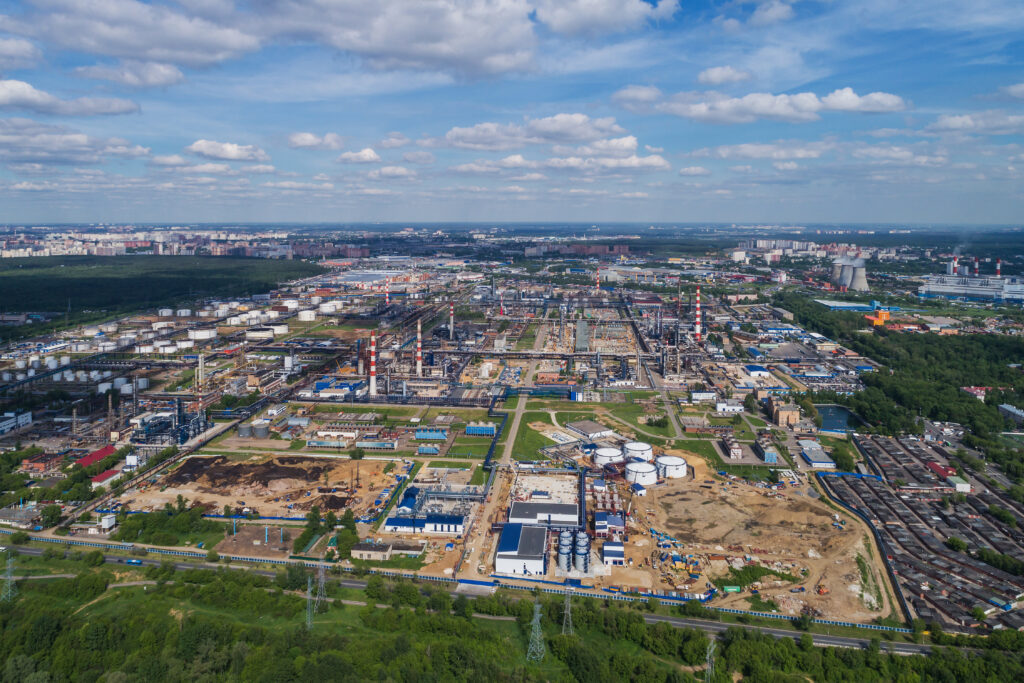
The attack targeted the Moscow Oil Refinery in the southeastern Kapotnya district, a facility that supplies a substantial portion of the capital’s gasoline and diesel fuel. Multiple drones penetrated Russian air defenses and ignited fires at the refinery, producing towering plumes of dark smoke visible across the city of 13.3 million.
HOLY SMOKES! Moscow right now 🔥🔥🔥 pic.twitter.com/Oxz4pLHIwQ
— Kate from Kharkiv (@BohuslavskaKate) June 18, 2026
Social media users and local residents posted images and videos showing dark residue coating vehicles, windows, and outdoor surfaces after smoke from the refinery drifted across nearby neighborhoods. Witnesses described the fallout as resembling oily precipitation or “oil rain,” though authorities have not yet released a formal environmental assessment of the material.
Holy moly.
— Kosher (@koshercockney) June 18, 2026
Moscow is quite literally looking like Mordor right now. pic.twitter.com/DXF6TbWSVE
Largest Strike on Moscow Since the Invasion
The refinery attack formed part of what Ukrainian and Russian officials described as the largest assault on Moscow since Russia launched its full-scale invasion of Ukraine in 2022. Ukrainian drones targeted multiple locations around the capital, forcing temporary disruptions at several major airports and prompting emergency responses throughout the region.
Russia claimed its air-defense systems intercepted hundreds of drones during the operation, though several successfully reached their targets. Moscow Mayor Sergei Sobyanin confirmed that the refinery sustained damage and that emergency crews were dispatched to contain the resulting fires.
The strike was reportedly the second attack on the refinery within days, highlighting Ukraine’s growing ability to conduct long-range operations deep inside Russian territory.
Strategic Energy Target
The Moscow Oil Refinery is among Russia’s most important energy facilities.
Located within the capital region, the refinery processes roughly 12 million tons of crude oil annually and provides a significant share of Moscow’s transportation fuel. The facility also plays a role in supplying fuel to major airports and supporting broader energy distribution networks.
Ukraine has increasingly focused on oil refineries, storage depots, and fuel infrastructure as part of its broader strategy to impose economic and logistical costs on Russia’s war effort. Ukrainian officials have referred to these operations as “long-range sanctions” aimed at reducing Moscow’s ability to finance and sustain military operations.
BREAKING:
— Visegrád 24 (@visegrad24) June 19, 2026
Ukraine launches another massive drone swarm attack on Russia around an hour ago.
Ukrainian drones are attacking the Russian capital city from several directions. pic.twitter.com/E1ygGESVSk
Moscow Residents Caught Off Guard
Many residents said they received little or no warning before the attack.
Unlike cities closer to the front lines, Moscow does not routinely operate public air raid warning systems. Several residents told independent media outlets they first became aware of the strike after hearing explosions, seeing drones overhead, or noticing smoke rising from the refinery.
Videos circulating online showed multiple smoke columns rising above the city skyline while emergency vehicles responded to the scene. Traffic disruptions were reported near the refinery, and authorities temporarily restricted operations at several Moscow-area airports.
The Russian Ministry of Defense reports that approximately 1,000 Ukrainian drones have attacked Moscow.
— Jürgen Nauditt 🇩🇪🇺🇦 (@jurgen_nauditt) June 18, 2026
Let us first note that Ukraine is now capable of launching up to a thousand unmanned aerial systems (UAVs) in a single wave. And it is not merely a matter of possessing such a… pic.twitter.com/HZTGT5sJnl
Escalating Cycle of Retaliation
Ukrainian President Volodymyr Zelensky framed the attack as retaliation for recent Russian strikes on Ukrainian civilian and cultural sites. In public remarks following the operation, Zelensky warned that continued attacks on Ukraine would increasingly bring the consequences of war to Russian territory.
Russian officials responded by pledging additional large-scale strikes against Ukraine and accused Kyiv of deliberately targeting civilian infrastructure.
The attack underscores how the war has evolved into an increasingly long-range conflict in which both sides are attempting to strike strategic infrastructure far from the front lines. As Ukraine expands its drone capabilities and Russia continues missile and drone campaigns against Ukrainian cities, energy facilities have become some of the most frequent targets.
While officials continue assessing the refinery damage, reports of oily residue falling from the sky have added a dramatic visual symbol to a conflict that is increasingly reaching deep into areas once considered far removed from the battlefield.
READ NEXT: Trump Says Goodbye To A Longtime Icon