

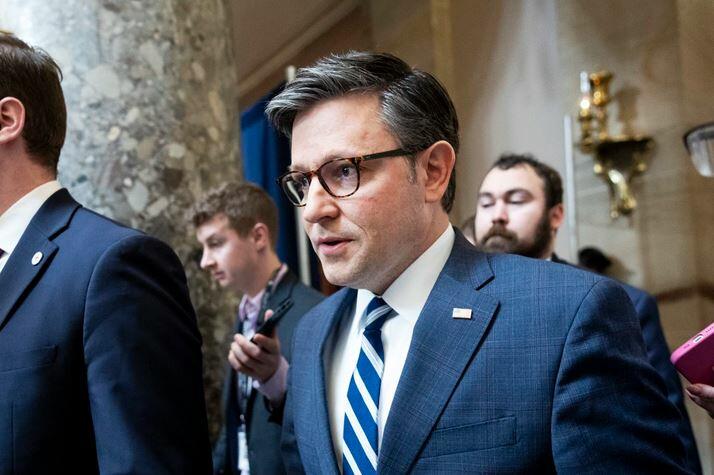
The Republican-controlled House declined Thursday afternoon to override two vetoes by President Donald Trump, underscoring the president’s firm grip on his party even after lawmakers from both parties had backed the bills.
Both measures passed the House and Senate earlier with broad bipartisan support. But when it came time to challenge the vetoes, most Republicans declined to break with Trump, leaving the override effort well short of the required two-thirds majority.
What the vetoes covered
Trump vetoed two separate bills.
One would have helped finance a water pipeline project in Colorado, and the other would have expanded part of the Miccosukee Indian Reservation in Florida’s Everglades.
Supporters described both measures as local or regional priorities with years of bipartisan backing.
As The Hill reports:
A vote to override Trump’s veto on a Colorado water project — a bill spearheaded by Trump ally Rep. Lauren Boebert (R-Colo.) — failed 248-177-1, with 35 Republicans voting with Democrats to override the veto and one Republican, Rep. Nancy Mace (S.C.), voting present.
A vote to override Trump’s veto on expanding lands for the Miccosukee Tribe in Florida failed 236-188, with 24 Republicans joining with all Democrats to override it.
Each of the votes needed a two-thirds majority to succeed and send the matter to the Senate. GOP leaders in the Republican-controlled House did not whip the override votes — which are standard procedure after presidential vetoes — allowing each member to make up their minds themselves.
The vetoes were unusual in that they shot down bills that were considered so bipartisan and uncontroversial that they initially passed through the House and Senate by voice vote and unanimous consent. They passed the House in July and the Senate in December.
Opponents of the vetoes said they believed Trump rejected the bills to punish political enemies and settle political grudges, citing Colorado’s prosecution of former Mesa County elections clerk Tina Peters.
High bar for overrides
Overriding a presidential veto requires a two-thirds vote in both the House and Senate. That threshold is difficult to reach under any circumstances and especially so when the president’s party controls Congress.
On Thursday, the House fell well short. Many Republicans who had earlier supported the bills voted to sustain Trump’s veto or skipped the override effort altogether.
Divisions inside the GOP
A minority of Republicans voted to override the vetoes, arguing that Congress should defend its institutional authority and honor its commitments to constituents.
Rep. Don Bacon of Nebraska said his vote reflected promises tied to the legislation and his belief in Congress’ role as a coequal branch of government.
Others took the opposite view. Rep. Nicole Malliotakis of New York said her voters expect her to stand with Trump, even when that means reversing a prior position on legislation.
Trump’s rationale
In his veto messages, Trump raised fiscal objections to both bills. In the case of the Miccosukee legislation, he also cited broader policy disagreements with the tribe, including its opposition to his immigration policies.
Those arguments gave Republicans political cover to stick with the president, even on measures that had previously drawn bipartisan support.
Why it matters
Veto overrides almost never succeed, and Thursday’s result was no exception. But the outcome sent a clear message: Trump’s influence over House Republicans remains strong heading into a critical election year.
Lawmakers who backed the bills before the veto faced political and strategic pressure not to challenge Trump. That pressure effectively shut down the cross-party coalitions needed to reach override thresholds.
For now, Trump’s legislative priorities remain firmly in control of his party.
This is a breaking news story. Please check back for updates.
READ NEXT: Lawmakers Fast-Track Draconian New Policies



















It is the responsibility of each individual state to supply clean water to every one of its residents. The “Finish the Arkansas Valley Conduit Act”, initiated by the state of Colorado in the 1960s, violates the 10th Amendment. It is a state issue only. There is no provision in the U.S. Constitution that gives the federal government power to spend 1.3 billion federal taxpayer dollars from all 50 states to pay the water bills of 50,000 residents of southeast Colorado. The 10th Amendment is part of every U.S citizen’s “Bill of Rights”. It is the responsibility of every US Congress member to make sure every citizen’s federal taxpayer dollar are spent to carry out the federal government’s eighteen designated duties listed in Article I Section 8 of the US Constitution. Federal taxpayer dollars are not to be spent for an in-state water pipeline that benefits only 50,000 residents of the state of Colorado.