

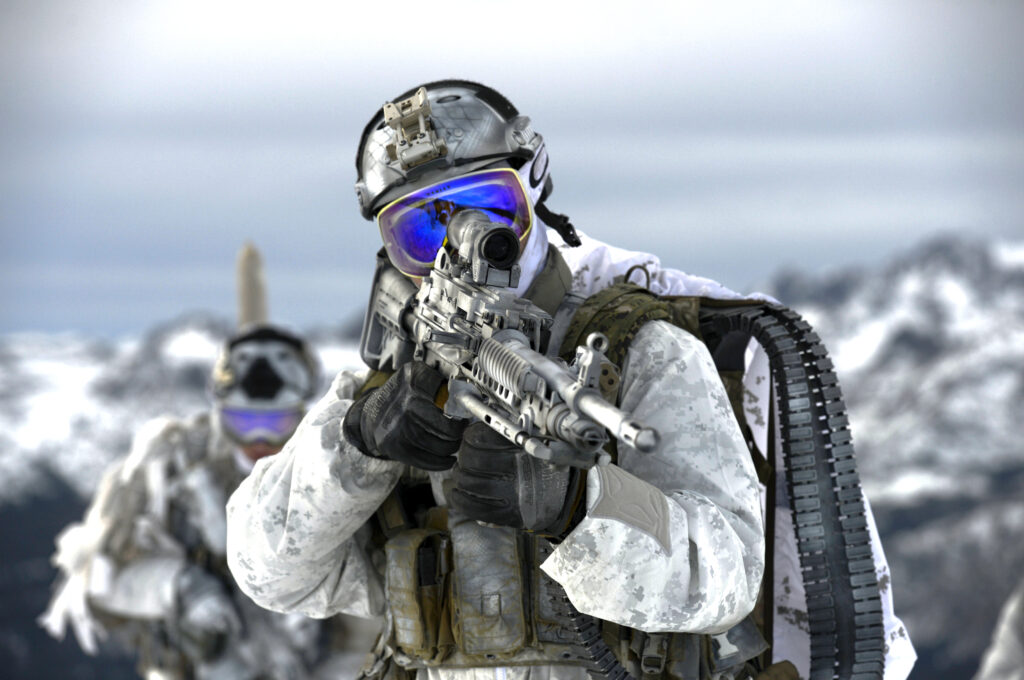
With his talk of buying the giant, autonomous Danish territory, President Donald Trump has reminded us all of the strategic importance of Greenland in recent weeks. But it’s not just Greenland and the Arctic that is critical to U.S. and NATO security, the area between Greenland, Iceland and the U.K., known as the GIUK Gap, also matters.
A key choke point during the Cold War with the USSR for U.S. and NATO naval forces and submarines to hold the line against equivalent Soviet forces attempting to cause havoc in the North Atlantic, the GIUK Gap is gaining new significance.
In decades past, the frozen Arctic acted as a defensive barrier for Russia, but the warming of the North Pole is presenting new opportunities and new risks to both sides.
Receding Arctic ice allows NATO greater access to previously frozen northern waters as well as expansion of Russia’s (and Chinese) naval operations, including new hybrid threats.
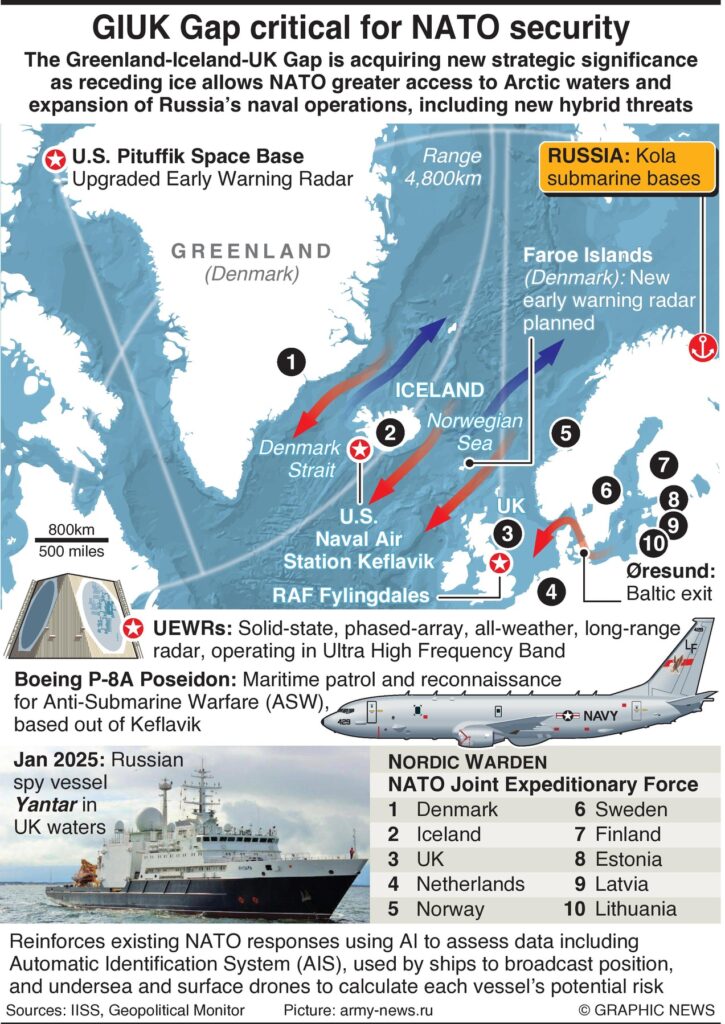
This means that the Gap, long a major maritime choke point, gives whoever controls it a decisive military advantage in the North Atlantic—and after two or more decades of neglect after the end of the Cold War—is again gaining importance for NATO, Russia and even China.
NATO can leverage its control of the GIUK Gap to improve surveillance of the Russian Navy in the Arctic, deploy forces in once-restricted areas, and more effectively challenge Russia’s defense strategy.
Russia for its part has intensified its Arctic militarization to secure control over polar shipping lanes, energy resources and military access points as well as for defensive purposes.
It has expanded its naval presence, deployed missile systems and ramped up weapons testing in the Arctic.
Meanwhile, our greatest adversary, and now Russian ally, communist China, is asserting itself as a “near Arctic” power, piggybacking on Russian efforts in the region.
China has deployed dual-use vessels capable of serving both military surveillance and civilian research functions in the region to collect data and secure access to resources and shipping lanes emerging as a result of melting ice.
In December, the then-deputy assistant secretary of defense for Arctic and Global Resilience, warned that Beijing is increasingly eyeing the Arctic as a domain to further China’s power and economic resources, mostly on the Pacific side of the equation.
As Defense News noted:
Those concerns have been amplified by a swarm of recent military activity in the region. Despite Russia approaching its third year of war following its February 2022 invasion of Ukraine, it has remained committed to directing military and economic resources to the region — at times with China by its side.
In summer 2023, Russian and Chinese militaries conducted joint training in the Bering Strait, a strategic waterway separating Russian and Alaskan peninsulas. Joint air exercises and patrols by the two nations’ coast guards have since added to the uneasiness stirring in the Pentagon.
Also in December, Canada unveiled a new security policy detailing plans to enhance its military and diplomatic presence in the Arctic. More recently, NATO is increasing its focus on Greenland and beyond.
In January, NATO activated a 10-nation, U.K.-led Joint Expeditionary Force (JEF) called Nordic Warden, to reinforce existing and planned NATO responses to Arctic threats.
Following the apparent sabotage to a major undersea cable in the Baltic Sea, it will be particularly focused on potential threats to undersea infrastructure and monitoring the Russian shadow fleet.
Using AI to assess data from a range of sources, including the Automatic Identification System (AIS) that ships use to broadcast their position, undersea and surface drones, Nordic Warden will calculate the risk posed by each vessel entering areas of interest, so forces can be quickly deployed.
Expect the Arctic, including the GIUK Gap to get increasingly hot in the next few years, geopolitically as well as temperature-wise.
The opinions expressed in this article are those of the author and do not necessarily reflect the positions of American Liberty News.
READ NEXT: Trump’s Executive Action Sends Shockwaves – Was It Even Necessary?




















Why we need a New Camp Century & Naval sub base in Greenland 2