

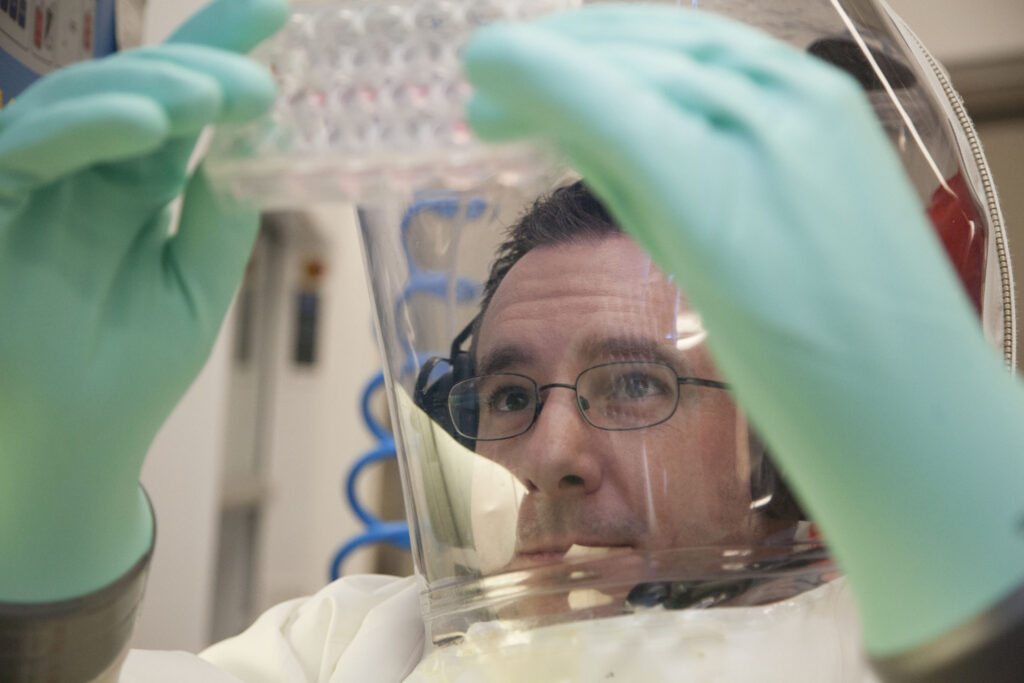
The discovery of an illegal Chinese bioagent lab in Fresno County unsettled many Americans because it forces a simple question, although the answer is anything but simple. Why was a clandestine laboratory stocked with infectious viruses, bacteria, engineered mice, and deep freezers operating inside the United States without oversight or authorization? The natural temptation is to treat the Reedley incident as an anomaly. That temptation is unwise. What was uncovered in that empty warehouse suggests a more troubling pattern of foreign activity inside the U.S. that deserves careful scrutiny, calm analysis, and immediate action.
A reader encountering this issue for the first time may feel puzzled about why a single building in a small California town matters. The scale of what investigators found clarifies the point. Prestige BioTech, a Chinese-owned firm registered in Nevada but unlicensed in California, had taken over an abandoned warehouse and filled it with pathogens that no private entity should ever possess. City code enforcement officers discovered the operation only because they noticed a garden hose running into the structure. What they found inside demonstrates how a minor curiosity can uncover something far more serious.
Investigators identified infectious bacterial and viral agents, including malaria, rubella, HIV, chlamydia, E. coli, streptococcus pneumonia, hepatitis B and C, and herpes 1 and 5. They found 900 genetically engineered Ace-2 humanized mice designed to catch and carry multiple COVID strains. Another 175 mice were found dead in cages under what authorities described as inhumane conditions. The CDC later identified at least 20 infectious agents, among them coronavirus, HIV, hepatitis, herpes, respiratory syncytial virus, dengue, and tuberculosis. Deep cold research freezers held samples of parasites, including malaria strains traced to Nigeria in 2000 and India in 2006. No one has provided a credible explanation for why Prestige BioTech possessed any of these materials.
At this point, a reader might ask whether Prestige BioTech was simply sloppy rather than malicious. The evidence offers little comfort. The company president, Xiuquin Yao, appeared in court documents only through email. Addresses listed for corporate officers led to empty offices or unverifiable locations in China. Thousands of packages with Chinese shipping labels were stacked throughout the facility, yet the people associated with the company refused to answer basic questions from local officials. This pattern suggests intent to obscure, not intent to comply.
Another point of confusion concerns how an unlicensed foreign-controlled lab obtained support from California authorities. Prestige BioTech, despite lacking authorization to operate in the state, received a $360K tax credit allocation from the Governor’s Office of Business and Economic Development in 2019. The credit was originally granted to Universal Meditech, a company that relocated to the Reedley warehouse after a fire. Prestige BioTech appeared as a creditor to UMI in court filings, yet neither entity maintained transparent operations or verifiable oversight. An ordinary reader could understandably view this as an administrative oversight. The nature of the lab’s contents makes that explanation inadequate. When a government issues financial incentives to entities linked to unregulated biological research, the risk is not bureaucratic embarrassment. The risk is national security failure.
Still another question arises. Could this have been an isolated case, a bizarre convergence of mismanagement, evasion, and local confusion? The answer depends on whether we believe China is interested solely in regulated, cooperative research inside the U.S. Given China’s record on intellectual property theft, covert police stations in American cities, cyber intrusions targeting federal agencies, and its documented ambitions in biotechnology, the assumption of innocence is difficult to defend. Intelligence analysts have long warned that China views biology as a strategic domain comparable to cyberspace. A clandestine lab stocked with infectious agents fits squarely within that strategic picture.
The Reedley discovery also illuminates a structural problem within the U.S. itself. The lab came to light not because of a federal security apparatus but because two local employees noticed a hose. This fact should trouble anyone concerned about national resilience. A country cannot detect biological threats consistently if it relies on luck. Local officials, including Reedley’s code enforcement team, the Fresno County Department of Public Health, and later the CDC and FBI, displayed commendable professionalism. Their work prevented potential harm that is difficult to quantify. Yet the larger national implication is that a single oversight could have allowed a foreign-controlled bioagent operation to function indefinitely.
Some might ask whether this interpretation is too alarmist. Perhaps the lab posed little real risk. That possibility deserves consideration, but the evidence argues otherwise. Pathogens like tuberculosis, HIV, dengue, and engineered COVID strains are not harmless. They become more dangerous when handled without safety protocols. Humanized mice used for viral research suggest experimentation with transmission and virulence. The combination of infectious agents, engineered animals, and a refusal to provide information is not the profile of an innocuous enterprise. Even if one assumes no malicious intent, the recklessness alone makes the operation intolerable.
Another concern involves the geopolitical environment. China has invested heavily in biotechnology, gene editing, and synthetic biology, often through opaque companies operating abroad. When a foreign adversary develops platforms for manipulating biological agents, the possibility of dual-use research is always present. A facility like the Reedley lab blurs lines that should remain clear. Without transparency, oversight, and lawful cooperation, biological work on US soil by a foreign adversary cannot be treated as benign.
The question that presses hardest is whether more labs like this exist. Authorities have not disclosed evidence of additional facilities, but absence of evidence is not evidence of absence. The fact that a small California town inadvertently uncovered one illegal Chinese biolab argues strongly for a broader, nationwide review. National security failures are often revealed through minor incidents that expose much larger vulnerabilities. The Reedley lab may be one such incident.
A prudent reader may also wonder why a foreign company would risk operating such a facility in the open instead of hiding it offshore. The answer lies partly in access. The U.S. offers advanced infrastructure, logistical networks, and proximity to research institutions. A covert operation inside the U.S. can exploit conveniences unavailable elsewhere. It can also evade certain export controls or inspections by positioning itself within the country it intends to study. Prestige BioTech’s choice of location was not irrational. It was opportunistic.
It is also important to consider how the Reedley case fits within China’s broader pattern of overseas activity. China has run overseas police operations disguised as cultural centers. It has monitored dissidents abroad through informal networks. It has acquired farmland near U.S. military installations and sought investment pathways into critical supply chains. A biolab operating without authorization aligns with a strategic posture oriented toward infiltration rather than cooperation. This does not prove malicious intent, but it shifts the burden of proof decisively onto those who claim the lab posed no threat.
We should also examine why federal agencies were not aware of the operation. The presence of specialized freezers, large numbers of engineered mice, and thousands of shipped containers should have triggered regulatory flags. That they did not suggests gaps in interagency oversight. The U.S. cannot afford these gaps at a time when biological threats, both natural and engineered, represent one of the most significant national security challenges of the century.
Some may fear that highlighting this issue risks inflaming anti-Chinese sentiment. Concern about national security should not be confused with prejudice. Many Chinese Americans contribute meaningfully to U.S. science, business, and public life. The problem here is not ethnicity. It is the behavior of a foreign adversarial government and the companies operating under its influence.
The Reedley discovery should therefore be treated as a warning, not an isolated curiosity. The U.S. must implement a thorough investigation into foreign-controlled biological research on its soil. It must audit tax credits, business registrations, warehouse leases, laboratory imports, and scientific supply chains. It must examine corporate ownership structures for entities with ties to adversarial governments. And it must establish a system of detection that does not rely on a garden hose to reveal biohazards.
The American people deserve clarity. They deserve to know whether foreign powers are conducting biological work that bypasses U.S. law, oversight, and public safety. They deserve institutions capable of identifying and stopping such activity. Most of all, they deserve a government that treats national security with sobriety instead of complacency. The discovery in Fresno County presents an opportunity to correct vulnerabilities that should never have existed. Whether that opportunity is taken depends on whether we regard this case as an aberration or a sign of things to come.
If you enjoy my work, please subscribe: https://x.com/amuse.
Sponsored by the John Milton Freedom Foundation, a nonprofit dedicated to helping independent journalists overcome formidable challenges in today’s media landscape and bring crucial stories to you.
READ NEXT: House Advances DHS Funding Bill With 7 Democrats Breaking Party Line On ICE


















This crap needs to stop NOW
Why is there no mention of when any of what was outlined in the article occurred. Did this all happen 5 years ago or last month?