

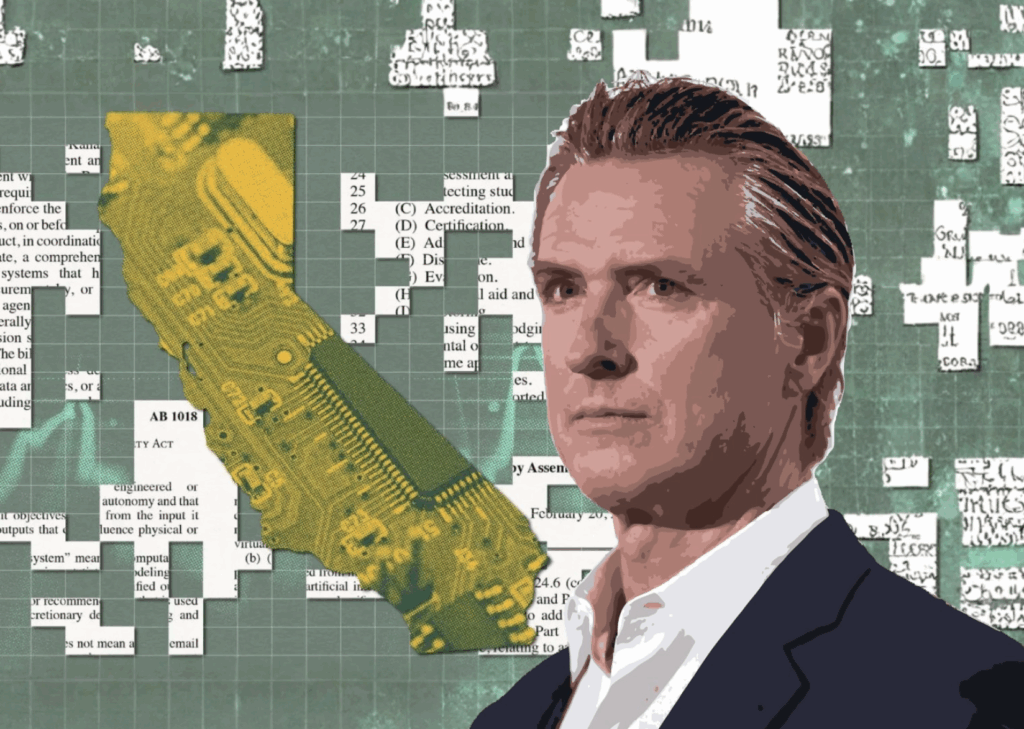
On March 30, 2026, California Governor Gavin Newsom signed Executive Order N-5-26, a document he called a “trusted AI” initiative. The name sounds benign, even admirable. Who could oppose trusted AI? The answer, once you read past the branding, is anyone who has watched California use regulatory power as a political instrument for the past two decades. This order is not primarily about safety. It is about control, and the mechanism it establishes, deliberately vague, deliberately discretionary, and explicitly designed to shape national market behavior, is one of the most consequential threats to free expression and technological competitiveness that conservatives have faced in a generation. Congress must act now to establish a national AI framework under President Trump’s direction. The alternative is to cede both the AI race and the information landscape to the ideological preferences of Sacramento and, ultimately, to the strategic ambitions of Beijing.
— @amuse (@amuse) March 20, 2026
Start with what the order actually does, because the details matter enormously. The order instructs California’s Department of General Services and Department of Technology to develop new “certifications” that AI vendors must satisfy to sell to the state. These certifications require vendors to attest that their systems do not engage in “harmful bias,” do not violate “civil rights and civil liberties,” including “free speech, voting, human autonomy,” and do not enable undefined “misuse.” The order also directs expansion of generative AI inside state government and creates a mechanism allowing a state official to review, and potentially override, federal supply-chain risk designations for AI companies in state procurement. On its face, the order reads like a responsible effort to ensure that taxpayer dollars fund responsible technology. In practice, it is a loaded regulatory weapon, and the ammunition is deliberate vagueness.
Consider what “harmful bias” means in California’s regulatory ecosystem. The order does not define it. It does not specify whether “bias” refers to statistical error rates, disparate impact across demographic groups, representational imbalances in training data, or, the most dangerous possibility, ideological content that state officials find objectionable. It does not establish a baseline for what counts as “unbiased,” does not define what “governance” means in measurable terms, and does not specify what evidence a vendor must produce to satisfy the state. That is not an oversight. Vague standards are a feature, not a bug, for regulators who want discretion. When the definition of compliance is left to the officials administering the certifications, those officials can apply the standard selectively, rewarding vendors whose outputs align with the preferred political narrative and penalizing those whose models produce results the left finds inconvenient.
The same logic applies to the order’s “civil rights and civil liberties” bucket, which the order says includes “free speech, voting, human autonomy,” and protections against unlawful discrimination, detention, and surveillance. This list is remarkable for its incoherence. Free speech raises First Amendment questions. Voting implicates election integrity and political speech, two domains where California’s political class has consistently pursued outcomes that disadvantage conservative voices. “Human autonomy” is undefined by nature, and its inclusion appears to give state officials a catch-all to classify any AI output they dislike as a threat to some unarticulated human interest. Most telling is the phrase “including but not limited to,” which appears in the order’s certification criteria. That language is a blank check. It means the categories can expand at any time through procurement guidance, without legislative debate, without public comment, and without judicial review until a vendor has already been excluded from the market.
Here is where the censorship mechanism becomes concrete. Vendors who want to sell to California must satisfy certifications that will be written and administered by state officials. Those officials will operationalize the order’s vague standards into content rules, guardrails, output restrictions, and monitoring requirements. The development of those restrictions will track the ideological preferences of the administering officials, not some neutral technical standard, because no neutral technical standard for “harmful bias” or “misuse” exists. A conservative political argument, a critique of open-border immigration policy, a factual statement about biological sex, any output that California officials classify as “harmful” or as a violation of some undefined civil right could become a compliance liability for any vendor that wants to remain in the California market. Vendors, facing that uncertainty, will do what rational economic actors always do when confronted with undefined regulatory risk: they will over-comply. They will build the most restrictive possible moderation systems, the tightest guardrails, the most aggressive content filters, not because those restrictions are technically necessary or legally required, but because the cost of being labeled noncompliant is exclusion from one of the largest government procurement markets in the world. The result is soft censorship at industrial scale, imposed not by statute but by procurement eligibility, and therefore largely insulated from First Amendment scrutiny, at least in the short term.
The White House’s own AI executive order recognized exactly this risk, warning that certain state AI laws may require models to “alter their truthful outputs” in ways that could implicate the First Amendment, and that state-level regulation may embed “ideological bias” into AI systems under the guise of safety. The Trump administration’s concern is not hypothetical. Constitutional law has long recognized that the government cannot use the conditional offer of a benefit, including a government contract, as a backdoor mechanism to compel speech or punish viewpoints. That doctrine, known as the unconstitutional conditions principle, will eventually become the legal battleground for orders like this one. But litigation takes years, and the market-shaping effects will arrive long before any court ruling.
The market-shaping effects are not incidental. They are the point. Newsom’s official announcement frames the order explicitly as a counterweight to federal AI policy, emphasizing California’s status as the world’s fourth-largest economy and its power as a buyer to set market standards. The order itself states that “public procurement represents one of the most powerful tools available to governments to shape market behavior.” That sentence is a confession. This is not internal California housekeeping. It is an explicit attempt to use state purchasing power to export California’s ideological preferences onto the national AI market.
Economic scholarship on regulatory dynamics, particularly the literature on what researchers call “California Effects,” explains why this works. When regulatory requirements vary across jurisdictions, the costs of running separate compliance systems for each jurisdiction often push firms to standardize on the strictest standard, because differentiation is expensive, especially for complex unified technical systems like large language models. Model weights, safety layers, content policies, logging systems: these are not easily fragmented at state borders. A vendor that wants to operate in California and everywhere else will build one system, and that system will reflect California’s certification requirements. The practical result is a two-tier national market: “California-certified” AI vendors whose outputs conform to Sacramento’s ideological expectations, and everyone else, effectively locked out of one of the most significant government procurement ecosystems in the country. Fifty states pursuing their own AI certification regimes would produce 50 overlapping and potentially contradictory compliance obligations, a burden that crushes startups, entrenches large incumbents with the legal and lobbying capacity to navigate complexity, and hands a decisive structural advantage to China’s state-directed AI sector, which operates under no such fragmented regulatory overhead.
That last point deserves extended treatment, because the strategic stakes are not abstract. The United States and China are engaged in a direct competition for AI supremacy, a competition whose outcome will determine not merely technological leadership but military advantage, economic productivity, and the structure of the global information environment for the next several decades. China’s approach to AI development is centralized, well-funded, and explicitly strategic. The Chinese Communist Party has identified AI as a core priority for national power and has directed resources accordingly, without the friction of fragmented state regulation, without the compliance overhead of 50 competing certification regimes, and without the ideological quarrels that California’s order will inject into the American AI ecosystem. American AI companies competing in that environment need regulatory frameworks that are clear, predictable, minimally burdensome, and nationally uniform. What they are getting instead, in the absence of federal preemption, is a patchwork of state-level certification requirements driven by the political preferences of governors who are positioning themselves for national office. If Congress does not act, the innovation tax imposed by that patchwork will fall disproportionately on American startups, will slow the deployment of American AI capabilities, and will gradually shift the technological frontier toward Chinese competitors who face no analogous friction. Surrendering the AI race to China by regulatory self-sabotage is not a metaphor. It is a predictable operational consequence of allowing Newsom’s model to proliferate.
Ironically, California’s own commissioned policy work anticipated this danger. California’s 2025 Frontier AI Policy report explicitly warned against a “patchwork approach” to AI regulation and stressed that harmonization is “critical to reducing compliance burdens.” EO N-5-26 advances a new state-specific certification regime on subjective, undefined topics while the ink on that warning is barely dry. The left hand of California’s AI policy apparatus is writing reports cautioning against exactly what the right hand is now implementing. That inconsistency is not a policy error. It is a political calculation: the report provides intellectual cover for the claim that California is acting responsibly, while the order delivers the actual regulatory power that Newsom’s political operation wants.
What Congress should do is straightforward in principle, even if the politics are complicated. President Trump’s AI framework offers a model: a national standard that is minimally burdensome, focused on genuine safety concerns, and preemptive of state laws that impose ideological certification requirements or effectively regulate beyond state borders. That framework should include explicit preemption language covering state procurement schemes that function as general market regulation, not merely proprietary purchasing choices. It should establish clear, measurable standards for what AI safety means in federal and federally-influenced procurement contexts, leaving no room for the kind of discretionary, undefined “harmful bias” gatekeeping that Newsom’s order enables. And it should include enforcement mechanisms, including the litigation function that the White House executive order already contemplates, to challenge state laws and orders that impose extraterritorial effects on the national AI market.
The objection will come that federal preemption of state procurement policy is constitutionally aggressive, that states have traditionally enjoyed broad authority over their own purchasing decisions. That objection has merit in general but misses what makes Newsom’s order different. The order is not a narrow proprietary purchasing choice. It is, by the governor’s own account, a deliberate exercise of market power to shape national behavior. The Supreme Court has held that state debarment schemes can be preempted when they are functionally regulatory rather than genuinely proprietary, and the dormant Commerce Clause has historically scrutinized state policies with impermissible extraterritorial effects. California has designed an order intended to work exactly like general national regulation while wearing the procedural clothes of a procurement policy. Congress is entitled, and arguably obligated, to respond to that by establishing the national standard that the order is attempting to preempt.
There is also the supply-chain override provision to consider, a feature of the order that has received less attention than it deserves. The order directs a state official to review new federal supply-chain risk designations for AI companies and, if the official deems the designation improper, to issue guidance allowing California agencies to continue procuring from the flagged company. This is a direct mechanism for California to neutralize federal national security determinations in state purchasing, creating a formal conflict between state and federal judgment on questions, specifically the security risk profiles of AI vendors, that have obvious implications for defense and intelligence. Recent federal risk designation activity in the AI sector, including designations involving companies whose technologies touch sensitive government systems, illustrates that this is not a theoretical power. It is a live friction point between Sacramento’s political preferences and Washington’s security apparatus. Congress should address this directly in any national framework, because allowing states to selectively override federal supply-chain risk determinations for ideological or political reasons is not a permissible exercise of state procurement authority. It is a national security problem.
The deeper principle at stake is not merely the structure of AI regulation, though that matters enormously. It is whether the left will be permitted to use the regulatory apparatus of large blue states to tilt the information environment in its favor before the legal and political system can catch up. AI systems are becoming the substrate of how Americans consume information, make decisions, and understand the world. A regulatory regime that allows state officials to define “harmful bias” and “misuse” without clear standards, and to use those definitions as eligibility criteria for the companies that build information infrastructure, is a regime designed for political capture. It does not matter whether Newsom personally intends that outcome. The structure invites it, and the people who will eventually administer these certifications in California will not be neutral technocrats. They will be appointed by governors and agency heads whose constituencies have a direct interest in AI systems that suppress conservative viewpoints under the administrative language of “safety.” Congress must close that door now, while the national AI architecture is still being built. The alternative is to find, a decade from now, that the information infrastructure of American life has been quietly shaped by a certification regime designed in Sacramento, and that the tools to challenge it have long since been exhausted.
If you enjoy my work, please subscribe: https://x.com/amuse.
Sponsored by the John Milton Freedom Foundation, a nonprofit dedicated to helping independent journalists overcome formidable challenges in today’s media landscape and bring crucial stories to you.
READ NEXT: Explosive Trump Ruling Looms — Millions Could Be Affected



















Who can’t laugh at slick haired NEW SCUM? And who could possibly not ignore the morons not so bright ideas? They try so hard to trash the constitution!