


The Citizenship Clause of the 14th Amendment contains 14 words before the comma, and three of them still do most of the work. All persons born or naturalized in the United States, and subject to the jurisdiction thereof, are citizens of the United States. Those words are spare, yet they direct the reader toward a demanding idea: citizenship follows allegiance. President Trump’s Executive Order 14160 asks whether a birth that occurs while both parents lack any lawful and durable tie to the U.S. satisfies that condition. The answer, rooted in text, history, structure, and the very logic of membership, is no.
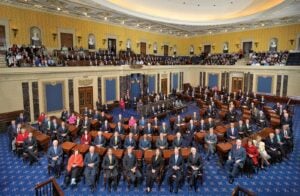
Today, April 1, 2026, that answer reaches the Supreme Court of the United States. The justices are hearing oral argument in Trump v. Barbara, the first case to squarely test the constitutional meaning of birthright citizenship since United States v. Wong Kim Ark in 1898, and the first case in American history in which a modern sitting president has walked through those bronze doors to watch his own policy argued. President Trump is in the courtroom. The visual is stark and deliberate. This is not a peripheral executive action being defended by a deputy assistant. This is the central domestic legal question of his second term, and he has made its significance plain by his presence. The moment is historic and the stakes are the highest they have ever been: who, as a matter of constitutional law, qualifies as an American.
Begin with the text itself. If the framers meant that every birth on U.S. soil confers citizenship, the qualifying phrase would serve no function. They did not say, all persons born in the United States are citizens. They wrote, born here and subject to the jurisdiction. Senator Lyman Trumbull explained the point with precision: being subject to the jurisdiction required owing no allegiance to any other sovereign and being under the complete jurisdiction of the United States. The 1866 Civil Rights Act used an almost identical formula, all persons born in the United States and not subject to any foreign power, excluding Indians not taxed, are citizens. The drafters understood the phrases as equivalent. Senator Jacob Howard, who introduced the Clause, described its scope as excluding the children of foreigners, aliens, and families of ambassadors or ministers. Senator Reverdy Johnson agreed and tied jurisdiction to allegiance to the United States at birth. Representative John Bingham had earlier distilled the same idea: citizenship attaches to those born here of parents not owing allegiance to a foreign sovereignty. The shared theme, expressed again and again in the legislative record, is allegiance rather than geography.
CITIZENSHIP: The UK ended birthright citizenship in 1983. Australia did so in 1986. India did in 1987. Ireland followed in 2005. New Zealand followed in 2006. Many European democracies have long required a parental tie. Canada and the United States have stood almost alone among… pic.twitter.com/JALwmSEGq6
— @amuse (@amuse) December 8, 2025
Some readers may worry that such statements were stray remarks. They were not. They reflected the Clause’s moral purpose. After the Civil War, Congress wanted to secure citizenship for freedmen who had been born here and owed allegiance here, yet had been denied membership in the political community. The goal was to lock in citizenship for those who already belonged, not to extend an open invitation to secure automatic membership through the accident of place. The jurisdictional language mattered because it directed the guarantee toward those who stood fully within American authority. The framers sought to protect an existing community, not to create an unconditional worldwide right to citizenship by mere geography.
Early judicial exposition aligned with this understanding. The Supreme Court in the Slaughter-House Cases read the Clause as excluding the children of ministers, consuls, and citizens or subjects of foreign states. In Elk v. Wilkins the Court denied birth citizenship to a Native American born within U.S. territory because at birth he owed allegiance to his tribe, a distinct sovereign. Congress later enacted the Indian Citizenship Act in 1924 to confer citizenship on Native Americans, which would have been unnecessary if territorial birth alone sufficed. The executive branch followed the same path. Secretaries of State Frederick Frelinghuysen and Thomas Bayard declined to treat certain U.S.-born children of transient foreign nationals as citizens, explaining that births implying alien subjection did not create citizenship by force of the Constitution alone. In the formative generation after ratification, jurisdiction meant more than latitude and longitude. It meant allegiance, and allegiance was indexed to the parents’ standing, including their domicile and permission to remain.
Critics often invoke Wong Kim Ark as though it answered the entire question. It did not. The Court held that a child born in San Francisco to Chinese subjects whose parents were lawfully and permanently domiciled in the United States was a citizen. That holding is careful and its facts are specific. The opinion repeatedly emphasized that the parents were resident aliens with an established and permanent domicile. The Court preserved traditional exceptions for diplomats and hostile occupiers, and it did not consider, let alone decide, the case of children born to those present unlawfully or temporarily. Extending Wong beyond its facts converts a precise holding about the children of lawful permanent residents into an unwritten rule for every newborn regardless of parental status. The majority did not write such a rule. The dissent warned explicitly against it. Read correctly, Wong is entirely consistent with the view that parental domicile and lawful permission to remain are central to jurisdiction in the constitutional sense, which is precisely the line President Trump’s order draws.
The Clause’s structure reinforces this reading. In the Constitution, jurisdiction is a demanding concept. It is not a synonym for physical control at a single moment. It marks a relation of rightful governance and reciprocal obligation. People temporarily present are physically within the government’s reach, yet their allegiance remains elsewhere. The diplomat’s child is the canonical illustration. The diplomat is within U.S. territory and subject to some local laws, yet everyone agrees the diplomat’s child is not a citizen at birth. Why? Because the Clause concerns membership rather than geography. A baby born to two tourists leaves the hospital with a passport to the parents’ nation because allegiance follows parentage when domicile does not tie the family to the United States. The order before the Court today draws exactly that line.
CITIZENSHIP: China is paying American women to carry Chinese babies so the child gets a US passport, then immediately returns to China. Motels of surrogates were found in California. SCOTUS will decide next year if this loophole is even legal. pic.twitter.com/OOIiEXkxXj
— @amuse (@amuse) December 8, 2025
President Trump’s order reflects this logic and channels it into a prospective rule. If at least one parent is a U.S. citizen or a lawful permanent resident, the child is a citizen at birth. If neither parent has that status, the child is not. No one loses citizenship retroactively. No one is denationalized. The order operates prospectively and leaves untouched the ordinary path of naturalization. It closes a gap that has widened between original meaning and modern administrative drift. It gives clear notice, avoids collateral hardship, and is restrained in design. It aligns the U.S. with peer democracies that require some parental tie for automatic birth citizenship. The United Kingdom tightened its rule in 1983. Australia did so in 1986. India did so in 1987. Ireland followed in 2005. New Zealand in 2006. Many European democracies have long required a parental tie. Canada and the U.S. have been outliers. It is no mark of constitutional virtue to maintain a policy that peer nations have independently concluded is unwise.
Today’s argument will test how the justices read that policy against the challenge that Wong Kim Ark controls the outcome. It does not, for the reasons already stated. But opponents of the order have also pressed a procedural argument that has received surprising traction in the lower courts: that a single district court judge may issue a nationwide injunction blocking the enforcement of a presidential executive order against all persons everywhere, not merely the parties before the court. That question, which the Court consolidated with the substantive one, deserves equal attention. The practice of nationwide injunctions by individual trial courts represents a structural deformation of the federal judiciary. It allows a single judge to nullify executive policy on behalf of the entire country on the basis of a preliminary record, before full briefing, and before any appellate review. The Court should use this case to impose limits on that practice regardless of how it resolves the citizenship question, because the rule of law depends on a functioning judicial hierarchy rather than on whichever district judge a plaintiff’s lawyer can reach first.
Some will say the order is un-American in spirit. The contrary is true. Citizenship is a reciprocal status. It is a bond of protection and allegiance. It is not a prize for successful travel or a reward for unlawful entry. Restoring the role of allegiance honors the basic republican premise that a people governs itself by consent, and that consent includes deciding the terms of membership. Citizens’ children and lawful permanent residents’ children belong by birth because their families stand within the country’s durable jurisdiction. Children of tourists, foreign students, temporary workers, and unlawful entrants are not citizens at birth because their families do not. That distinction is neutral. It applies equally regardless of race or national origin. It creates no permanent bar to membership. It preserves and respects the naturalization process. It is not punitive. It is equality under law.
Others will fear administrative complexity or raise the specter of statelessness. Both concerns dissolve under examination. Administrative systems already verify parental identity and status for a range of federal programs. Adding a single inquiry, whether at least one parent is a citizen or a lawful permanent resident, is feasible and proportionate. Statelessness does not follow because most nations confer citizenship by descent, and Congress has always had authority to address edge cases through statute, as it did in 1924 for Native Americans. The policy rationale is, moreover, affirmative and substantial. Unconditional birthright citizenship creates a market incentive that encourages birth tourism and drives smugglers to promise a downstream sponsorship benefit when the child reaches adulthood. It distorts immigration choices, burdens state governments that have no say in how citizenship is allocated, and turns the most consequential legal status in the nation into a commodity. A rule requiring a citizen or lawful permanent resident parent removes those incentives at the source.
Still others raise reliance. The argument is that decades of administrative practice counsels against disturbing the current rule. But reliance on a constitutional error is not a reason to perpetuate it. The order is prospective precisely to protect legitimate expectations. It changes no one’s past or present status. And the people themselves rely on the Constitution to mean what it says. If the Court concludes that administrative practice has drifted from original meaning, the answer is to restore meaning, not to canonize the drift.
President Trump’s presence in the courtroom today is, in one sense, unusual. Sitting presidents do not typically attend oral arguments. In another sense, it is perfectly fitting. The question before the Court, who is a citizen of the United States, is among the oldest and most fundamental questions in American law. It was asked and partly answered in 1866, addressed again in 1898, and left unresolved by a century of lower court assumptions rather than judicial holdings. The justices now have the opportunity, and the obligation, to supply the clarity that has been avoided for too long.
The path to a sound ruling is clear. The Constitution does not compel citizenship by birth when neither parent has a lawful and durable tie to the United States. That principle preserves citizenship for the children of citizens and lawful permanent residents. It leaves the naturalization process intact for everyone else. It reconciles the Clause’s text with early judicial and executive practice. It gives coherence to the diplomat exception and the 1866 Act’s parallel language. It aligns the U.S. with peer democracies that long ago concluded allegiance and geography are not the same thing. And it restores the first sentence of the 14th Amendment to what the Reconstruction Congress actually wrote, a sentence whose clarity has been obscured by administrative drift, lower court assumptions, and the accumulated weight of a practice that was never examined at the highest level.
Citizenship is the nation’s most consequential legal status. It ought to rest on a genuine bond of allegiance, not on the accident of place. Today, the Court has the chance to say so. It should.
CITIZENSHIP: The 14th Amendment was not intended to grant citizenship to children of undocumented immigrants. It was meant to provide citizenship to former slaves and their descendants. If SCOTUS doesn't correct this error there is something Trump could do: Simply grant all… pic.twitter.com/2DuhzYbulY
— @amuse (@amuse) December 8, 2025
If you enjoy my work, please subscribe: https://x.com/amuse.
Sponsored by the John Milton Freedom Foundation, a nonprofit dedicated to helping independent journalists overcome formidable challenges in today’s media landscape and bring crucial stories to you.
READ NEXT: Judge Moves To Block Trump Plan After Unexpected Military Reveal


















Frankly, the SG was literally all over the place on this during oral arguments, and it wasn’t very satisfying – it sounded to me as if he was trying to straddle at least two fences at the same time, rather than focus, as you have, on the historical and original intent and meaning of the Amendment, regardless of how much and how far later revisionists strayed. The intersection of textualism and purposivism come into focus here, and an argument could be made that the SG did, well… neither. If your arguments are valid, and I believe they are, then this argument would upend decades if not a century of leaky jurisprudence in favor of a ruling that properly frames both the intent and the outcome of what the original Amendment was intended to provide relief for. – and spells doom for millions unless Congress acts, something not likely to happen easily without cries of “comprehensive immigration reform”, a dog whistle if there ever was one. Unfortunately, rather than focus, as you did, on the meaning and intent that Congress intended with the Amendment, the SG bobbed and weaved around the simple truth and failed to thread the needle. Frankly, I wonder whether Senator Cruz should have been drafted for this oral argument. My gut says 6-3, maybe 5-4, against, because this was likely a (weak) argument too far, as it was delivered. Trump and others will be livid, and the country will not be better off. Madison and Hamilton would be outraged, in my view. And so it goes…
I prayer President Trump gets this win. I may not live to see what these misinformed ppl that can’t distinguish the words meanings of Amendment 14 brings but it will come just as it has came upon other countries. Enjoyed your writings Amuse. Glad to hear in your words the actual brilliance to the writings. Spot on. Sincerely DSA