

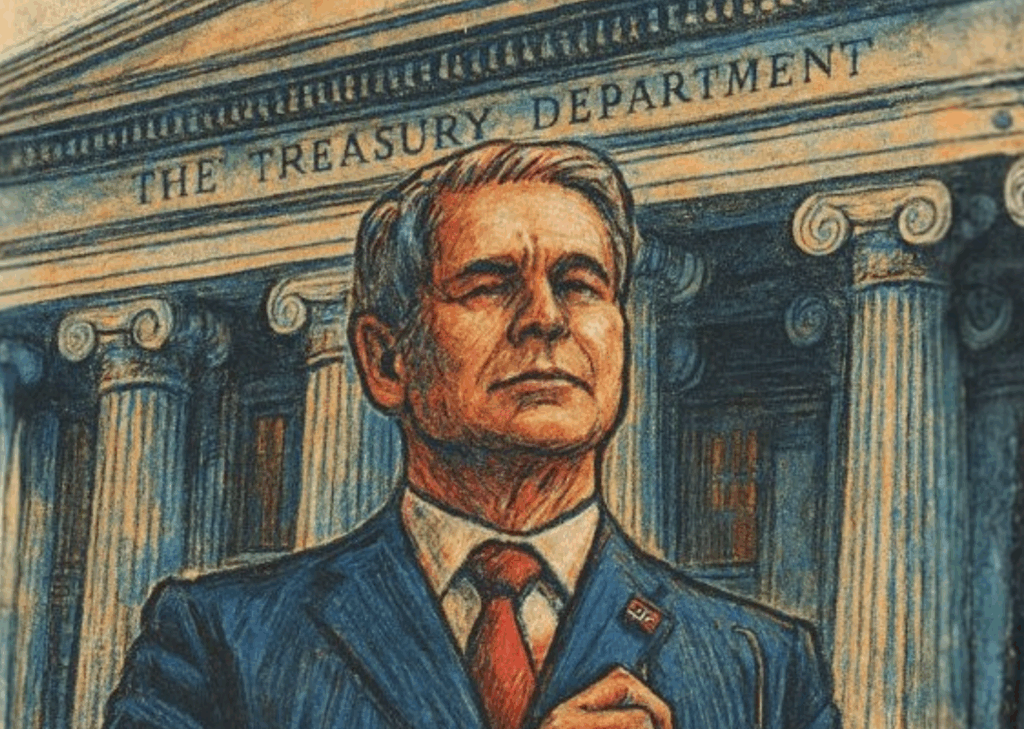
The U.S. Treasury market is often called the world’s safest asset, the bedrock of global finance. It funds our government, anchors the dollar, and serves as the benchmark for every other interest rate in the world. Recently, however, a chorus of pundits and journalists has tried to convince the public that this market is secretly fragile, corrupted by hedge funds and their leveraged trades. A recent Planet Money episode, titled “
How the Government Got Hedge Funded
,” claimed that the Treasury market has grown dependent on hedge-fund risk-taking, implying that America’s fiscal foundation now rests on speculative sand. This narrative is not merely mistaken; it is dangerous. It undermines confidence in the U.S. financial system and plays directly into the strategic goals of China, which is conducting a coordinated information campaign to erode global faith in America’s economic resilience.
To understand why this argument fails, one must first grasp what hedge funds actually do in the Treasury market. They engage in what is known as the “basis trade.” This involves buying Treasury securities and simultaneously selling Treasury futures, capturing small price differences between the two. The trade requires leverage, typically financed through the repo market, where loans are collateralized by the Treasuries themselves. These trades do not weaken the system; they strengthen it. They ensure that Treasury prices in different venues remain aligned, creating liquidity that allows trillions of dollars in government debt to be bought and sold smoothly each day. In the absence of hedge funds, bid-ask spreads would widen, market depth would shrink, and borrowing costs for the U.S. government, and therefore the taxpayer, would rise.
Critics argue that leverage introduces fragility. Yet this argument misunderstands both the structure and the safeguards of the system. The leverage used in these trades is heavily collateralized, monitored, and subject to daily margin calls. When hedge funds borrow in the repo market, they post Treasuries as collateral, which are themselves the most liquid and creditworthy assets in existence. This means that even if a fund fails, the lender can liquidate its position with minimal loss. Moreover, the regulatory framework governing these markets has evolved dramatically since 2020. The Federal Reserve, SEC, and Treasury now have granular visibility into hedge-fund exposures through Form PF reporting, TRACE data, and oversight from the Office of Financial Research. The image of a dark, unregulated corner of finance propping up the U.S. government is a fantasy designed to inflame, not to inform.
The panic of March 2020, often cited as proof of structural weakness, tells a different story upon closer inspection. That episode was not a hedge-fund collapse; it was a global liquidity crisis triggered by the sudden shock of the COVID pandemic. Investors everywhere sold assets en masse to hoard cash, freezing even the most stable markets. Money-market funds, corporate bonds, and commercial paper all seized simultaneously. The Federal Reserve’s intervention was not a bailout of speculators but a broad stabilization measure to preserve market function in the face of panic. Hedge funds that overextended themselves lost money and closed. The system absorbed those losses, cleared the debris, and emerged more transparent and resilient. In the years since, new reforms have expanded central clearing, broadened access to repo facilities, and increased reporting requirements, all of which have hardened the Treasury market against future shocks.
Another fallacy is that the Treasury market now “depends” on hedge funds, as though their departure would cause collapse. This is nonsense. If hedge funds were to step back, other market participants, asset managers, foreign central banks, sovereign wealth funds, and even corporate treasuries, would step in. The demand for Treasuries is structural, not speculative. It arises from the dollar’s role as the world’s reserve currency, from Basel III liquidity requirements, and from the fundamental need for a risk-free asset in global portfolios. Hedge funds simply serve as liquidity bridges, smoothing flows between auctions and end-investors. Their presence does not replace traditional buyers; it supplements them.
Furthermore, the notion that hedge funds “own” the Treasury market is factually wrong. They hold only a small fraction of the $29 trillion market, and most of those positions are short-term and offset by other trades. The bulk of Treasury ownership remains with the Federal Reserve, U.S. banks, mutual funds, pension funds, and foreign official institutions. Hedge funds’ primary contribution is to trading volume, not ownership. They facilitate price discovery and liquidity, the grease, not the gears, of the system.
Critics also misunderstand the nature of moral hazard. Banks enjoy deposit insurance and access to the Fed’s discount window; hedge funds do not. If a hedge fund’s leveraged trades implode, its investors, not taxpayers, absorb the losses. There is no implicit government guarantee. The Federal Reserve’s market interventions protect the functioning of the Treasury market as a whole, not individual firms. This distinction matters, because it shows that market discipline still operates. The players who miscalculate risk lose money, while the broader system remains intact.
To grasp why these misconceptions persist, one must look beyond economics to geopolitics. China has spent the last decade trying to undermine the dollar’s dominance by promoting the yuan as an alternative reserve currency. Failing that, it has turned to psychological and informational warfare, planting stories, funding think tanks, and amplifying Western media narratives that question the soundness of the U.S. system. The “fragile Treasury market” story is a textbook example of this strategy. By sowing doubt about the safety of U.S. debt, Beijing hopes to raise borrowing costs for the United States, discourage foreign investment, and accelerate de-dollarization. When American journalists repeat these narratives uncritically, they do China’s work for them.
It is true that the U.S. debt burden has grown, and fiscal discipline is urgently needed. But conflating fiscal risk with market fragility confuses two separate issues. The Treasury market’s structure, the mechanisms by which debt is issued, traded, and financed, remains sound. Hedge funds make it stronger, not weaker. They add liquidity where banks have retreated due to post-2008 regulations like the Supplementary Leverage Ratio. These funds have become the adaptive shock absorbers of modern finance, absorbing flows that would otherwise cause turbulence. In a world where central banks and commercial lenders face constraints, the private risk-taking of hedge funds fills a crucial stabilizing role.
Moreover, risk is not the enemy of stability; unmanaged or hidden risk is. The Treasury market today is neither unmonitored nor opaque. The reforms implemented since 2020, expanded central clearing, broader FICC access, and real-time data collection, mean that regulators can see, in near real time, who holds what and at what leverage. This transparency converts potential fragility into managed resilience. Markets evolve, and the Treasury market is evolving intelligently.
The moral panic about hedge funds mirrors earlier scares about derivatives, high-frequency trading, and mortgage-backed securities. In each case, critics mistook complexity for danger. But complexity is not synonymous with fragility. It can also signify sophistication, a system with multiple redundancies and actors that balance one another. The Treasury market, with its interlocking web of dealers, funds, banks, and official institutions, exemplifies precisely this kind of adaptive robustness.
The real fragility lies not in hedge funds but in narratives that corrode trust. Confidence is the foundation of finance. The dollar’s value, the Treasury’s yield, the repo market’s functioning, all depend on faith that the U.S. system is fair, transparent, and resilient. When media outlets, knowingly or not, amplify claims that this foundation is crumbling, they chip away at the credibility that underpins American power. China understands this. It does not need to outgun us militarily if it can convince the world that our financial might is hollow.
Americans should reject that narrative. We should defend our markets, not apologize for their sophistication. Hedge funds are not a symptom of decline; they are a reflection of the entrepreneurial dynamism that defines the American economy. They make our markets faster, deeper, and more efficient. The alternative, a world where liquidity depends solely on central banks or state institutions, is one in which financial freedom gives way to bureaucratic control.
The Treasury market remains the envy of the world because it is anchored in innovation, competition, and trust. Hedge funds are part of that success story. Far from being a source of fragility, they embody the very resilience that adversaries fear and critics misunderstand.
If you enjoy my work, please share my work and subscribe: https://x.com/amuse.
Sponsored by the John Milton Freedom Foundation, a nonprofit dedicated to helping independent journalists overcome formidable challenges in today’s media landscape and bring crucial stories to you.
READ NEXT: NFL Star Honors Charlie Kirk With Surprise Political Announcement

















China has the fragile economy NOT the US right