




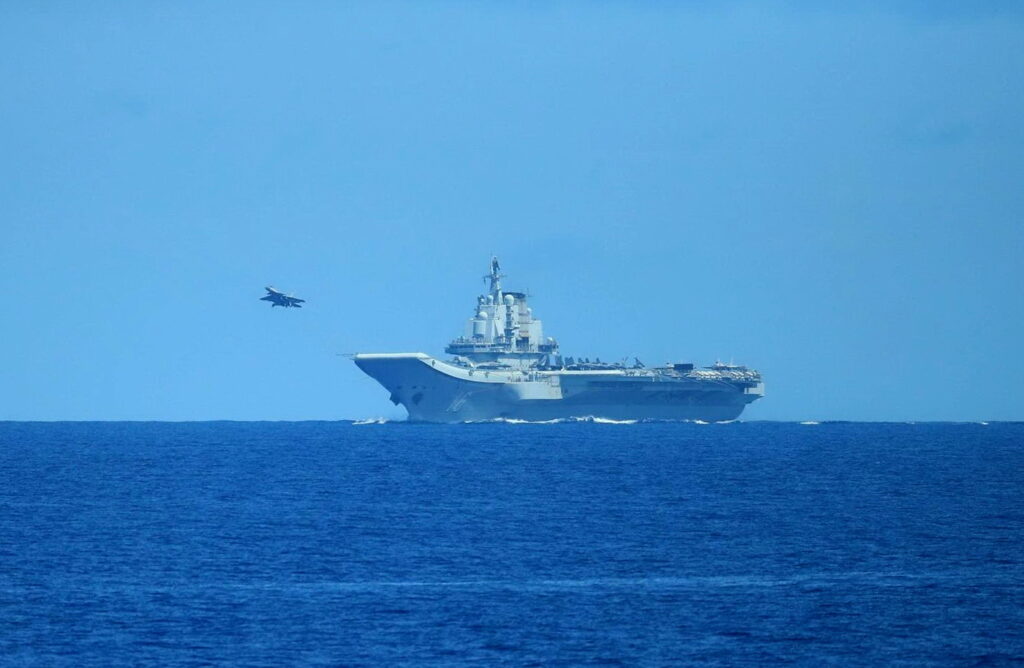
China’s navy is spreading its wings and flexing its might. In February, a task force of the Chinese People’s Liberation Army Navy (PLAN), now the world’s largest by number of hulls (370), conducted an unprecedented 12,000 nautical mile circumnavigation of one of America’s staunchest and most strategic allies in the South Pacific.
Australia is also a member of the U.S.-led “Five-Eyes” intelligence sharing group which also includes the U.K., Canada and New Zealand.
The audacious Chinese mission, which included live-fire drills (“actual use of weapons” in Chinese terms), reportedly tested the PLAN’s ability to maintain an “actual combat alert status,” and to conduct long-term operations.
But it was also a surveillance and intelligence mission as well as a show of force. (RELATED: China Deploying ‘Jack-Up’ Naval Barges To Invade Taiwan)
Chinese fleet encircles Australia for nearly a month of military drills — see the map for details. pic.twitter.com/6CfUPQTmmq
— Global Defense Insight (@Defense_Talks) March 13, 2025
While not technically impressive, the voyage was the farthest south the Chinese military had ever come and was deeply uncomfortable for Australia.
The United States, Australia and America’s regional allies, especially the rest of the U.S.-led QUAD strategic partnership (India and Japan), should be concerned. And so should others like South Korea and the Philippines.
The only reason to be south of Australia or in the Tasman Sea would be to send a message to Australia, said Ray Powell, who previously served as a U.S. defense attaché in Canberra.
“That particular message is, we are able to hold you at risk,” he said.
The heavily armed Chinese naval flotilla consisted of a destroyer, a frigate and a supply and replenishment ship. One ship could carry land-attack missiles or anti-ship ballistic missiles. (RELATED: China Conducted Final Test Of Secretive Hypersonic Air-To-Air Missile)
The task group began its deployment in early February near the Philippines and then traversed waters off of Australia clockwise from mid-February to early March, traveling from the eastern seaboard to the western seaboard.
A U.S. nuclear powered attack submarine reportedly deployed to Australia as the Chinese fleet sailed around the island continent and past Perth in Western Australia, days after the U.S. sub docked at a nearby naval base.
A Chinese naval task group recently sailed around Australia in a voyage that took about a month, with its movements shadowed by the Australian Navy. https://t.co/TKCZ8TZlPF
— Newsweek (@Newsweek) March 17, 2025
Meanwhile, the Royal Australian Navy shadowed the Chinese the entire time.
As Newsweek reported:
While operating off the east coast of Australia, the Chinese flotilla held a war game, which had prompted airlines to divert flights. The Chinese ambassador to Australia said it is normal for China to send its vessels to the area to conduct activities as a major power.
It is not immediately clear if the naval task group has returned to China. Its last reported position was in the Sunda Strait, an Indonesian waterway, on March 9. It was on a northward voyage after passing through waters off the Australian west coast.
During an interview on March 12, the Australian Defense Minister Richard Marles said the country’s military had “totally shadowed” the Chinese naval vessels when they were in the vicinity of Australia.
Marles added:
We shadowed this [Chinese] Task Group from the moment that it came into Australian waters in an unprecedented level of surveillance. So, we know exactly what they did, exactly what their configurations were, what exercises they were practicing.
However, the entire scenario has prompted a debate in Australia about its naval inadequacy, aging fleet and reliance on the United States.
The New York Times reported:
[Australia’s] navy is the oldest and smallest it has been since World War II, analysts and former navy officials say. It has two tankers, which are crucial for navigating long distances, as the Chinese did, but both have been out of commission for months. The two Chinese warships had a combined 144 vertical launch missile cells, while the Royal Australian Navy’s 10 warships, altogether, have 200.
The outlet added:
“The Chinese are showing us up in our own backyard,” said Marcus Hellyer, an expert on military spending and capability who previously worked for Australia’s defense department.
“We can’t even sail around our own country. They are really rubbing it in,” he said. Australian forces, could of course, rely on friendly countries like New Zealand, which refueled an Australian ship in the Tasman Sea as the two countries jointly surveilled the Chinese ships.
This all occurred in February, when Australia paid half a billion dollars to Washington as a down payment to eventually receive used U.S. nuclear attack submarines as part of a security pact with America and Britain known as AUKUS.
While Newsweek notes that, “It remains to be seen whether the Chinese navy will dispatch another task group to the South Pacific in the short term,” I predict we will see a lot more of these types of operations near Australia and elsewhere, in the coming months and years.
The opinions expressed in this article are those of the author and do not necessarily reflect the positions of American Liberty News.
READ NEXT: Supreme Court Chief Justice Issues Extraordinary Response To Trump


















Rerun Battle of the Coral Sea?? with missiles this time
Talk about deaf dumb and totally clueless !!! When told to leave sleeping Bears LAY ??? Sorry for your LUCK !!! when you disturb a undefeatable advisory !!!! Bend over Folks !!! You are about to get a very serious Deadly AWAKENING!!!!!!!!!!!! PROOF is in the PUDDING !!!! I hope you like RICE PUDDING ???? Because YOU are going too see what ( SHIT HITS THE FAN IS ALL ABOUT !!!!!!!!!!!!!!!!!!!!!!!!