

The Constitution states a simple rule. Only citizens may vote in federal elections. That proposition is not controversial. It is not partisan. It is not novel. It is a condition built into the very idea of a political people governing itself. Yet in modern election administration, this basic rule is routinely treated as if it were difficult to enforce, legally suspect, or even impermissible to verify. How did a constitutional certainty come to be treated as an administrative problem?
The answer lies not in the Constitution but in a statute, the National Voter Registration Act of 1993. The NVRA was written with a clear purpose. Congress wanted to make voter registration easier. It chose convenience over verification at the front end, relying instead on later enforcement mechanisms and criminal penalties. That choice was embedded in the structure of the federal voter registration form, which requires applicants to attest to citizenship under penalty of perjury but does not require documentary proof. The statute did not say that noncitizens may vote. It did something subtler. It constrained the mechanisms states may use when registering voters for federal elections.
Over time, that constraint hardened. What began as a statutory design choice became an administrative doctrine. Election officials learned that asking for proof of citizenship was risky. Advocacy groups learned to describe such requests as illegal. Courts learned to treat documentary verification as presumptively incompatible with federal law. The result is a rhetorical inversion. A statute designed to streamline registration is now invoked as if it redefined the electorate itself.
This inversion was crystallized in Arizona v. Inter Tribal Council of Arizona in 2013. Arizona had attempted to require documentary proof of citizenship for voters using the federal registration form. The Supreme Court held that the NVRA preempted that requirement. States, the Court said, must accept the federal form as sufficient for federal elections. If Congress wanted proof of citizenship to be required, Congress would have to say so.
That holding is often misdescribed. The Court did not say that citizenship verification is unconstitutional. It did not say that noncitizens may vote. It did not even say that proof of citizenship is bad policy. It said something narrower and more technical. Congress, by statute, required states to accept a particular form, and that form did not require documentary proof. Under the Supremacy Clause, the statute prevailed.
Nevertheless, the practical effect was broad. The decision entrenched the idea that documentary citizenship requirements are legally suspect. It taught administrators and legislators the same lesson. Do not touch this area unless you want to be sued. Over a decade later, that lesson remains operative. It is in this environment that opposition to the SAVE Act should be understood.
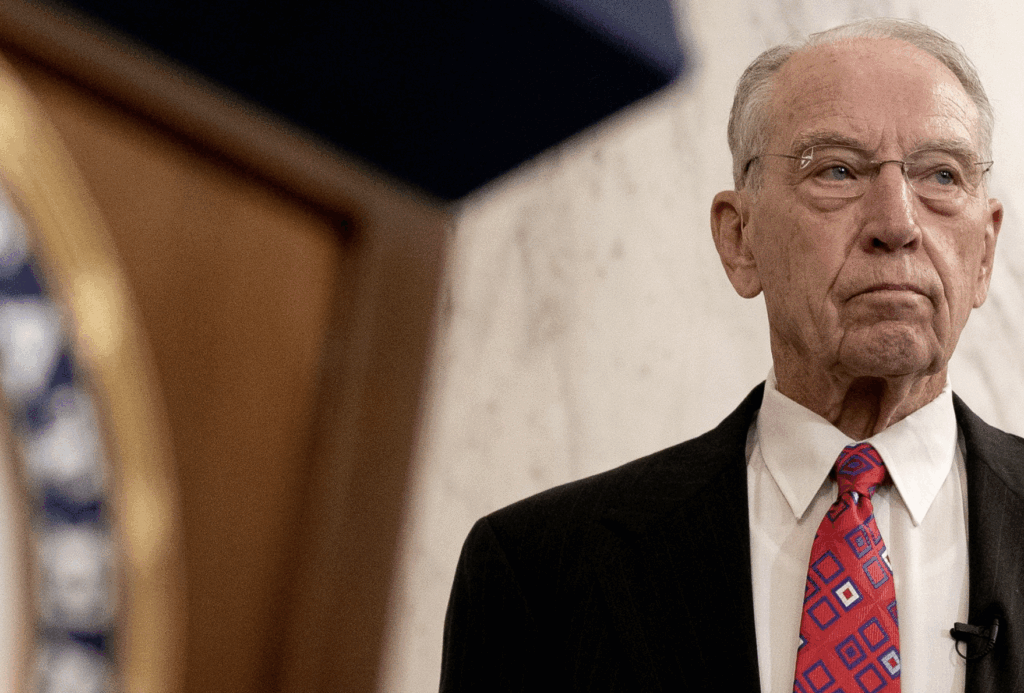
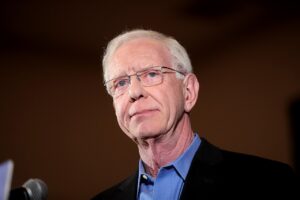
Consider Senator Chuck Grassley. He is often portrayed as opposing the SAVE Act because he doubts the importance of citizenship verification or because he underestimates the risk of noncitizen voting. That portrayal is too shallow. A more charitable and more accurate steelman is institutionalist caution. From this perspective, Grassley is not rejecting the constitutional rule. He is respecting the statutory landscape that Congress itself created and that the courts have repeatedly enforced.
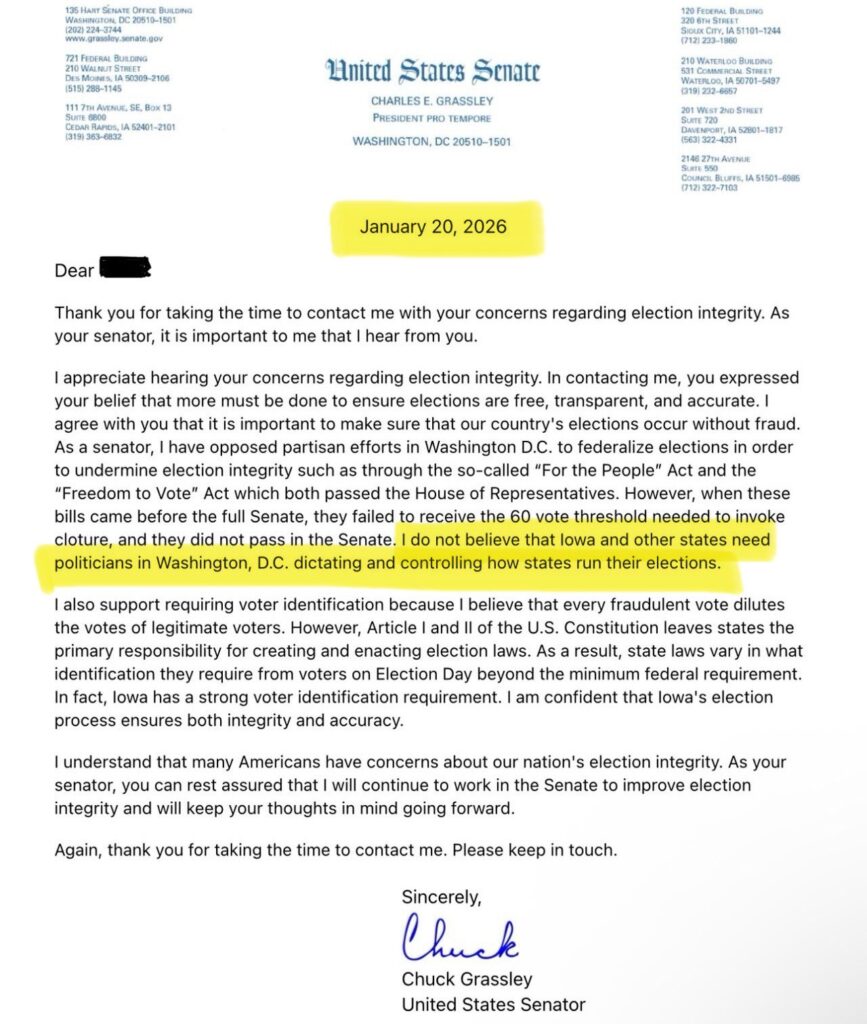
From an institutionalist point of view, the NVRA is settled law. It has been on the books for over 30 years. It has generated an extensive body of judicial interpretation. Election systems across the country have been built around it. To impose a sudden documentary requirement, even one aligned with constitutional principles, risks litigation chaos, administrative disruption, and confusion among lawful voters. Courts may enjoin implementation. States may diverge in compliance. Voters may be caught between inconsistent rules.
Moreover, from this perspective, the courts are not acting in bad faith. They are reading the statute as written. Congress chose to prioritize ease of registration. Congress chose an attestation model rather than a verification model. The judiciary merely followed that choice to its logical conclusion. If that conclusion is unsatisfactory, the fault lies with the statute, not with the courts.
This steelman deserves to be taken seriously. It explains why a legislator committed to institutional stability might resist reforms that appear, at first glance, to conflict with entrenched doctrine. It also explains why appeals to constitutional principle alone may fail to persuade. The problem, on this view, is not what the Constitution allows. It is what the statute currently requires.
But once the argument is stated clearly, its implication becomes unavoidable. If the problem is statutory, then the remedy must be statutory. And that is precisely the case for the SAVE Act.
The SAVE Act does not defy the NVRA. It amends it. It does not ask courts to reinterpret existing text. It rewrites the text. It does not invite administrative improvisation. It provides legislative clarity. By requiring documentary proof of citizenship for federal voter registration, Congress would be exercising the very authority the Supreme Court identified in Inter Tribal Council. The Court did not bar such a requirement. It pointed directly to Congress as the only institution capable of imposing it.
Seen this way, opposition grounded in NVRA preemption actually supports the SAVE Act rather than undermines it. If states are blocked from acting because federal law occupies the field, then federal law must be changed. Treating that blockage as immutable confuses judicial interpretation with constitutional necessity. The NVRA is not part of the Constitution. It is not entrenched beyond amendment. It is an ordinary statute, passed by Congress and subject to revision by Congress.
There is no constitutional barrier to such a revision. The Constitution grants states and Congress broad authority to regulate the time, place, and manner of elections. It presupposes a citizen electorate. Requiring proof of citizenship does not add a new qualification. It enforces an existing one. Courts have long recognized the difference between eligibility rules and reasonable verification measures. The SAVE Act falls squarely on the verification side.
Nor does the SAVE Act undermine the values that motivated the NVRA. Ease of registration matters. So does integrity. The question is not whether registration should be accessible, but whether accessibility must come at the cost of abandoning verification entirely. A system that verifies citizenship at the front end may reduce the need for burdensome investigations later. It may increase public confidence. It may clarify rules for administrators rather than leaving them to navigate a maze of litigation threats.
Critics often say that there is no evidence of widespread noncitizen voting. That claim, even if accepted, misses the point. Laws governing elections are not merely reactive. They are constitutive. They define the terms of participation. We do not abolish age requirements because few 15-year-olds attempt to vote. We do not eliminate residency rules because most voters comply voluntarily. We enforce baseline qualifications because they define the electorate itself.
The deeper issue is coherence. At present, the US operates under a system in which the Constitution says one thing, statutory law constrains enforcement of that thing, and administrative practice treats the constraint as a prohibition. That is an unstable equilibrium. It invites distrust. It encourages rhetorical overreach. It allows opponents of reform to say, inaccurately, that citizenship verification is illegal rather than merely unimplemented.
The SAVE Act restores coherence. It aligns statutory law with constitutional principle. It removes the preemption obstacle that the Inter Tribal Council identified. It replaces ambiguity with clarity. And it does so through the ordinary legislative process, not through judicial adventurism or administrative workaround.
This is why the institutionalist steelman ultimately collapses into support for reform. Yes, the NVRA, as currently written, blocks states. Yes, courts have enforced that blockage. Yes, sudden state-level defiance would be destabilizing. But none of that argues against congressional action. It argues for it. Congress created the problem by writing a statute that decoupled eligibility from verification. Congress can solve it by repairing that statute.
Treating the NVRA as untouchable mistakes longevity for legitimacy. Many statutes persist long after their assumptions have eroded. The NVRA was written in a different technological and political environment. It assumed a level of trust and homogeneity that no longer exists. Updating it is not radical. It is responsible governance.
Senator Grassley’s caution, understood charitably, reflects respect for law as it stands. But law as it stands is not law as it must stand. Fidelity to institutional process does not require paralysis. It requires recognizing when a statute no longer serves its foundational purpose and acting through the proper channel to amend it.
The SAVE Act is that channel. It does not invent new constitutional theory. It does not undermine federalism. It does not disenfranchise lawful voters by redefining eligibility. It simply requires that the eligibility rule everyone agrees on be verified in a straightforward way.
Once this is seen clearly, the debate changes shape. The question is no longer whether citizenship verification is allowed. It is whether Congress is willing to take responsibility for the consequences of its own statutory design. The Constitution has already answered the first question. The SAVE Act answers the second.
If you enjoy my work, please subscribe: https://x.com/amuse.
Sponsored by the John Milton Freedom Foundation, a nonprofit dedicated to helping independent journalists overcome formidable challenges in today’s media landscape and bring crucial stories to you.
READ NEXT: Europe Makes Shock Call On Landmark Pact With US

















Democrats unite! Here’s your chance to further advance your destruction of the U.S. with illegal voting.
BUT DC Estd Swamp will Block act
Darn right only American Citizens are able to Vote and any so called politicians that tries to change this need Fired run out of Washington on a rail,or any state we have to put an end to these so called American politicians that are out to Destroy America, for their own perverted one world order, and Trump Congress have the power and the proof t9 rid our government, judiciary and state politicians judges, governors, mayors, senators, congress, and the illegal lobbyists they are criminals they bribe to get what they want and that is a Crime against the American People, and those that sell themselves to lobbyists need prosecuted, removed all benefits gone security clearance gone all for life