

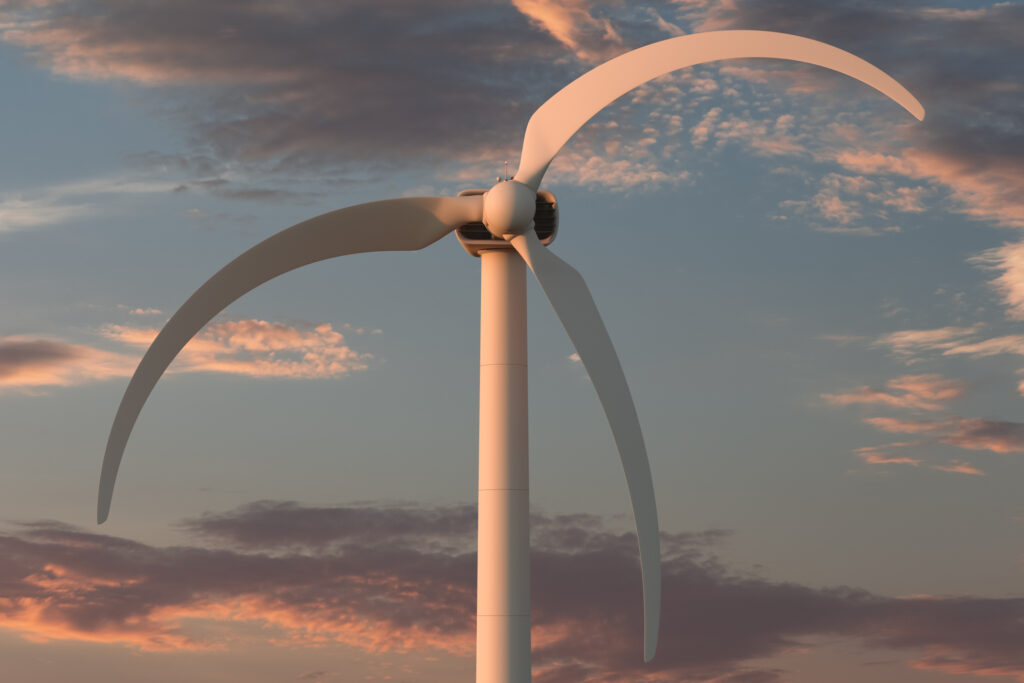
Recently I was driving with my nine‑year‑old daughter through the Allegheny Mountains, just north of Blackwater Falls, West Virginia. As we crested the ridge, a forest of wind turbines came into view — towering machines spaced across the mountain range, some blades spinning, others frozen in place. She looked at them, paused, and said, “They look like they shouldn’t be there.”
That quiet comment stuck with me.
I explained to her, as best I could, that while windmills are often presented as clean and progressive, they can also carry steep environmental costs. Roads have to be carved into mountainsides. Water tables shift. Debris and runoff taint the watershed. Thousands of tons of concrete are hauled up to these ridgelines. Wildlife gets pushed out — or killed outright. All this, for infrastructure that often doesn’t live long enough to justify the damage.
I told her that sometimes disturbing nature is necessary — when what we get in return is vital to our lives or our economy. But wind power doesn’t always meet that standard. It’s expensive to build, difficult to maintain, and doesn’t reliably replace fossil fuel use. Instead, it often becomes a symbolic exercise — an aesthetic gesture that makes people feel good and helps energy developers get rich through government subsidies. They’re the perfect case study in economic futility pursued for emotional comfort, and more often than not, a way for elites to enrich themselves with public subsidies while giving people a false sense of moral progress.
Then, after a long drive and an evening scratching at bug bites, I did something unusual: I relaxed on the couch and watched an episode of Landman. Billy Bob Thornton’s character echoed exactly what I’d just told my daughter. I figured that was the nudge I needed to finally write something about it.
The True Carbon Cost of Wind Power
At first glance, wind energy seems clean and effortless — just air turning blades. But like most things that sound too good to be true, it deserves a closer look.
The Construction Footprint
- Foundations: A single industrial wind turbine requires 1,500–2,000 tons of concrete and about 250 tons of steel — two of the most carbon-intensive materials on Earth.
- Blades and Nacelles: The blades are usually made of fiberglass and resin composites — difficult to recycle and almost always landfilled when their 20-25 year lifespan ends. The generator housing (nacelle) includes rare earth metals, often mined in China under severe environmental degradation.
- Access Roads: Even in remote places like the ridge north of Blackwater Falls, roadways must be widened or built from scratch to accommodate massive transport trucks and cranes. This causes erosion, sediment runoff, and long-term disruption to wildlife corridors.
The Mirage of Carbon Offsets
Windmills are often used in carbon offset schemes. But here’s the problem:
- Double Counting: Emissions “savings” are often claimed multiple times — by wind farm operators, investors, and the corporations purchasing offsets.
- Shaky Baselines: These savings are calculated by assuming wind replaces coal. But in modern grids, it might actually be replacing hydropower or natural gas — or generating unneeded surplus at off-peak times.
- Storage Requirements: Since wind isn’t always blowing, power must be stored using lithium batteries (adding another environmental footprint) or supplemented by fossil-fuel plants kept running on standby.
Bottom line: The supposed carbon offset is often a shell game, not a real environmental benefit.
A Failing Economic Case
Without government subsidies, most wind installations would not exist. And even with those subsidies, the math doesn’t always work.
- Taxpayer Subsidies: The Production Tax Credit (PTC) pays operators roughly 2.75 cents per kWh — enough to tip the scale from unprofitable to barely tolerable.
- Decommissioning Costs: At end-of-life, the turbines are not easily recycled. Blades go to landfills. Towers require removal and site restoration—costs frequently dumped on local governments or landowners.
- Energy Payback Time: A turbine might take 2.5-3 years to “repay” its carbon cost — under perfect wind conditions. In lower wind areas or if poorly maintained, the numbers never pencil out.
- A Harvard Business Review analysis warns of “hidden costs” in maintenance and decommissioning, especially as turbines age or move offshore — potentially swamping early gains. This is echoed by European experience: UBS reports returns plunged from 14% to 6% by mid‑2023, and “wind project costs…have risen by 30–35 percent” post‑pandemic.
- Utility‑scale turbines cost $1.3-2.2 million per MW, meaning a typical 2 MW unit comes with a $3-4 million price tag — excluding site prep and habitat disruption.
- Installation costs alone can add $100k+ per MW, plus yearly maintenance (typically $40k–50k per turbine).
- New York’s Empire Wind One offshore project is charging consumers $155/MWh — 2.5× market rate (around $50/MWh)—with total subsidies topping $9 billion, thanks to tax credits covering up to half the $8 billion cost.
And when you tally up the backup systems needed for reliability—like natural gas peaker plants or massive battery arrays—the true cost skyrockets.
Ecological Disruption Disguised as Progress
The environmental impact of wind power isn’t limited to materials. There’s a toll on ecosystems that’s often brushed aside:
- Bird and Bat Mortality: Estimates suggest wind turbines kill between 140,000 and 500,000 birds per year in the U.S. alone. Bats are even more susceptible, with deaths documented from barotrauma (lungs rupturing from pressure changes).
- Forest and Habitat Fragmentation: Mountain ridge lines, like those in West Virginia, are chosen for their high wind exposure. But these are also biodiversity hotspots. Even conservation advocates agree: public lands need protection. As Trout Unlimited warns, rollout of wind/solar projects on these lands must include habitat exclusions and careful siting to avoid harming fish and wildlife—which is often not happening.
- Noise and Visual Pollution: The low-frequency “whoop” of turbines travels far and disrupts both wildlife and rural residents. The massive structures also dominate viewsheds, reducing property values and quality of life.
“Wind power facilities can…degrade or destroy habitat, cause disturbance and displacement, and disrupt important ecological relationships.” — Audubon Society
“Our public lands contain some of the best trout and salmon habitat in the country and…even clean energy has its impacts.” — Chris Wood, CEO, Trout Unlimited
Feel-Good Policy or Sound Investment?
It’s easy to feel righteous when backing wind energy. But too often, that feel-good sentiment masks deeper issues:
- Wind turbines often provide no real energy independence, since backup power is still required.
- The projects are largely sustained by government subsidies, not private markets.
- They disrupt sensitive areas with minimal long-term gain — a tragedy for conservationists, not a victory.
As Billy Bob Thornton’s character put it in Landman, wind power is “like trying to power Texas with a fan and a prayer.” It’s not a solution — it’s a diversion.
The next time you see windmills rising from a ridgeline, ask yourself: Are they there because they’re the best option — or because they look good in a press release? Or to pad some elites’ pockets with taxpayer subsidies?
We need to be honest about our energy choices. Wind can play a role — but it’s not the panacea it’s made out to be. And if we truly want clean, reliable, and cost-effective power, we should start by reactivating what we already have: hydro.
The opinions expressed in this article are those of the author and do not necessarily reflect the positions of American Liberty News.
READ NEXT: Is Justice Coming? Top Republican Teases Shocking DC Leak Inquiry



















It’s been a really long time since I took basic science in junior high but one lesson stuck: every step within a system degrades the efficiency of that system to some degree. IOW, the more steps involved the less efficient (and cost effective) that system becomes. And that doesn’t even factor in all of the other costs as noted in the article. the last studies I saw speculated that even if all of the pieces of a wind (or solar) generating plant works absolutely perfectly, it will NEVER come close to paying for itself. Don’t get me wrong, I’m not against wind or solar but unless or until such systems can at least break even they are more of a drain than a solution. Never forget NIMBY!
I’ve heard that wind farms create jobs. I never see any parked cars ( of employees ) at wind farms. Maybe they create jobs for lawyers and lobbyists .