

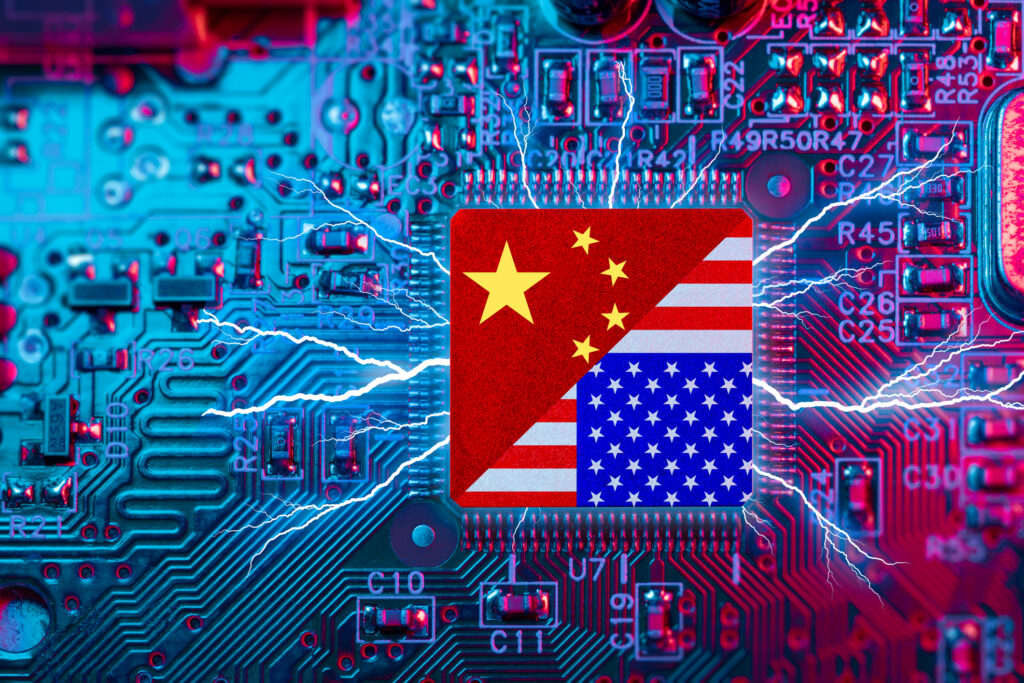
Some conservatives are very concerned. GOP Senators are pushing back. In light of President Trump’s AI Action Plan released in July, which I discussed earlier, and promotes American dominance in Artificial Intelligence (AI), many on the right are wondering aloud how the president could suddenly approve the shipment of advanced Nvidia H200 Artificial Intelligence (AI) microchips to China.
This decision doesn’t only appear to contradict his own AI plan but reverses decades of U.S. restrictions on exporting advanced technology to foreign countries, especially adversaries.
While Trump emphasized in his Truth Social Post on the deal that these are not the latest Nvidia chips and that the U.S. Treasury would get 25% of any proceeds, Republican leaders are questioning whether Trump is prioritizing short-term economic gain over long-term U.S. national security.
Though the H200 chips aren’t Nvidia’s most advanced, they are more powerful than the company’s H20s, which were previously developed specifically for the Chinese market. According to the House Select Committee on China, a GOP-led panel that focuses on the “threat posed by the Chinese Communist Party,” noted in a statement on X:
Right now, China is far behind the United States in chips that power the AI race. Because the H200s are far better than what China can produce domestically, both in capability and scale, @nvidia selling these chips to China could help it catch up to America in total compute.
Beijing will use the H200s, which boast significantly more processing power and memory bandwidth than China’s top chips, “to strengthen its military capabilities and totalitarian surveillance,” [emphasis added] the panel’s statement read.
Outside experts also warn that giving China access to these better chips will shrink America’s hardware advantage and help Chinese developers vastly improve their AI models and other tech.
Rosh Doshi, an Assistant Professor at Georgetown University, who wrote a book on China’s strategy to reverse the U.S.-led world order in its favor, posted on X:
This is a big deal. Essentially a reversal of the US export control policy on advanced chips. Possibly decisive in the AI race. Compute is our main advantage — China has more power, engineers, and the entire edge layer — so by giving this up we increase the odds the world runs on Chinese AI.
This is a big deal. Essentially a reversal of the US export control policy on advanced chips. Possibly decisive in the AI race. Compute is our main advantage — China has more power, engineers, and the entire edge layer — so by giving this up we increase the odds the world runs on… pic.twitter.com/33YDpgZ2pi
— Rush Doshi (@RushDoshi) December 8, 2025
Meanwhile, some of Trump’s most solid Republican allies in the Senate appear to be worried as well.
“Alarm bells go off in my head here,” Sen. Lindsey Graham (R-S.C.) told CNBC when asked about the chip sales agreement.
“I don’t mind doing normal business with China. But if you can prove to me this will accelerate their military capability, I’ll oppose it,” Graham said.
CNBC continued: “My general view on this is that China’s progress on AI is almost entirely parasitic on our technology, in particular on our hardware,” Sen. Josh Hawley (R-Mo.).
“So, I don’t want China to win the AI race. I want to win the AI race,” Hawley added. “But if we want to beat China, I think we need to constrain their ability to leverage our own technology, and I think we would want to reduce their access to our hardware, not increase it.”
Sen. John Cornyn (R-Texas) was more succinct about the Trump chip deal:
“I’m concerned,” he said.
The House Select Committee on China concluded:
…Nvidia should be under no illusions – China will rip off its technology, mass produce it themselves and seek to end Nvidia as a competitor. That is China’s playbook and it is using it in every critical industry.
To preserve American AI dominance, in spite of any Trump efforts that may threaten that, Sen. Pete Ricketts (R-Neb.) last week introduced bipartisan legislation that would direct the Trump administration to deny export licenses for advanced chips to China and other adversaries for at least 30 months.
READ NEXT: Mamdani’s Latest NYC Hire Raises Serious Alarms




















While these chips are not of the latest advances in technology, what’s to preclude the Chinese from using them to reverse-engineer them and proceed to improve on the strengths of these chips to advance their own ability to produce even better chips with which to overpower our ability to sell ours to other countries, and even to sell them within the U.S. if they can sell their chips at a lower price than ours?
While I am certainly ‘pro-Trump’, not always do I totally agree with everything that he wishes to do.
I don’t think this is a wise move. Advisers need to learn to say NO.