

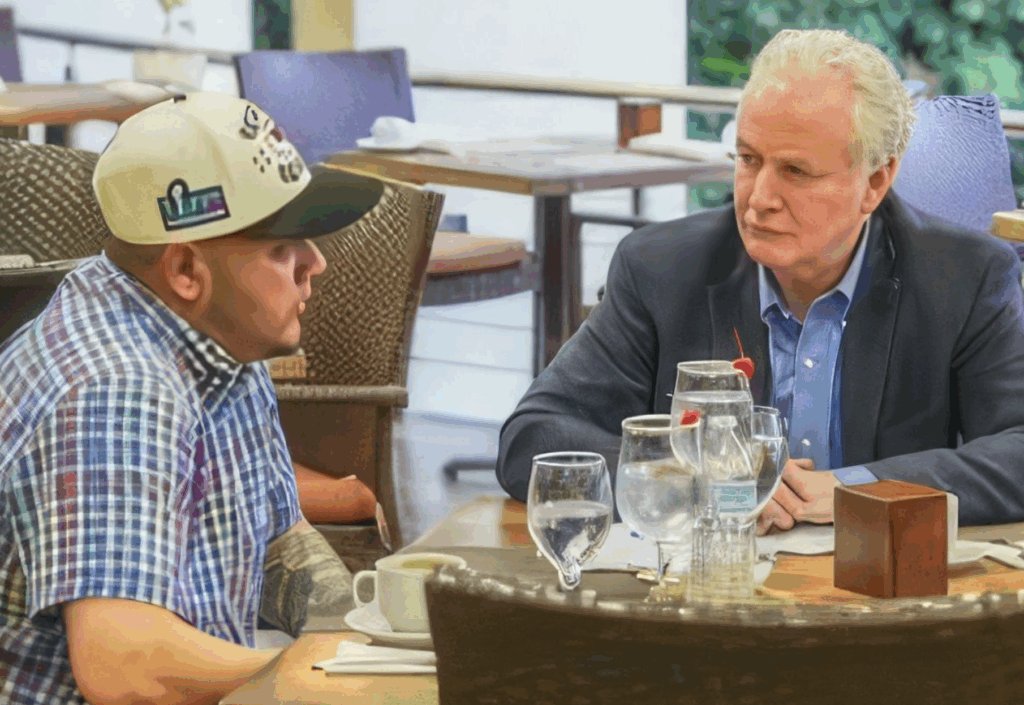
In federal law clarity is not optional. A judgment’s meaning hinges on precise language, not wishful interpretations. So when immigration attorneys Simon Sandoval-Moshenberg and Andrew Rossman stood before US District Judge Paula Xinis and claimed that their client, Kilmar Abrego Garcia, had been illegally deported to El Salvador, one might reasonably ask: On what document, what legal foundation, did they stake that assertion?
The answer, it turns out, is both stunning and troubling: no document at all. Not even the one that matters most. Because the only extant legal order governing Mr. Abrego Garcia’s deportability, a final withholding of removal issued by an immigration judge in October 2019, states, unequivocally, that removal to Guatemala is barred. Not El Salvador. Guatemala. That order, still binding, does not even mention El Salvador in its operative sections. Yet the drive-by media and Democratic officials loudly claimed that the order prohibited deportation to any country, implying that Garcia was entirely shielded from removal. This is categorically false. The ruling explicitly restricted deportation only to Guatemala, leaving all other destinations, including his home country of El Salvador, fully permissible under the law.
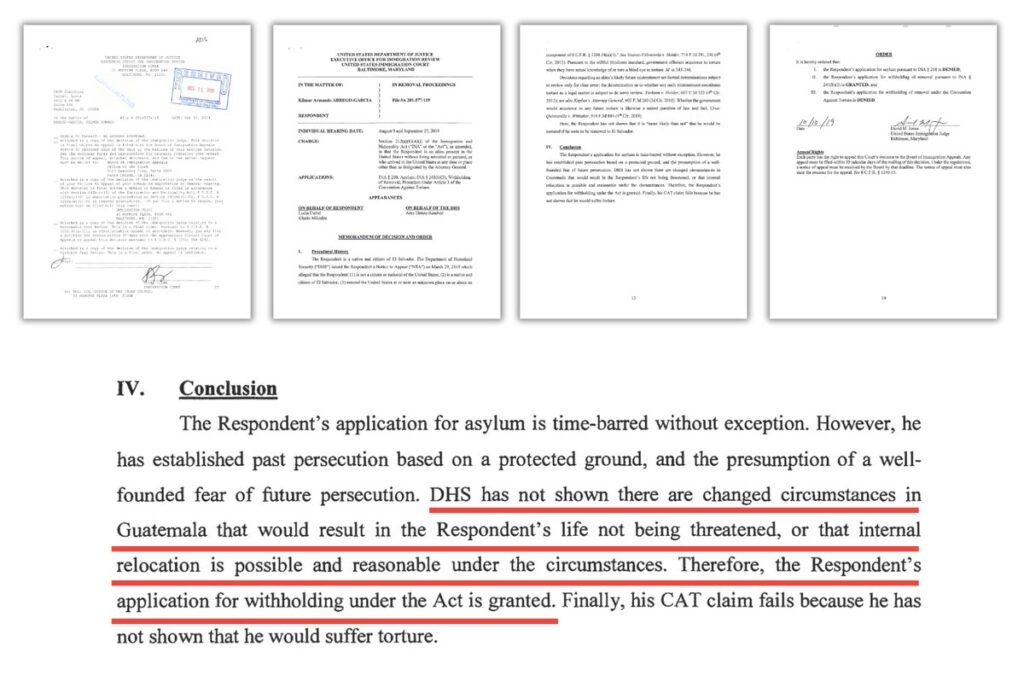
This is not a footnote. It is the core legal premise upon which a cascade of judicial rulings, from Judge Xinis’s courtroom to the Fourth Circuit to the US Supreme Court, were predicated. And it is wrong.
The October 10, 2019 ruling by Immigration Judge David M. Jones,
, clearly and explicitly grants Kilmar Abrego Garcia withholding of removal to Guatemala, citing gang-related threats and persecution of his family by Barrio 18 operatives residing there. The Department of Homeland Security did not contest that point. They agreed not to deport him to Guatemala. That was the limit of the order.
And yet, when Garcia was deported to El Salvador, his native country, and the jurisdiction where he holds citizenship, his lawyers cried foul. So did the media. So did Judge Xinis. And so, eventually, did a majority of the US Supreme Court. Each relied, to varying degrees, on representations made by Garcia’s attorneys that the 2019 order barred deportation to El Salvador. But no such language exists in the ruling. It is a ghost, a fabrication, a fiction that metastasized through the legal system unchecked.
To grasp the magnitude of this error, consider what occurred next. The Justice Department lawyer who initially represented the government, Erez Reuveni, assumed the order said what Garcia’s lawyers claimed it said. He took them at their word. For that misplaced trust, he was placed on administrative leave and, not long after, fired by Attorney General Pam Bondi. In the world of political scapegoating, that’s a gold-medal-worthy performance.
Meanwhile, Judge Xinis, suddenly faced with the uncomfortable fact that her rulings may have been premised on a mischaracterization of law, attempted to backfill the gap. She asked Garcia’s counsel to produce his immigration file, his “A-File,” the authoritative record of his immigration history, applications, and court orders. Their response? They had lost it.
Let that sink in. The legal team arguing that the Trump administration committed an illegal deportation not only failed to present a document supporting their claim, they cannot even locate the file that might clarify the record. The Department of Homeland Security, by contrast, does have a copy of the relevant order, and it plainly shows Garcia was not protected from removal to El Salvador.
This, then, is the steelman case: A fraud, knowingly or through negligent misrepresentation, was committed upon the courts, culminating in a legally improper demand that the US government retrieve an individual who was lawfully deported under the plain meaning of a judicial order. The scope of that fraud extends to every taxpayer footing the bill for ICE agents to re-import a gang-affiliated alien, to the Justice Department now under pressure to explain itself, and to a Supreme Court forced to issue rulings based on facts that are, at best, dubious.
There are two possibilities. Either Garcia’s attorneys made a good-faith mistake, in which case they had a duty to correct the record once they became aware of it. Or they acted knowingly, with full access to the 2019 order, and chose to misrepresent its contents to the court. If the former, they are grossly incompetent. If the latter, they are ethically compromised.
What of the judiciary? Judge Xinis, in her opinion, assumed the worst about the Trump administration, opining with moral certitude that this deportation amounted to a constitutional affront. But her outrage, like that of the Fourth Circuit panel that affirmed her, was grounded in a proposition that is simply false. The decision does not bar removal to El Salvador. The judge could have read the order herself. She did not. She could have required its production before issuing rulings. She did not. And in doing so, she presumed malevolence on the part of the executive branch where she should have demanded proof from her own courtroom.
Likewise, the drive-by media, from MSNBC to The Washington Post, repeated the falsehood that Garcia’s deportation was illegal. They used words like “lawless” and “rogue.” But lawlessness lies not in the act of returning a man to his home country when the law allows it. Lawlessness lies in lying to a federal judge, and persuading the Supreme Court to co-sign the error.
And what of the costs? ICE, DOJ, and DHS are now entangled in a quagmire. Agents were ordered to retrieve Garcia from El Salvador, only to return him to Maryland where he now faces charges of human trafficking and other serious offenses. He could spend years in a US prison before being sent back to El Salvador, all because his lawyers misrepresented the contents of a plainly written judicial order. Legal staff are being disciplined or removed. Judges are scrambling to rationalize how they came to believe something that was never written. This is not harmless error. It is a systemic breakdown, induced by ideological bias, compounded by legal negligence, and sanctified by judicial inertia.
In legal philosophy, we often ask what it takes for a statement to be true. In law, we ask a similar question: What must exist for an action to be lawful? In this case, the answer is clear. Deportation to El Salvador was lawful because the only controlling judicial order did not prohibit it. That was true on October 10, 2019. It remains true now.
To pretend otherwise is not advocacy. It is manipulation. And it threatens the integrity of our judicial system in ways no border policy ever could.
If you enjoy my work, please consider subscribing: https://x.com/amuse.
Sponsored by the John Milton Freedom Foundation, a nonprofit dedicated to helping independent journalists overcome formidable challenges in today’s media landscape and bring crucial stories to you.
READ NEXT: Nancy Mace Signals Interest In 2026 Gubernatorial Run
















So the big question is, what is being done to all of those who perpetrated the lies and those judges who believed the lies? In today’s judicial it’s obvious to anyone that has comminsence not a d#%e thing is going to happen.
So, will this be corrected? Or is this another liberal fraud perpetrated on the judiciary that will be swept under the rug? Tired of reading the wrongs of the left with no action being taken.
Whatever the costs to send this “Maryland Man” back to the US and then deport him again should be paid for by the judge, shouldn’t it?
Did anyone notice how his right arm looks to have been edited. Were they trying to conceal what tattoos he had that might reflect his connection to the gangs. He was lucky he was only deported.
Thank you. A well-reasoned and cogent article. Funny how the “best and brightest” ain’t necessarily.
I downloaded and read through that KAG 2019 Judge’s ruling completely, including all the background info. Throughout it El Salvador was stated as his homeland and Guatemala was thrown in at the end of the background. Since it was so odd I added pdf notes to areas that didn’t align with the ruling for withholding of deportation as it was, included mapping out his story of where he and his family ONLY lived, but moved around in El Salvador to avoid the gangs. It was too far from Guatemala to fit the time frames of movement before they sent him to the U.S., let alone him stating the family only lived in El Salvador. So, I belive the Judge erred in voicing Guatemala for transscription to the ruling doc, possibly mixing up cases. BUT, it definitely appeared to me he lied to the Judge about his reasons for not wanting to return to “El Salvador” – there were too many holes and oddities in his “fear of the El Salvador Barrio gangs” testimony (for one gangs were already being erradicated by Bukele). IMO, the ruling for withholding was in error to begin with, but reported my suspicions and the error in the ruling mentioning “Guatemala” to Julie Kelley in a comment to one of her reports. Since his trafficking activities were reported shortly after he was deported and before allowing him to return for “due process”, I figured it had become a moot point then, but hopefully they are looking at prior rulings closer now.