

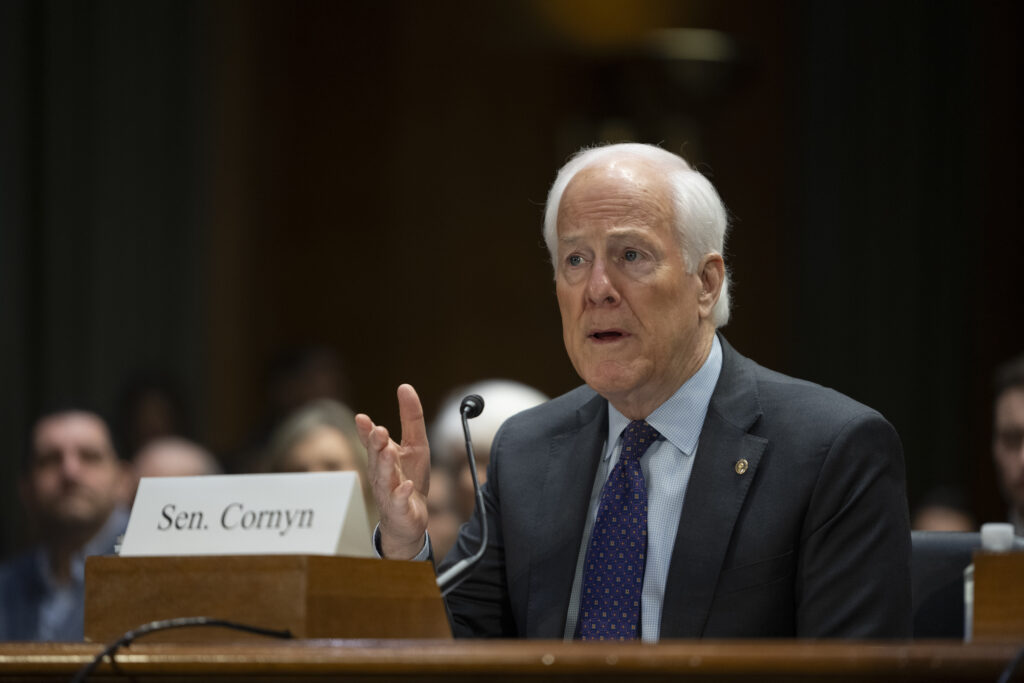
The challenge now facing Senator John Cornyn is unusually simple. Pass the Save America Act and send it to President Trump’s desk. In exchange, the president offers an endorsement in the Texas Senate race, and Texas Attorney General Ken Paxton has offered to consider dropping out of the runoff. It is a stark test of power. The challenge asks a straightforward question. After 24 years in the U.S. Senate, does Senator John Cornyn possess the influence he has long claimed inside the chamber?
To understand why this challenge matters, it helps to step back and examine how the Senate actually works. Many voters imagine that legislation rises or falls purely on ideological agreement. Senators debate, they vote, and the majority prevails. That picture is appealing but incomplete. The Senate is not merely a chamber of speeches and votes. It is a chamber of obligations. Influence accumulates through favors, through assistance in difficult elections, and through the most concrete political resource of all, money.
Consider a simple analogy. Imagine a cooperative of farmers who must occasionally borrow equipment from one another. One farmer lends tractors repeatedly during the harvest season. Another rarely helps anyone. When the moment comes to ask for help, which farmer will find willing partners? The one who has spent years lending equipment. The Senate functions in much the same way. Instead of tractors, the resource is campaign money. Senators who can raise money for colleagues build political capital. Over time, those contributions create obligations that can later be called in when legislative priorities arise.
In the modern Senate Republican conference, one senator has spent decades accumulating precisely this form of capital. That senator is John Cornyn. For years, he has been widely described as one of the most prolific fundraisers in the history of the Senate. Reporting earlier this year credited him with raising almost half a billion dollars for fellow Republicans.
Why does that number matter? Because the modern Senate runs on fundraising networks. Campaigns require vast sums of money. Television advertising, digital operations, travel, polling, legal compliance, and staff infrastructure all require capital. Senators who can provide access to donors, therefore, become valuable allies. A senator who helps colleagues raise money repeatedly builds a ledger of political gratitude.
Cornyn’s political operation reflects this structure. Unlike many senators who raise primarily for themselves, his apparatus has long been oriented toward multi-committee fundraising. Joint fundraising committees allow donors to contribute once, while the proceeds are distributed across multiple campaign entities. The mechanism is entirely legal and widely used. But it also creates an efficient political machine. A single donor relationship can support several candidates, committees, and outside groups in one coordinated structure. It is precisely this kind of entrenched financial network that makes removing a sitting U.S. senator extraordinarily difficult. As a result, modern history incumbent senators have been successfully defeated in their own party’s primary only twice, a reminder that the fundraising infrastructure surrounding a long-serving senator often becomes a formidable defensive moat.
One example illustrates the scale of this infrastructure. The Cornyn Victory Committee has functioned as a central fundraising hub connecting his campaign with other Republican committees. Through this architecture, donors can route funds not only to Cornyn but also to the National Republican Senatorial Committee and allied political committees that distribute resources to key races. In off-year periods when most political operations slow down, Cornyn’s apparatus has continued raising millions. Reports indicated that his committees collected more than $7M in just the final months of 2025.
To see the significance of this system, imagine again the cooperative of farmers. Some farmers occasionally lend equipment. Cornyn built an entire equipment rental business. His operation does not simply assist one neighbor at a time. It channels resources across a network.
The donors who fuel this system come from multiple sectors of the American economy. Texas energy leaders have long been part of the coalition. Figures associated with oil refining, pipelines, and energy infrastructure appear frequently among major contributors. But the network extends far beyond energy. National finance executives, technology entrepreneurs, consumer brand founders, and large corporate PACs have also contributed through committees associated with Cornyn’s political operation.
This breadth matters. A narrow donor base produces fragile influence. A diversified donor base produces durable influence. If one sector retreats, others remain. Over decades, Cornyn has cultivated relationships across multiple donor classes, ranging from ideological contributors aligned with conservative causes to institutional corporate donors and national finance figures.
The influence created by such a system does not remain abstract. It manifests through concrete actions inside the Senate conference. One well-known pattern involves the distribution of funds raised through joint committees to colleagues facing competitive elections. When a senator transfers significant financial support to another senator’s campaign, the recipient understandably remembers that assistance. Gratitude accumulates. Relationships deepen. The result is a network of colleagues who have benefited materially from one senator’s fundraising capacity.
This dynamic helps explain why fundraising is treated inside the Senate as a leadership credential. When Mitch McConnell dominated Senate Republican fundraising, his financial network functioned as a stabilizing force for the conference. Candidates relied on it. Vulnerable incumbents relied on it. Party committees relied on it. Now that McConnell has announced he will not seek reelection in 2026, the conference inevitably asks who will inherit that role.
Many observers have conceded that Cornyn is the most obvious successor. For years, he has been described as the second most prolific fundraiser in the Senate Republican orbit. With McConnell’s exit, the logic follows naturally. The number two becomes number one.
This background explains the political significance of the Save America Act challenge. Paxton’s offer and President Trump’s endorsement condition together create a direct test of Cornyn’s influence. If he is indeed the Senate’s premier rainmaker, then he should possess the leverage to move legislation across the finish line.
A puzzled reader might object at this point. Legislation is complicated. The Senate has procedural hurdles. Surely one senator cannot simply command passage of a bill. That objection has some force. The Senate contains 100 independent political actors. No single member controls every vote.
But that description misses an important feature of Senate behavior. Senators do not operate in isolation. They operate within networks of trust, reciprocity, and mutual assistance. When a senator has spent decades helping colleagues secure campaign funding, those colleagues possess strong incentives to reciprocate when legislative priorities arise. Reciprocity is not a crude transaction. It is a long term relationship structure that underlies the functioning of the chamber. The present debate over the Save America Act illustrates the point clearly. The bill already has 50 Republican co sponsors. Four of them have told Leader Thune they are unwilling to force a talking filibuster, which is widely understood to be the only procedural path to overcome the Democrats’ promised filibuster. Yet the arithmetic itself reveals how narrow the problem really is. Only four holdouts remain. A senator with deep reserves of political capital could sit down with each of them, negotiate concessions, and unify the conference behind the strategy required to force the bill through after confronting the promised Democratic filibuster.
Cornyn himself has demonstrated how this influence can be cultivated. During his tenure as chairman of the National Republican Senatorial Committee from 2009 through 2013, he helped direct fundraising for Republican Senate candidates nationwide. That role required recruiting candidates, coordinating donor networks, and allocating resources strategically across competitive races. The position effectively trained him as a central financial organizer for the party’s Senate operation.
Years later that experience remains embedded in his political infrastructure. His donor lists persist. His finance staff maintain relationships. His committees continue routing money to colleagues and allied groups. These networks do not disappear simply because leadership titles change.
Indeed Cornyn relied on precisely this fundraising reputation during his recent bid to succeed McConnell as Senate Republican leader. His argument to colleagues emphasized the same theme. He could raise money for the conference. Reports described him raising large sums for incumbents and candidates during the early phases of that leadership contest, including more than $5M in a single quarter through joint fundraising committees. His pitch was clear. A leader who can raise money strengthens the entire conference.
Yet Cornyn ultimately lost that leadership race to Senator John Thune. The result produced an interesting political situation. Cornyn remains one of the Senate’s most prolific fundraisers even though he does not hold the top leadership post. In other words, he still possesses the network of influence even if he lacks the formal title.
This brings us back to the Save America Act. If Cornyn’s fundraising machine truly commands the loyalty and goodwill attributed to it, then it represents a reservoir of political capital. Political capital is valuable precisely because it can be spent. It exists to achieve outcomes.
Passing legislation often requires persuading colleagues to prioritize one bill over another. It requires negotiating procedural obstacles. It requires persuading committee chairs to advance legislation and leadership to allocate floor time. These processes involve judgment calls. They involve choices about which issues receive attention and which remain stalled.
A senator with deep reserves of goodwill can influence those choices. Colleagues who have benefited from financial support may be more willing to lend their votes. Party leaders who recognize the senator’s fundraising contributions may be more willing to allocate legislative time. Influence operates through persuasion and relationships rather than commands.
— @amuse (@amuse) March 6, 2026
This is why the Paxton Trump challenge functions as a bear trap. If Cornyn succeeds in passing the Save America Act quickly, critics will ask why the effort required a presidential ultimatum. If the bill could move now, could it not have moved earlier? But if he fails to deliver, the implication is equally uncomfortable. A senator who has raised nearly half a billion dollars for colleagues should possess extraordinary leverage inside the conference.
Either outcome, therefore, reveals something about the nature of Cornyn’s influence. Success suggests the capacity existed all along. Failure suggests the influence may be weaker than advertised.
From a strategic perspective, the rational response is clear. Cornyn should accept the challenge. He should treat the Save America Act as the highest legislative priority and deploy every tool his network provides. He should call in favors accumulated over decades. He should mobilize colleagues whose campaigns benefited from his fundraising apparatus. He should persuade Senate leadership that delivering the bill will strengthen the party’s standing with Republican voters nationwide.
Doing so would produce a straightforward political payoff. The president receives the legislation he has demanded. Texas voters witness a concrete demonstration of Cornyn’s effectiveness. Paxton’s conditional offer to reconsider the runoff becomes relevant. Most importantly, Cornyn proves that the Senate’s most prolific rainmaker can convert fundraising influence into legislative results.
Politics often revolves around rhetoric. But occasionally a moment arrives when rhetoric must give way to demonstration. The Save America Act challenge presents exactly such a moment. For years, John Cornyn has built one of the most powerful fundraising networks in the Senate. The time has come to spend that political capital.
— @amuse (@amuse) February 24, 2026
— @amuse (@amuse) March 4, 2026
If you enjoy my work, please subscribe: https://x.com/amuse.
Sponsored by the John Milton Freedom Foundation, a nonprofit dedicated to helping independent journalists overcome formidable challenges in today’s media landscape and bring crucial stories to you.
READ NEXT: US Nearing Surprise Economic Deal With Communist Regime



















Cornyn is Uniparty. Uniparty does not want SAVE.
This is why we must return to the Constitution when Senators were appointed!!! Get the money out of politics and demand term limits.
Check his bank account records that may tell a lot.