

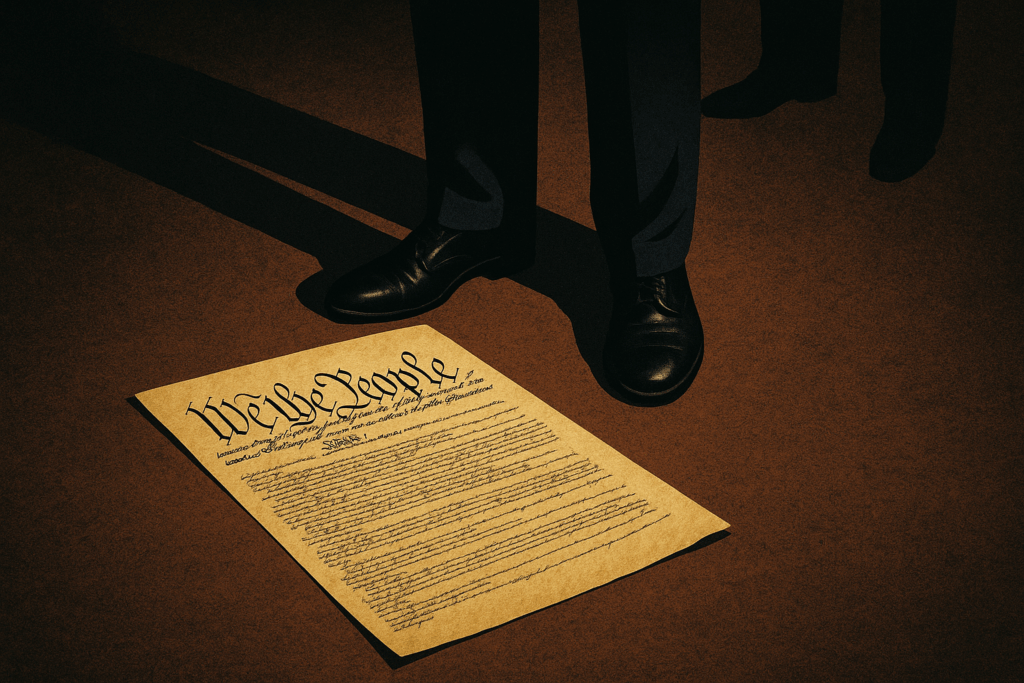
The revelation, first reported by 404 Media’s Joseph Cox, that the Airlines Reporting Corporation, a company owned by major U.S. airlines, is selling vast troves of passenger data to federal agencies should alarm anyone who values constitutional limits on government power. With a reported database of roughly five billion records, ARC is handing over names, flight itineraries, financial details, and other sensitive information to the FBI, ICE, and the Secret Service. The transactions are conducted without warrants, without probable cause, and without transparency. In doing so, the government is attempting to buy its way around the very limits the Framers of the Constitution intended to impose. This practice amounts to surveillance laundering: the government cannot directly seize the information, so it purchases it indirectly through a private intermediary. The move is no less a violation of the 4th Amendment simply because dollars, rather than subpoenas, change hands.
SURVEILLANCE LAUNDERING: Airlines Sell 5 Billion Plane Ticket Records to the Government For Warrantless Searching. https://t.co/VP3Ne667Gg
— @amuse (@amuse) September 15, 2025
The principle at stake is clear. The 4th Amendment prohibits unreasonable searches and seizures, requiring warrants grounded in probable cause. This was not an incidental design choice, but a core safeguard against the general warrants and writs of assistance used by British authorities to rummage through the lives of colonial Americans. The lesson was seared into the DNA of our Republic: government must not indiscriminately monitor its citizens. Yet what is the bulk acquisition of five billion plane ticket records if not the modern equivalent of a general warrant? It is surveillance conducted without suspicion of wrongdoing, treating every traveler as a suspect, and every itinerary as evidence in waiting.
Defenders of this scheme may point to the third-party doctrine, established in cases such as Smith v. Maryland, which held that information voluntarily shared with third parties carries diminished constitutional protection. The doctrine has been stretched far beyond its original scope, but even on its own terms it does not justify this program. When Americans purchase plane tickets, they are entrusting their data to airlines for the limited purpose of securing travel, not for wholesale resale to the government. A reasonable expectation of privacy still attaches, as the Supreme Court recognized in Carpenter v. United States, where long-term cell-site location data was deemed so revealing that it required a warrant. Air travel data is no different, and perhaps even more sensitive, as it tracks not just where we are, but where we are going, when we leave, and with whom we travel.
The circumvention of the warrant requirement here is glaring. Federal agencies know that to compel this information directly they would need judicial approval. They know, too, that such approval could not be granted on a blanket basis. To get around this, they purchase access from ARC, which functions as a commercial cutout. But courts have consistently warned that the government cannot accomplish indirectly what the Constitution forbids directly. If a warrant would be necessary to subpoena these records, then the government should not be able to launder its surveillance through a private broker. Doing so is not a clever innovation, it is an unconstitutional evasion.
Beyond doctrine lies the spirit of the 4th Amendment. Even if courts permitted such workarounds, the fundamental purpose of the Amendment would be gutted. The Framers did not design the Bill of Rights as a set of clever drafting tricks for government lawyers to exploit. They intended to place firm boundaries on surveillance, boundaries that protected ordinary citizens from being tracked and catalogued en masse. The idea that government agencies can bypass those boundaries by simply paying for the data is corrosive to the rule of law. It reduces constitutional liberty to a commodity on the open market, available for purchase by those with sufficient resources and power.
The scale of the ARC program further underscores its illegitimacy. We are not dealing with a handful of records tied to ongoing investigations, but billions of data points covering decades of human movement. This is dragnet surveillance masquerading as data analysis. It is precisely the kind of generalized search the Constitution was written to prohibit. To argue otherwise is to suggest that Americans surrendered their privacy rights at the airport gate, a claim both dangerous and absurd.
The problem extends beyond airlines. Similar issues have arisen with the government’s purchase of location data from cell phone apps and brokers. Both left and right have criticized this practice as unconstitutional, with bipartisan concern that the state is eroding privacy through financial transactions rather than legal process. The NSA once used foreign partners to spy on Americans in ways it could not do directly, then shared the results back home. Surveillance laundering by proxy is no less offensive when practiced in the commercial sphere. The Constitution does not lose its force when data flows through a corporate account.
Statutory frameworks also cast doubt on this arrangement. The Privacy Act of 1974 was intended to restrict government collection of personal data, requiring transparency and limiting dissemination. The sale of ticket records to the government appears to subvert both the letter and spirit of that law. Likewise, airline and Department of Transportation rules typically assume passenger data will be used for travel and security purposes, not for resale to federal investigators. Agencies engaged in this practice are skating on thin ice, legally as well as constitutionally.
The stakes could not be higher. Travel data can reveal religious affiliations, as when pilgrims fly to Mecca. It can disclose political activity, as when activists attend rallies in other states. It can expose intimate family details, medical trips, and financial constraints. To give government agencies unfettered access to such information is to invite abuse and chill the exercise of basic freedoms. This is not a hypothetical concern. Under the Biden administration, federal investigators obtained data from banks like Bank of America to identify and investigate anyone who traveled to Washington DC before, during, or after January 6th. That sweeping search treated countless innocent Americans as suspects simply for visiting the nation’s capital. If people know that their every trip may be catalogued and scrutinized, they may think twice about exercising rights of speech, assembly, or religion. The chilling effect itself is a constitutional injury.
The path forward requires legislative and judicial intervention. Congress should bar the executive branch from purchasing data it could not constitutionally seize. Courts should extend Carpenter’s logic to cover not just location data but all forms of sensitive digital records, including travel itineraries. Agencies that have purchased such data should be compelled to destroy it, and airlines should be prohibited from selling it in the first place. Transparency requirements must be strengthened, ensuring that such arrangements cannot be hidden from public scrutiny.
Some may argue that these measures will hinder law enforcement. But the Constitution is not a document of convenience. Its purpose is to restrain government precisely when expedience beckons. Warrants grounded in probable cause are not impossible burdens, they are minimal safeguards. If investigators cannot make their case to a judge, they should not have access to the data. To pretend otherwise is to endorse a surveillance state that can track every movement of every citizen without accountability.
The airlines’ complicity in this scheme adds insult to injury. Passengers who trust carriers with their financial and travel data do not consent to become unwitting subjects of federal monitoring. Airlines, as custodians of uniquely sensitive information, have a duty to protect that trust. Their decision to monetize it by selling data to the government is not just a commercial betrayal, but a civic one.
The Framers of our Constitution would have recognized this scheme for what it is: a general search in digital disguise. They would not have permitted the government to rummage through the travel records of millions without probable cause, nor should we. Surveillance laundering is no less dangerous for being clever. It is, if anything, more insidious, because it cloaks the violation of liberty in the appearance of legality. Our task now is to restore the plain meaning of the 4th Amendment: that no citizen’s private life should be opened to government inspection without cause, and without a warrant.
Leaked documents show that Geedge Networks, a company with ties to the founder of China’s “Great Firewall” mass censorship infrastructure, is selling its censorship and surveillance systems to at least four other countries.https://t.co/LHCRTqb7Qn
— WIRED (@WIRED) September 14, 2025
If you enjoy my work, please consider subscribing: https://x.com/amuse.
Sponsored by the John Milton Freedom Foundation, a nonprofit dedicated to helping independent journalists overcome formidable challenges in today’s media landscape and bring crucial stories to you.
READ NEXT: Extremist Dem Shocks During Hearing — Says This Sick Thing About American Victim




















Pvt firms selling our data=- ID Theft alone X1000+
NO More
They seed ID Theft.