

Political parties often choose candidates the way marketers choose packaging. The product must look familiar before voters examine what is inside. Consider a simple analogy. A grocery store sells two jars that both say honey on the label. One jar contains honey. The other contains corn syrup flavored to resemble honey. From a distance, they look identical. Only when the buyer reads the label closely does the difference appear.
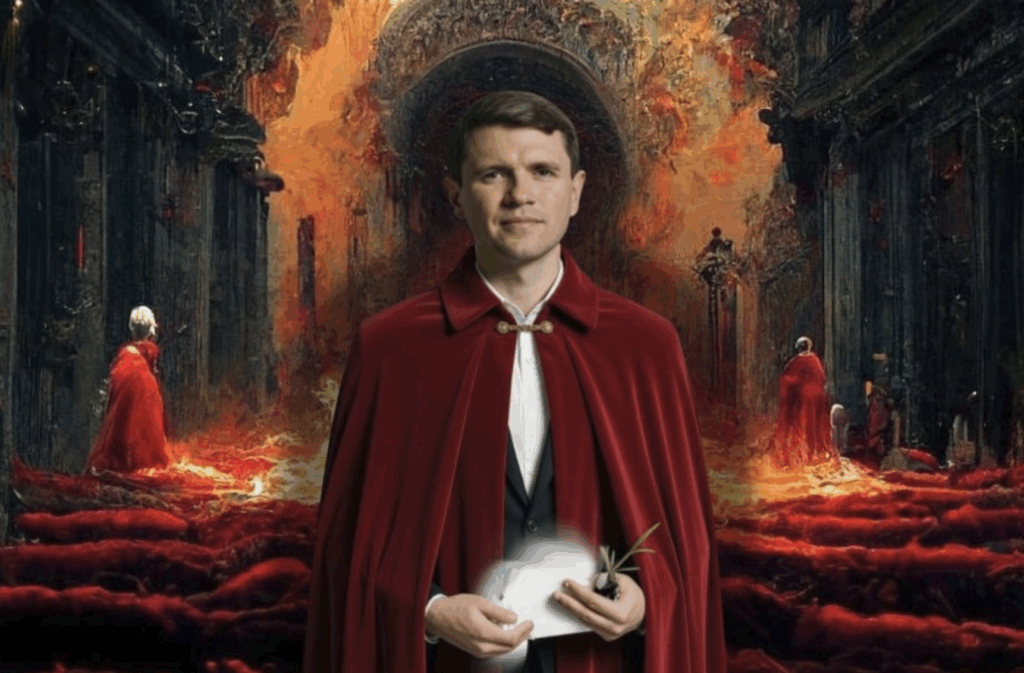
I believe Texas Democrats applied the same logic when selecting their U.S. Senate candidate. They chose James Talarico, a clean-cut white preacher who openly claims to be a Christian. The strategy is easy to see. Texas is a deeply Christian state. Roughly two-thirds of Texans identify as Christian. White evangelicals alone represent roughly a quarter of the electorate and voted nearly 90% for President Trump in 2024. If Democrats want to compete statewide, they must at least appear comfortable speaking the language of faith.
But packaging does not determine substance. The real question is whether the theology being presented corresponds to historic Christianity as most Texas Christians understand it.
Christians disagree about many things. Baptists disagree with Catholics. Pentecostals disagree with Presbyterians. Yet beneath these disagreements lies a shared structure of belief. Scripture carries authority. Sin and repentance matter. Salvation comes through Christ. Moral teachings about life and the human body follow from these foundations.
My argument is straightforward. James Talarico departs from this shared structure. The problem is not merely that he interprets the Bible differently. The problem is that he changes the rules of interpretation themselves.
This is the only ad needed to defeat Texas Senate Democrat James Talarico.
— C3 (@C_3C_3) March 4, 2026
Run this on loop. pic.twitter.com/pRDVCggWgX
Start with the authority of Scripture. Talarico often frames moral debates by asking whether Jesus explicitly addressed them. If Jesus did not speak directly about a subject, he suggests Christians should hesitate to treat it as central. At first, this sounds intuitive. Christians follow Jesus. Why not focus primarily on what Jesus said?
But historic Christianity has never operated under that rule. The New Testament itself treats the Hebrew Scriptures as authoritative revelation. Jesus repeatedly quotes the Old Testament when discussing moral questions. The apostles treat the entire body of Scripture as inspired. If Christian authority shrinks to a curated collection of red-letter sayings, the structure of Christian teaching changes dramatically. Moral questions once addressed through the full canon suddenly become negotiable.
This shift becomes clearest in the abortion debate. Talarico argues that Christian theology can support abortion rights. He appeals to themes of bodily autonomy and to passages such as Genesis 2:7, where Adam receives the breath of life, and Luke 1, the story of Mary receiving the announcement that she will bear Christ.
NEW: Texas House Democrat and pastor James Talarico suggests the Bible supports abortion, says there is no Biblical basis for Christians to be anti-abortion.
— Collin Rugg (@CollinRugg) July 18, 2025
"So this idea that to be a Christian means you have to be anti gay and anti abortion… There really is no historical,… pic.twitter.com/GPo5udFzIF
I believe this reverses the direction of interpretation. Instead of drawing conclusions from the text, the text is being used to justify conclusions formed elsewhere. Genesis 2 describes the unique creation of Adam. It does not establish a universal rule that life begins only with breath. Luke 1 records Mary welcoming God’s plan. It does not transform the Incarnation into a modern argument about abortion rights.
The deeper issue is methodological. The Bible becomes a source of symbolic language rather than moral authority. Scripture provides illustrations for modern political commitments rather than boundaries that constrain them.
The same pattern appears in discussions of salvation. Consider Matthew 25, the passage in which Christ praises those who fed the hungry and clothed the poor. Talarico frequently treats this passage as the centerpiece of Christian political ethics. Care for the marginalized becomes the defining measure of faith.
Get to know Beto 2.0 James Talarico.
— Will Cain (@willcain) March 4, 2026
1. Trans community needs abortion care too. (Bonus: What’s a woman anyway?)
pic.twitter.com/cM4gyxKxV3
No serious Christian tradition objects to caring for the poor. The disagreement concerns the order of explanation. Historic Christianity teaches that salvation is a gift of grace. Good works follow from that grace as evidence of transformation. Talarico’s rhetoric often flips that structure. Activism becomes the path to salvation rather than its fruit.
That shift may appear small. In Christian theology, it is enormous. Remove sin, repentance, and redemption from the center of the story, and the structure of Christianity changes.
Another departure appears in his treatment of religious truth itself. Talarico has spoken in ways suggesting that multiple religions contain the same fundamental truth. Christianity, in this framing, points toward that truth rather than uniquely embodying it.
Most Christians cannot accept that claim because it conflicts directly with the core message of the New Testament. Christianity has always proclaimed that Christ uniquely reveals God and uniquely provides salvation. Treat Christianity as one spiritual path among many, and the religion becomes something fundamentally different from what Christians historically believed.
Meet James Talarico, Texas’ Democrat nominee for U.S. Senate.
— Senate Republicans (@NRSC) March 4, 2026
He thinks “God is nonbinary.” pic.twitter.com/PTXKT6GdeK
The same interpretive move appears in his language about gender. Talarico has described God as nonbinary and has suggested that biblical passages about spiritual equality support modern gender ideology. He has also taught that there are six distinct genders. Yet the biblical passages in question speak about equality before God. They do not erase the male and female distinction embedded throughout Scripture.
James Talarico, a “Christian”, uses the Gnostic “Gospel of Thomas”, a text associated with heresies condemned in the 2nd century, to prove Jesus was a “feminist.”
— AF Post (@AFpost) March 5, 2026
Early Church Fathers condemned these books well before Protestantism.
Follow: @AFpost
pic.twitter.com/SEaCjRYq0U
To understand why these disagreements matter politically, one must consider the religious landscape of Texas. The state contains millions of evangelical Protestants, large Catholic communities, and many other Christian traditions. These groups disagree about many theological questions. Yet on issues such as abortion, sexual ethics, and the authority of Scripture, there is broad overlap.
This overlap explains why progressive reinterpretations of Christian doctrine generate intense reactions. The disagreement is not perceived as a minor denominational dispute. It is perceived as a challenge to the basic framework of the faith itself.
A reader might object that Christianity has always contained diversity. That is true. Christian history includes many internal debates. Yet diversity operates within boundaries. Once a theologian rejects the authority of Scripture, revises central doctrines, or radically redefines moral anthropology, many believers conclude that the disagreement has crossed those boundaries.
That is how I understand the dispute surrounding Talarico. His message retains the vocabulary of Christianity. Words such as love, justice, and compassion appear frequently. Yet the doctrinal architecture behind those words has been rebuilt.
The easiest analogy is architectural. Imagine renovating an old house while keeping the exterior facade intact. From the street, the house looks familiar. Step inside, and the internal structure is entirely different.
This has obvious political implications. Democratic strategists likely believed that nominating a candidate who speaks openly about faith would soften the party’s image among religious voters. Compared with other potential candidates, Talarico appears to fit the role. He quotes Scripture. He speaks about Jesus. He frames political arguments in explicitly moral language.
But this strategy misunderstands the nature of religious voters in Texas. For many Christians, the question is not whether a candidate speaks about faith. The question is what that candidate means by faith.
If voters conclude that the candidate’s theology conflicts with their own understanding of Christianity, the rhetorical strategy may backfire. Instead of appearing relatable, the candidate appears to be redefining their religion.
“This summer, more than half our population became second-class citizens.
— James Talarico (@jamestalarico) November 6, 2022
Every one of our neighbors with a uterus became the property of the State.
And nothing is more un-Christian.” pic.twitter.com/GMl9mHKoTd
The tension becomes even sharper when combined with policy positions. Talarico supports abortion rights and medical gender transitions for minors. While serving in the Texas legislature, he even called on the Biden administration to effectively nationalize the abortion industry, proposing that abortion facilities be moved into federal buildings and that abortion doctors be hired as federal employees. In other words, the state itself would take direct responsibility for killing babies rather than leaving them in the private sector. When these positions are framed through explicitly Christian language, many believers interpret that language not as explanation but as justification.
That perception fuels the political backlash already emerging across Texas.
Democrat strategists assumed religious voters would respond to symbols. Display the right language, quote the right verses, and suspicion fades. But religious traditions are more complex than that. They possess internal structures of belief developed over centuries. Voters who belong to those traditions recognize when those structures are being altered.
For that reason, I believe Democrats have made a serious strategic miscalculation. They appear to believe that nominating a “Christian” candidate automatically bridges the cultural divide between progressive politics and religious voters in Texas. But if the theology underlying that presentation clashes with the beliefs of those voters, the symbolic advantage reverses.
In politics, appearances matter. Substance matters more. The label on the jar may say honey. Texans, however, are accustomed to tasting what is inside. And early signs suggest many Texas voters already dislike the taste of Talarico’s version of Christianity, even though it is only the third day since Democrats selected him as their nominee.
Texas Democrat James Talarico in 2019:
— Bobby LaValley (@Bobby_LaVallley) March 5, 2026
"For me, prophetic voices like Jesus have helped me reckon with my own whiteness, my own masculinity, my own certainty, my own ego. It's a never-ending process, and it's a painful process." pic.twitter.com/sQo5J9Vu0N
If you enjoy my work, please subscribe: https://x.com/amuse.
Sponsored by the John Milton Freedom Foundation, a nonprofit dedicated to helping independent journalists overcome formidable challenges in today’s media landscape and bring crucial stories to you.
READ NEXT: Caught On Camera: Photo Lands Trump Opponent In Legal Trouble





















Another “mentally ill”Democrat seeking to destroy reality