

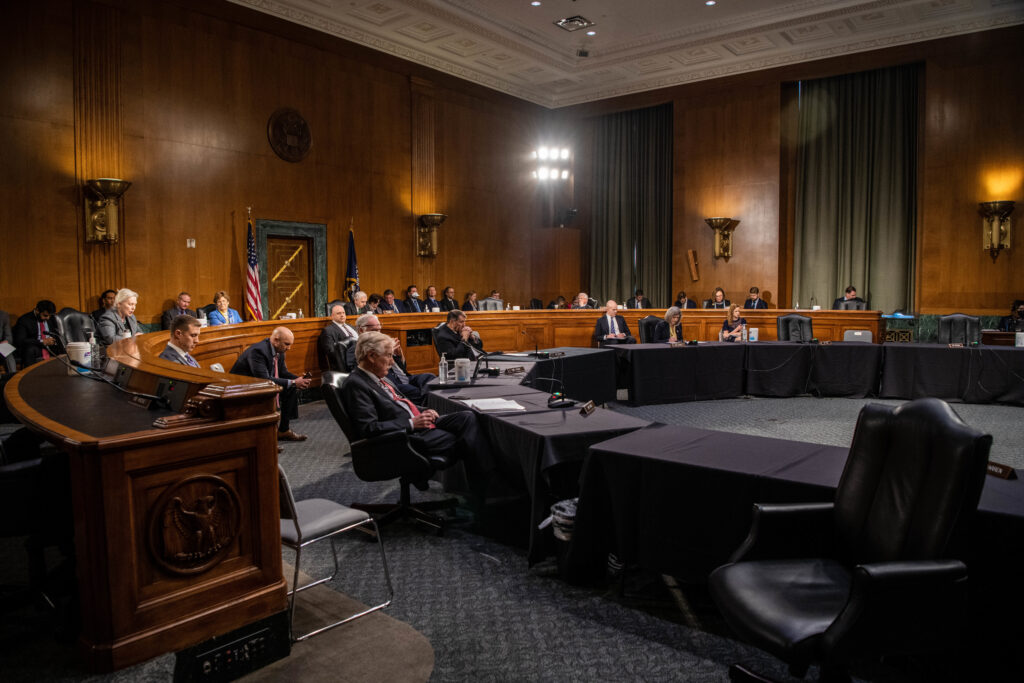
The dispute is simple to state. Senator Tim Kaine suggested that to say rights come from the Creator, not from government, resembles the ideology of Iran’s theocrats. The claim sounds cautionary. In fact it is confused. The American doctrine of natural, God-given rights is the opposite of theocracy. It grounds equal liberty for believers and nonbelievers, restrains state power by principle, and places the Constitution under a standard that government does not invent and cannot erase. If the goal is to preserve pluralism and prevent sectarian abuse, the American Founders’ view is the surer path. I will explain why by starting with first principles, then addressing familiar objections.
“The notion that rights don’t come from laws and don’t come from the government, but come from the Creator — that’s what the Iranian government believes. It’s a theocratic regime that bases its rule on Sharia law and targets Sunnis, Bahá’ís, Jews, Christians and other religious… pic.twitter.com/XcrPHbVplp
— Laura Powell (@LauraPowellEsq) September 4, 2025
Begin with the structure of the Declaration of Independence. The order matters. First there are rights, inherent and unalienable. Only then comes government, as an instrument to secure those prior rights, deriving just powers from consent. That sequence is the hinge. If government is conceptually first, then government may define and redefine rights at will. If rights are conceptually first, government is bounded. The Founders affirmed the second view. They spoke of the “Laws of Nature and of Nature’s God,” a philosophical way to say that moral reality does not originate in statute. Natural rights are constraints on power, not creations of power. On that foundation the Constitution operates, not as a font of favors, but as a charter that recognizes and protects what already belongs to persons as persons.
At this point a reader might ask, what keeps the appeal to God from collapsing into rule by clergy. The answer is in the Founders’ language and legal design. Their references to a Creator were ecumenical and philosophical. They did not propose a sectarian code. They enacted no national church. Instead they protected free exercise and barred establishment. They also appealed to reason as the arbiter of how natural law should be applied in civil life. Jefferson’s Virginia Statute for Religious Freedom forbids coercion of conscience and explains why. The mind was created free. Coercion of belief is a wrong against the person, not an instrument of public good. A society can therefore affirm an objective source of basic rights while refusing to privilege any church. That is not a slide to theocracy. It is a barrier against it.
A second worry is that people disagree about what natural rights are. True enough at the edges. Yet disagreement at the margins does not erase agreement at the core. The Founders identified fundamental liberties that admit of wide consensus, the equal right to life, to liberty of speech and conscience, to the security of one’s home, to fair procedure before the state. They then built institutions to translate those principles into legislation and adjudication. The First Amendment speaks in the grammar of restraint, Congress shall make no law abridging liberty of speech or press or religion. The Fifth Amendment and its companions secure due process and fair criminal procedure. The Ninth Amendment acknowledges the existence of other retained rights not enumerated, a textual reminder that the Constitution is not the source of all that citizens may rightly claim. The Bill of Rights does not grant indulgences. It fences in government.
If the doctrine of God-given rights is carefully distinguished from clerical rule, the comparison to Iran is misplaced. Iran’s regime enforces a sectarian legal code and privileges one orthodoxy. The American creed denies any such authority. Natural rights are universal, not tribal. They vest in the Jew, the Gentile, the Christian, the Muslim, the Hindu, and the skeptic. That is why the Founders rejected the attempt to narrow religious liberty to one name. They meant the law’s protection to reach every conscience. They did so precisely because they held that rights precede government. If a right exists before the state, then the state may not distribute it as a favor to friends. The distinction is decisive. A theocracy says rights flow through the state’s favored revelation. The American idea says rights constrain the state, regardless of revelation.
I now turn from principles to texts, since in philosophy as in law the record matters. Jefferson’s etched lines at the Memorial capture the point succinctly, God who gave us life gave us liberty. He asks whether liberty can be secure once a people lose the conviction that their liberties are the gift of God. His answer is uneasy, and for good reason. A government that imagines itself the author of rights will imagine itself free to unwrite them. John Adams wrote in the same spirit a decade earlier. The people, he said, have rights antecedent to all earthly government, rights that cannot be repealed or restrained by human laws, rights derived from the great Legislator of the universe. Alexander Hamilton, in The Farmer Refuted, called the rights of mankind sacred and said they are written, as with a sunbeam, in human nature by the hand of Divinity, and can never be erased by mortal power. William Blackstone, whose commentaries shaped American legal thought, called natural law superior in obligation to any other law and concluded that no human laws are valid if contrary to it, and such laws as are valid derive their authority from it. These are not the words of men seeking priestly rule. They are the words of men anxious to keep rulers in their proper place.
Tim Kaine just crossed a line. Rights are not granted by the government or the DNC.
— TheCommonVoice (@MaxRumbleX) September 4, 2025
They are inherent, given by God, and no politician or party has the power to take them away.
Claiming otherwise is reckless and dangerously authoritarian. pic.twitter.com/Et9x2ucLVn
One might resist the religious language. Does the argument require belief in God. No. The Founders offered natural law in a register that deists, theists, and philosophical realists can share. Call the source God, or call it the moral order inscribed in human nature and accessible to reason. The core claim is the same. Rights are not mere products of legislative grace. They are moral facts prior to politics. The Constitution, therefore, is not an altar but a framework that presupposes a standard higher than itself. That is why the American oath is to a written charter rather than to a person. It is also why the charter begins with limits.
A further objection is pragmatic. If we say rights do not come from government, do we weaken the role of law. Not at all. Law is the means by which a people secures and specifies preexisting rights in concrete circumstances. Law gives shape to liberty in a world of neighbors. But shape is not source. To say that law secures preexisting rights is to insist that statutes are subject to review and correction when they contradict those rights. Judicial review of unconstitutional laws is coherent only on this premise. If all rights come from government, then when government speaks, rights simply change. That is the road to illiberalism, and it is well traveled in regimes that lack a conviction about any order higher than the state.
Consider also the civic consequences of the two visions. If rights depend on statute alone, majorities can redefine minorities out of their protections. If rights precede statute, minorities stand on ground that majorities did not make. The American experience confirms the wisdom of this structure. Our history includes grave failures. The Founders’ language outran their practice. Slavery was a contradiction to natural right, and many knew it. What, then, sustained the effort to abolish it and to extend equal protection. The same creed that rights are inalienable and universal. The words of 1776 and the logic behind them armed later generations against the hypocrisy of their time. An appeal to natural rights was the instrument of reform, not its obstacle.
Placing the debate in modern terms may help. Imagine two slogans. First, rights are whatever the state says they are. Second, rights constrain the state. Which better secures liberty for the dissenter, the religious minority, the investigative journalist, the critic of the governing party, the prisoner awaiting trial. The answer is plain. A state that conceives itself as the author of rights will be tempted to abridge those that inconvenience it. A state that conceives itself as the guardian of prior rights must give reasons when it limits liberty, and those reasons are tested against standards it did not invent. That difference protects real people.
Senator Kaine invoked the inscription equal justice under law as if it conflicted with the Founders’ creed. But the inscription presupposes the creed. Equal justice under law is a promise about how government will treat persons whose moral status is equal and whose rights are independent of official favor. If there were no such equality before law, the inscription would be a veneer on preference. It is precisely because rights do not originate in legislative grace that equal justice under law has content.
I anticipate one last concern. Talk of God-given rights might invite political actors to claim divine warrant for policy and to smuggle sectarian doctrine into civil law. That is a real risk if rhetoric is reckless. The Founders were not reckless. They separated theological doctrine from political principle. They refused an established church. They preserved free exercise while prohibiting government from prescribing orthodoxy. They expected argument in the public square to proceed by reasons all citizens could in principle assess. That is the opposite of theocratic rule. It is liberal republicanism with moral ballast.
What of the comparative case that points to Iran. The conflation fails at every key juncture. Iran’s model rests on clerical supremacy. America’s model rests on popular sovereignty constrained by prepolitical rights. Iran aligns authority with one religious interpretation. America bars any such alignment, not despite its belief in natural rights, but because of that belief. Iran empowers the state to punish dissenters in the name of doctrine. America, when faithful to its principles, protects dissenters because their rights do not come from the state. The practical fruits diverge. Under the American view, Jews, Christians, Muslims, Hindus, and nonbelievers are equal citizens. Under sectarian rule, they are subjects of unequal favor. The difference in first principles explains the difference in outcomes.
The American tradition has been reaffirmed across our history, and not only by conservatives. President John F. Kennedy said at his inaugural that the rights of man come not from the generosity of the state but from the hand of God. He was right about the structure of our political order. Call it the humility of government. Call it the sovereignty of moral reality over legal paperwork. Either way, it is the best guard we have against the ancient impulse to place rulers above rule.
Let me close by returning to the hearing that sparked this debate. A nominee said that our rights come from our Creator, not from our laws or our governments. That is a summary of the Declaration’s logic. It does not imply rule by priests. It implies that government is a fiduciary, entrusted to secure a birthright that it did not create. If we keep that order straight, we preserve both freedom and pluralism. If we invert it, if we teach citizens that the state is the author of what they may be, then there will be no principled limit when power becomes impatient with liberty. Americans should reject that inversion and restate the obvious. Rights are prior. Government is derivative. That is not a threat to equal justice under law. It is its condition.
If you enjoy my work, please consider subscribing: https://x.com/amuse.
Sponsored by the John Milton Freedom Foundation, a nonprofit dedicated to helping independent journalists overcome formidable challenges in today’s media landscape and bring crucial stories to you.
READ NEXT: Major US Partner Reveals Alarming Shift Toward New World Order



















Kaine couldn’t be more wrong. He needs to reread our founding documents.
As I see it, Senator Kaine fails to see a critical distinction between theocracies and the US. In theocracies, laws come from God. In the US rights come from God.
He’s the type of person that should not even be close to a position of power.
To compare Natural Rights to Sharia Law is to miss the whole concept of the Constitution. Sharia law governs Muslim countries as a mandate, rather than a protection.. Natural Rights protects the individual rights of each American that our government isn’t allowed to trample on. Without it, our government could decide to dissolve or change our rights at whim. God doesn’t act like this. His will is eternal.