

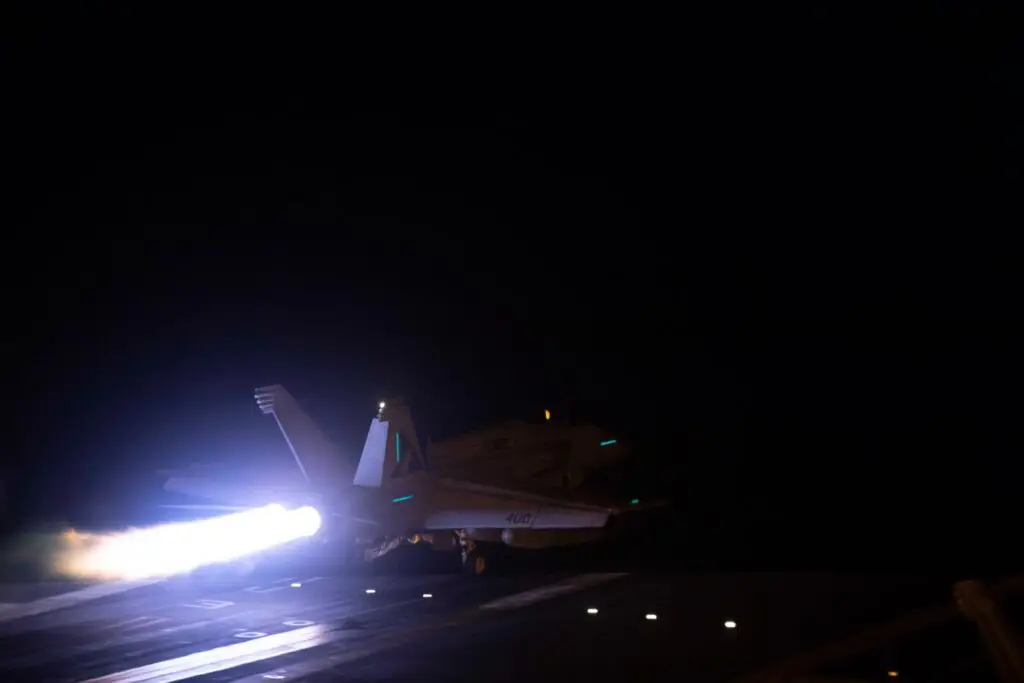
U.S. Central Command accused Iran of committing an “egregious ceasefire violation” after Tehran allegedly launched a ballistic missile toward Kuwait late Wednesday night amid rapidly escalating tensions in the Gulf.
According to CENTCOM, the missile was successfully intercepted by Kuwaiti defenses before it could strike its target. U.S. officials said the launch occurred at approximately 10:17 p.m. Eastern time.
“This egregious ceasefire violation by the Iranian regime occurred hours after Iranian forces launched five one-way attack drones,” CENTCOM said in an official statement Thursday morning.
Drone interceptions heighten regional tensions
The missile strike came only hours after U.S. forces reportedly intercepted multiple Iranian attack drones operating near the Strait of Hormuz.
CENTCOM stated that U.S. forces shot down five drones and prevented the launch of a sixth from a ground control site in Bandar Abbas. American officials described the operations as defensive measures intended to protect commercial shipping and U.S. military assets in the region.
Iranian state-linked media framed the attack differently, describing it as retaliation for recent U.S. military strikes and drone interceptions tied to ongoing tensions surrounding Hormuz.
The latest exchange further strains what was already a shaky ceasefire between Iran, the United States, and regional actors after months of escalating military confrontation across the Middle East.
Kuwait and Gulf states condemn attack
Kuwait strongly condemned the missile launch, calling it a direct violation of Kuwaiti sovereignty and regional stability.
Several Gulf allies — including Saudi Arabia, the United Arab Emirates, Qatar, and Bahrain — also issued statements denouncing the attack and expressing support for Kuwait.
The Gulf Cooperation Council reportedly described the strike as a violation of international law and warned against further destabilization in the region.
Kuwait has become increasingly vulnerable during the broader Iran conflict because of its role hosting American military infrastructure and coalition operations.
Earlier this year, Iranian missile and drone attacks targeted multiple sites inside Kuwait during the height of the regional war, including military installations and airport infrastructure.
Hormuz tensions continue driving conflict
The latest confrontation also underscores how central the Strait of Hormuz remains to the broader crisis.
President Donald Trump has repeatedly insisted the waterway must remain open to international shipping and recently rejected reports suggesting Iran and Oman could jointly control maritime traffic through the strait.
Iran, meanwhile, has continued asserting authority over shipping routes near Hormuz while using drones, missile deployments, and naval operations to pressure the United States and Gulf states.
Global energy markets reacted nervously to the latest escalation, with oil prices reportedly jumping again amid fears the fragile ceasefire could fully collapse.
CENTCOM said American and allied forces “remain vigilant and measured” while continuing to defend U.S. personnel and strategic interests from what it called “unjustified Iranian aggression.”
This is a breaking news story. Please check back for updates.
READ NEXT: California’s Next Free Speech Battle May Already Be Here




















Just obliviate Iran already. Whatever deal (if one is reached) will not stop Iran from being a “leading state of terrorism”. PERIOD. Just do it President Trump.